
By Dr. Anush S. Pillai, DO, FAAFP | Reviewed by CME Travel Academy Faculty
7 min read · Reviewed November 2026
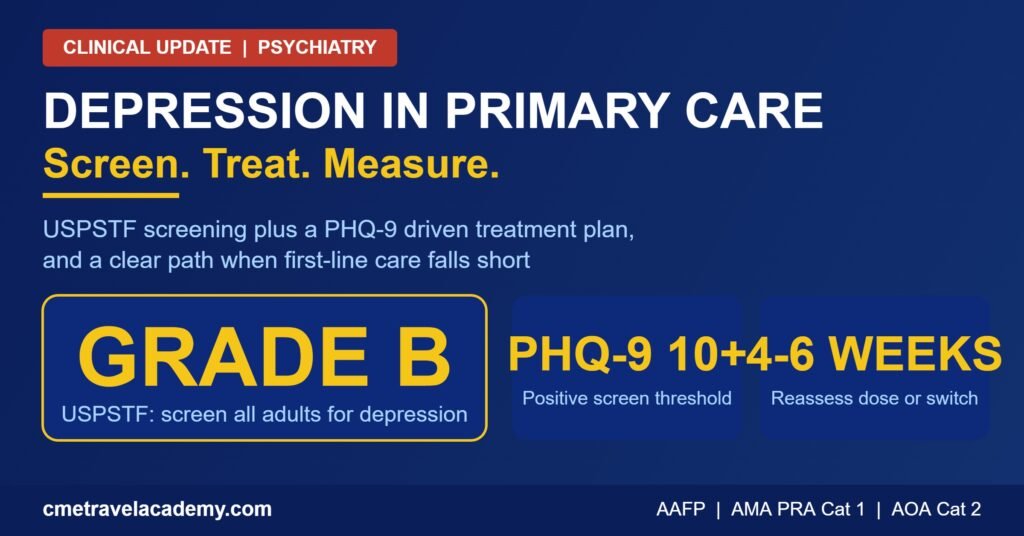
Depression is one of the conditions primary care clinicians manage most often, and one of the easiest to undertreat. Doses stay low, follow-up slips, and a partial response gets labeled “good enough.” The USPSTF recommendation (Grade B) still calls for screening all adults for major depressive disorder, including pregnant and postpartum patients and adults 65 and older. This guide walks through a practical workflow for family medicine and internal medicine clinicians: screen, confirm, treat, measure, and escalate. It is also the depression content we teach on day two of our Las Vegas CME conference, where primary care CME for physicians, NPs, and PAs comes with afternoons free.
Why Screening Still Matters
The USPSTF statement, published in JAMA in June 2023 and summarized for clinicians in American Family Physician, makes two separate points. Screening adults for depression earns a Grade B. Screening for suicide risk in adults without symptoms earns an I statement, meaning the evidence is insufficient. The task force found no evidence on the best screening interval, so a pragmatic approach is to screen anyone not previously screened and rescreen based on risk factors, comorbid illness, and life events.
Screening only helps when a positive result leads somewhere. The USPSTF stresses evaluation after a positive screen and evidence-based care, and it points to collaborative care, in which a care manager links the primary care clinician, the patient, and a mental health specialist. If your practice has no such program, a registry of patients with a PHQ-9 of 10 or higher and a scheduled follow-up call is a reasonable start. Depression and anxiety overlap often, so pair this with our review of anxiety screening in primary care.
Confirming the Diagnosis
A positive PHQ-2 or PHQ-9 is a prompt, not a diagnosis. Confirm that the patient meets DSM-5 criteria for a major depressive episode, which requires depressed mood or loss of interest plus other symptoms for at least two weeks with functional impairment. Then work through the mimics and the modifiers:
- Bipolar disorder. Ask about prior manic or hypomanic episodes and family history before starting an antidepressant. A positive screen changes the plan.
- Medical contributors. Check TSH, a CBC, and a metabolic panel, and review sleep apnea, alcohol use, and medications that can worsen mood.
- Cognitive change in older adults. Apathy and slowing can signal early dementia as easily as depression. See our post on cognitive impairment in primary care.
- Suicidal ideation. Ask directly at every visit where the diagnosis is made or treatment changes.
First-Line Treatment
For mild to moderate depression, psychotherapy and antidepressant medication are both reasonable first choices, and the VA/DoD Clinical Practice Guideline lists cognitive behavioral therapy, behavioral activation, acceptance and commitment therapy, interpersonal therapy, and problem-solving therapy among evidence-based options. For moderate to severe illness, combination treatment is the usual approach. Shared decision-making matters because adherence follows the patient’s preference.
Among medications, an SSRI or SNRI is the standard opening move, with bupropion or mirtazapine as alternatives chosen by side-effect profile. A few details that save trouble in practice:
- Start low, then reach a therapeutic dose. Many patients sit on a starter dose for months and are labeled non-responders.
- Citalopram. The FDA limits citalopram to 20 mg per day in patients older than 60 because of QT prolongation.
- Hyponatremia. Check sodium in older adults after starting an SSRI or SNRI, especially with a thiazide.
- Age under 25. The boxed warning for suicidality applies, so schedule close early follow-up.
- Sexual side effects and weight. Ask about them up front, since they drive early discontinuation.
Conference Spotlight: Depression at Caesars Palace
Day two of our Las Vegas CME conference (Caesars Palace, December 18-19, 2026 or April 2-3, 2027) covers first-line agents, augmentation strategies, and newer pharmacologic treatments for depression, alongside heart failure, type 2 diabetes, and obesity. You earn 12 AMA PRA Category 1 Credits including 1 hour of Ethics in two morning sessions, with afternoons free for the Strip. Registration is $995, with discounts for military and resident physicians. Prefer New Orleans on February 19-20, 2027? See the New Orleans conference. Prefer to stay home? CME Live: Your Location delivers the same credits by livestream.
✓ 12 CME hours including 1 hour of Ethics
✓ Hot breakfast both mornings and session recordings
✓ 12-month spaced-repetition curriculum and one-page point-of-care references
Measure Response and Know When to Switch
Treat depression like hypertension: set a target and measure against it. Record a PHQ-9 at baseline and at each visit, and aim for remission, defined as a PHQ-9 below 5, rather than “some improvement.” Reassess within two to four weeks of starting treatment for tolerability, and judge efficacy at about four to six weeks on an adequate dose. If improvement is minimal, increase the dose. If there is a partial response at a full dose, add psychotherapy, augment, or switch.
Expect imperfection. In the large STAR*D effectiveness trial, roughly one in three patients reached remission with the first antidepressant step, and further steps helped many of the rest. That is the case for persistence, not for stopping after one failed drug. Once a patient remits after a first episode, continue treatment for at least six to twelve months, and taper rather than stop abruptly.
Treatment-Resistant Depression and Newer Options
Treatment resistance is usually defined as inadequate response to two adequate trials. Before labeling a patient resistant, confirm adherence, dose, and duration, and look again for bipolar disorder, substance use, sleep apnea, and thyroid disease. Options then include augmentation with bupropion or an atypical antipsychotic, switching class, and referral for neuromodulation. Esketamine nasal spray is FDA-approved for treatment-resistant depression, used with an oral antidepressant or, since 2025, as monotherapy, and it must be given in a certified setting with post-dose monitoring. The VA/DoD guideline suggests esketamine as an option in this population. Zuranolone is a 14-day oral course approved for postpartum depression specifically, not for depression in general.
Suicide Risk and Safety Planning
Because screening for suicide risk has an I statement, clinical judgment carries the load. Ask about ideation directly, assess access to firearms and medications, and complete a written safety plan with any patient at risk, listing warning signs, coping steps, contacts, and the 988 Suicide and Crisis Lifeline. Follow up soon after any change in risk. Suicide is the tenth-leading cause of death in US adults, which is reason enough to make this routine.
Practice Pearls: Depression FAQ
Who should be screened for depression in primary care?
The USPSTF recommends screening all adults for major depressive disorder (Grade B), including pregnant and postpartum patients and adults 65 and older. Screening for suicide risk in asymptomatic adults has insufficient evidence (I statement).
What PHQ-9 score is a positive screen?
A PHQ-9 of 10 or higher is the usual threshold for further evaluation. A positive screen should be followed by a diagnostic interview, a bipolar history, and a medical review, not an automatic prescription.
How long should an antidepressant trial last before switching?
Reassess tolerability within two to four weeks and efficacy at about four to six weeks on an adequate dose. If response is minimal, raise the dose; if partial at a full dose, consider augmentation, psychotherapy, or a switch.
How long should treatment continue after remission?
After a first episode, continue for at least six to twelve months after remission and taper gradually. Longer maintenance is reasonable after recurrent episodes.
Bring It Back to Your Practice
Good depression care is mostly process: screen, confirm, dose adequately, measure, and escalate on schedule. If you want the full update with case-based teaching, join us at our December 2026 CME in Las Vegas, the February 2027 CME in New Orleans, or the April 2027 CME in Las Vegas. Think of it as a CME vacation: two focused mornings, then the rest of the day is yours, and the same faculty livestream via CME Live: Your Location. Our Disney World conference returns July 30-31, 2027 for CME travel with the family. Clinics can book group CME for your practice, and the online course library covers primary care CME at your own pace. For related reading, see our posts on CKM syndrome staging and travel and learn CME.
Related CME Articles