
By Dr. Anush S. Pillai, DO, FAAFP | Reviewed by CME Travel Academy Faculty
7 min read · Reviewed August 2026
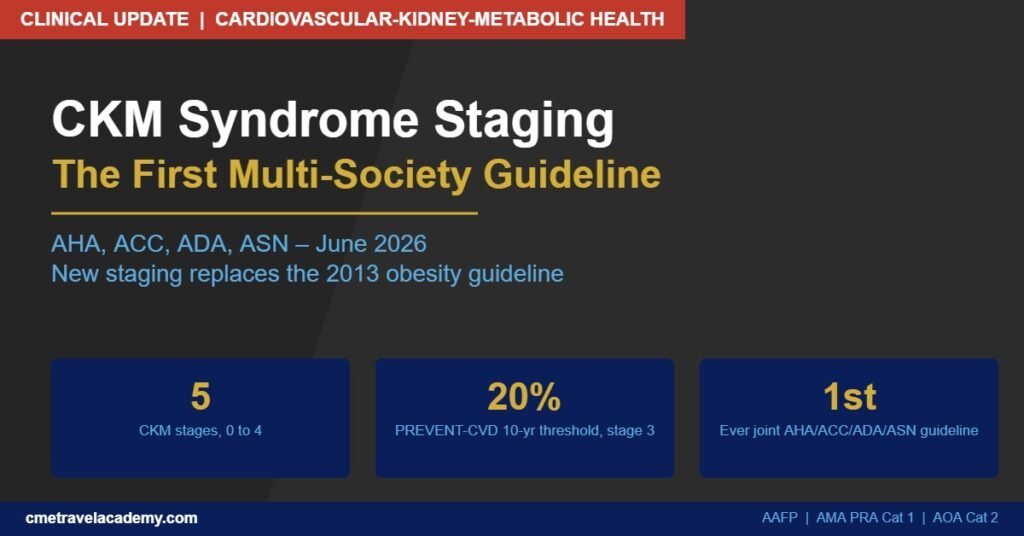
On June 9, 2026, the American Heart Association, American College of Cardiology, American Diabetes Association, and American Society of Nephrology published the first ever multi-society guideline for cardiovascular-kidney-metabolic (CKM) syndrome. This is not a minor update. The 2026 AHA/ACC/ADA/ASN Guideline retires the 2013 AHA/ACC/TOS obesity management guideline and replaces it with a unified framework spanning obesity, type 2 diabetes, chronic kidney disease, and cardiovascular disease.
For decades these four conditions have been managed in silos: endocrinology treats the diabetes, nephrology treats the kidneys, cardiology treats the heart. The new guideline argues that this misses the point. A patient with obesity and prediabetes is already on a CKM trajectory long before an A1c crosses a diagnostic threshold. The guideline introduces a standardized staging system, stages 0 through 4, designed to catch that trajectory early and guide risk-based treatment before organ damage accumulates. For the family physicians, internists, NPs, and PAs who see this population daily, this guideline changes how risk should be documented and treated starting at the next visit.
What Is CKM Syndrome, and Why a Joint Guideline Now
CKM syndrome describes the interconnected biology among excess or dysfunctional adiposity, insulin resistance, chronic kidney disease, and cardiovascular disease. The AHA formalized the concept in a 2023 presidential advisory, but until this year there was no shared staging framework that cardiology, endocrinology, nephrology, and primary care could reference from the same document. The 2026 guideline changes that, drawing on a literature search from October 2024 through April 2025 and designed as a living document the writing committee expects to update as new trial evidence accumulates.
The case for a unified approach is straightforward. Obesity, type 2 diabetes, CKD, and cardiovascular disease frequently coexist and share upstream drivers and, increasingly, overlapping pharmacologic solutions. SGLT2 inhibitors and GLP-1 based therapies improve outcomes across more than one domain at once. Treating them as separate problems, each with its own referral, has produced fragmented care and preventable progression to heart failure and kidney failure.
CME Travel Academy built its curriculum around exactly this overlap. Every conference weaves heart failure, diabetes, CKD, and hypertension into the same two-day agenda, because that is how these patients present in clinic. If your last training on cardiometabolic risk predates the PREVENT equations, the staging system below is a good reason to close that gap. See the full curriculum on our Primary Care CME page.
The New CKM Staging System (Stages 0 to 4)
The staging system is the guideline’s central organizing tool, designed to be assigned at a routine visit using data most practices already collect.
Stage 0. No CKM risk factors. Normal weight, glucose, blood pressure, lipids, and kidney function, with no subclinical or clinical cardiovascular disease.
Stage 1. Excess or dysfunctional adiposity, defined as BMI 25 or higher (23 or higher for patients of Asian ancestry) or waist circumference 88 cm or more in women and 102 cm or more in men (80 cm and 90 cm for Asian ancestry), or prediabetes with fasting glucose 100 to 125 mg/dL or HbA1c 5.7 to 6.4 percent, with no other metabolic risk factors yet present.
Stage 2. Metabolic risk factors have appeared, such as blood pressure 130/80 mm Hg or higher, triglycerides 150 mg/dL or higher, metabolic syndrome, type 2 diabetes, or moderate-to-high-risk CKD.
Stage 3. Subclinical cardiovascular disease is present, or the patient has very high-risk CKD, or a 10-year PREVENT-CVD risk of 20 percent or greater.
Stage 4. Clinical cardiovascular disease is established in a patient who also carries CKM risk factors, and now splits into two subclasses. Stage 4a is clinical CVD without kidney failure. Stage 4b is clinical CVD with kidney failure, defined as eGFR under 15 mL/min/1.73m2 or a need for kidney replacement therapy.
Staging is not a one-time label. The guideline frames regression, moving a patient from stage 2 back toward stage 1 through weight loss and risk factor control, as a legitimate treatment goal, not just slower progression.
The PREVENT Risk Equations Replace Pooled Cohort Equations, With Caveats
For adults 30 to 79 years of age without cardiovascular disease, in CKM stages 0 through 3, the guideline recommends the AHA PREVENT equations, not the older Pooled Cohort Equations, to estimate 10-year and 30-year cardiovascular risk. PREVENT incorporates eGFR and, optionally, UACR and HbA1c, none of which the older equations captured. That inclusion lets kidney and metabolic status directly shape a cardiovascular risk estimate in one calculation.
PREVENT is not one number. It is a family of outcome-specific equations; the companion AHA/ACC scientific statement (JACC, June 9, 2026) ties each to a different action:
- PREVENT-CVD 10-year risk of 20 percent or higher defines CKM stage 3.
- PREVENT-CVD 10-year risk of 7.5 percent or higher, in a patient with type 2 diabetes and CKM stage 2 or 3, supports starting an SGLT2 inhibitor, a GLP-1 based therapy, or both for cardiorenal protection (Class 1, strong recommendation, LOE A).
- PREVENT-HF risk of 5 percent or higher supports cardiac biomarker testing to screen for pre-heart failure (Class 2a).
- PREVENT-ASCVD risk of 5 percent to under 10 percent (intermediate risk), or select patients at 3 percent to under 5 percent (borderline risk) when a statin decision is genuinely uncertain, supports coronary artery calcium scoring (Class 2a).
A PREVENT-CVD estimate is not interchangeable with the ASCVD-only or heart-failure-only outputs; using the wrong sub-score can misclassify a patient’s stage or point to the wrong next test.
One caveat: PREVENT tends to run lower than the Pooled Cohort Equations it replaces. Anderson and colleagues found mean 10-year ASCVD risk fell from 8.0 percent under the old equations to 4.3 percent under PREVENT, with 17.3 million US adults projected to lose statin eligibility, including 4.1 million already on a statin; a separate analysis by Diao and colleagues put the eligibility loss at 14.3 million. That is not a reason to distrust PREVENT, since it corrects overestimation in the older math and adds kidney function to the calculation, but expect that conversation at the next visit.
Screening: What Changes in Your Next Physical
The screening cadence is now explicitly staged rather than uniform. Blood pressure is checked at least annually in every adult, regardless of stage. Lipids, glycemia, and eGFR are reassessed at least every five years in stage 0 and every two to three years in stage 1. At stage 2, that panel moves to at least annually, and UACR joins it for the first time, since albuminuria becomes meaningfully more prevalent once metabolic risk factors appear. UACR is not a universal stage 0 or stage 1 test; it is targeted to stage 2 and above.
Targeted screening also picks up conditions that are easy to miss in a short visit. For adults with CKM syndrome and obesity, annual assessment for sleep apnea symptoms using validated screening tools is reasonable (Class 2a), with polysomnography if suspicion is clinical. Patients with CKM syndrome and diabetes, or two or more cardiometabolic risk factors, should have a FIB-4 index calculated every one to two years for MASLD-related liver fibrosis risk (Class 1); for CKM stage 1 due to prediabetes, that cadence is every two to three years (Class 2a). Waist circumference is elevated alongside BMI as a required measurement, since BMI alone under-detects visceral risk.
Social determinants of health, including food insecurity, transportation access, and housing stability, are formally incorporated into the recommended assessment as clinical variables that influence CKM stage progression, not administrative add-ons.
Upcoming CME Conference
New York City CME Conference – New York City
Late Spring 2027 · 12 AMA PRA Category 1 Credits™
Cover CKM syndrome staging and the PREVENT equations alongside heart failure, diabetes, COPD, and more. Morning sessions. Afternoons free.
Reserve Your Spot →Treatment Priorities: Obesity, Diabetes, and Kidney Protection Together
Obesity treatment is foundational, not secondary
The guideline positions excess adiposity as a primary driver of CKM progression, not a comorbidity to address later. Lifestyle intervention remains first-line, with anti-obesity medications and bariatric surgery used when appropriate; the guideline notes bariatric surgery is cost-effective in severe obesity regardless of baseline diabetes status, supporting an earlier referral conversation. The guideline’s concrete target: 5 to 10 percent weight loss, with greater benefit at greater loss (Class 1, LOE A).
Diabetes therapy is chosen for cardiorenal protection, not glucose control alone
In patients with type 2 diabetes and elevated cardiovascular risk, the guideline recommends SGLT2 inhibitors and GLP-1 based therapies because they improve cardiovascular and kidney outcomes independent of glucose-lowering effect. Agent selection is guided by coexisting CKD, heart failure, and obesity, echoing the 2026 ADA Standards of Care.
Kidney disease gets an active treatment pathway, not just monitoring
Patients identified with CKD via eGFR and UACR should receive renin-angiotensin system inhibitors and SGLT2 inhibitors as a baseline, with nonsteroidal MRAs or GLP-1 based therapies added when albuminuria persists, mirroring the four-pillars framework familiar from KDIGO 2024 and covered in our CKD Four Pillars post.
What this guideline does not replace
It is worth being precise about scope here. The CKM guideline does not issue general management recommendations for blood pressure, chronic coronary disease, dyslipidemia, heart failure, or peripheral artery disease. Those stay in their own dedicated AHA/ACC documents, including the four-pillars GDMT framework for heart failure. What the CKM guideline adds is the instruction to treat obesity, diabetes, and kidney disease concurrently and aggressively in patients who already carry cardiovascular disease, rather than deferring those problems, using CKM staging as the shared framework.
Finally, a designated CKM care coordination point person, most often the family physician or internist already managing the full problem list, is a Class 1 recommendation for patients in stages 2 through 4 who carry two or more of type 2 diabetes, CKD, or CVD.
Want the full staging algorithm, PREVENT walkthrough, and medication selection framework in one sitting? CME Travel Academy’s conferences include a dedicated CKM session with a one-page point-of-care reference and 12-month spaced repetition follow-up so it sticks. View All 2026 Conferences.
Frequently Asked Questions
What CKM stage should trigger a PREVENT risk calculation at the visit?
Adults 30 to 79 years of age without cardiovascular disease, in CKM stages 0 through 3, using the correct sub-score for the decision at hand: PREVENT-CVD at 20 percent or higher for stage 3, PREVENT-CVD at 7.5 percent or higher for GLP-1 or SGLT2i therapy in diabetes, PREVENT-HF at 5 percent or higher for pre-heart-failure biomarker testing, and PREVENT-ASCVD 5 to under 10 percent, or select patients at 3 to under 5 percent when the statin decision is uncertain, for CAC scoring (Class 2a). Stage 4 patients do not need a PREVENT score to justify aggressive treatment.
Does the new guideline replace the KDIGO 2024 CKD guideline, the ADA 2026 Standards of Care, or AHA/ACC guidance on blood pressure and heart failure?
No. It sits above and coordinates with both, and it does not issue new general management recommendations for blood pressure, dyslipidemia, heart failure, or PAD, which stay in their own AHA/ACC documents. It asks clinicians to view the whole problem list through a shared CKM staging lens.
Is BMI still used, or has waist circumference replaced it?
Both are used together as complementary stage 1 threshold measurements, since BMI alone can miss visceral adiposity in patients with a normal or overweight BMI who still carry elevated metabolic risk.
What is the single most practical change for a busy primary care visit?
Assigning a CKM stage using data already in the chart and documenting it explicitly. Staging drives every downstream decision, from which PREVENT sub-score to calculate to which medication class to prioritize.
Do social determinants of health actually change management under this guideline?
Yes. The guideline recommends assessing food insecurity, transportation access, and housing stability as part of CKM evaluation, and addressing identified barriers as part of the treatment plan itself, not a separate referral.
Conclusion
The 2026 AHA/ACC/ADA/ASN CKM guideline gives primary care a shared language with cardiology, endocrinology, and nephrology for a population already managed jointly in practice, just without a common framework until now. Staging patients 0 to 4, calculating PREVENT risk, and choosing therapy for cardiorenal benefit rather than glucose control alone are changes that can start at the next visit.
CME Travel Academy will be covering CKM staging alongside heart failure, diabetes, CKD, and hypertension at the New York City CME Conference, late spring 2027, and the Las Vegas CME Conference, December 18 to 19, 2026. Both conferences offer 12 AMA PRA Category 1 Credits, including one hour of ethics, with morning-only sessions and afternoons free. Can’t travel? The same content and credit are available through CME Live: Your Location.