
By Dr. Anush S. Pillai, DO, FAAFP | Reviewed by CME Travel Academy Faculty
8 min read · Reviewed August 2026
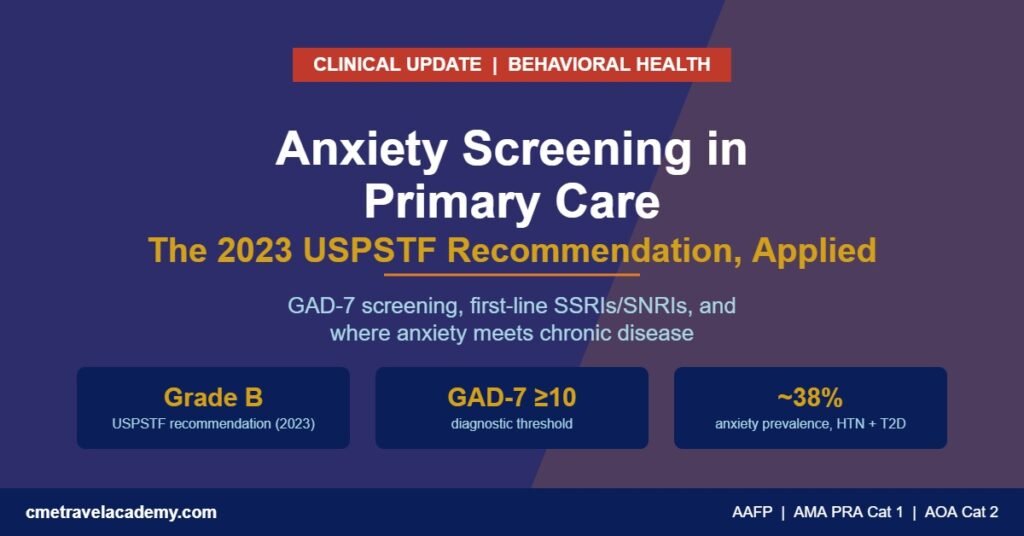
Anxiety disorders are the most common mental health condition in the United States, yet in the typical primary care visit they remain the quiet cousin of depression: screened for less often, coded less often, and treated later. The US Preventive Services Task Force closed part of that gap in 2023 with a Grade B recommendation that adults younger than 65, including pregnant and postpartum patients, be screened for anxiety disorders. Three years later, implementation is still uneven. For clinicians managing patients with diabetes, hypertension, or cardiovascular disease, that gap matters clinically: anxiety and cardiometabolic disease travel together, and untreated anxiety measurably worsens adherence, glycemic control, and quality of life. This post walks through the current recommendation, a practical GAD-7-based screening and treatment pathway, and where anxiety intersects with the chronic disease panels most primary care clinicians already manage every day.
Why Anxiety Screening Belongs in the Same Conversation as Chronic Disease
Primary care clinicians already screen routinely for depression under the USPSTF’s longstanding Grade B recommendation. Anxiety disorders are frequently discussed alongside depression, but the evidence base and the recommendation itself are distinct, and newer than most clinicians realize. The USPSTF’s June 2023 recommendation statement, published in JAMA, concluded with moderate certainty that screening adults ages 19 to 64 for anxiety disorders (including generalized anxiety disorder, panic disorder, and social anxiety disorder) has moderate net benefit. For adults 65 and older, the Task Force issued an “I statement,” meaning current evidence is insufficient to weigh benefits against harms of routine screening in that age group, not that screening is discouraged, only that the evidence to support a blanket recommendation does not yet exist. This sits alongside the Task Force’s separate, longer-standing depression and suicide risk screening recommendation, which most practices have already built into their intake workflow.
The clinical case for folding anxiety screening into chronic disease visits is strong. Anxiety and depression together are reported in roughly 30 percent of patients with diabetes in primary care samples, and studies of hypertensive and diabetic populations have found anxiety prevalence approaching 38 percent. Comorbid anxiety is consistently linked to worse glycemic control, lower medication adherence, and reduced quality of life. Patients with cardiovascular diagnoses who also carry an anxiety disorder are, on average, treated less intensively for their cardiac disease than patients without anxiety, a pattern researchers describe as systematic under-recognition. For a family medicine or internal medicine panel built around hypertension, type 2 diabetes, and cardiovascular risk reduction, a five-minute anxiety screen at the point of care is arguably one of the highest-yield additions available.
This is exactly the kind of guideline-to-practice gap that a well-built CME conference is designed to close. CME Travel Academy’s primary care CME courses weave behavioral health screening into the same sessions that cover hypertension, diabetes, and heart failure, because in a real outpatient visit, these conditions do not arrive separately.
Conference Spotlight
Behavioral health screening is one of twelve topics covered at every CME Travel Academy conference, alongside heart failure, diabetes, hypertension, CKD, and more. Every session earns AMA PRA Category 1 Credit™ including one hour of Ethics, runs mornings only (afternoons are yours), and comes with a one-page point-of-care reference and 12 months of spaced-repetition follow-up. Registration starts at $895–$995, with $100 off for military and $200 off for resident physicians.
The GAD-7: A Two-Minute Tool With Real Diagnostic Value
The Generalized Anxiety Disorder 7-item scale (GAD-7) is the workhorse screening instrument for this recommendation, playing a role analogous to the PHQ-9 for depression. It is a brief, self-administered, seven-item questionnaire scored 0 to 21, and it can be completed in the waiting room or embedded in intake forms alongside the PHQ-9.
Interpretation bands most practices use:
- ✓ 0 to 4: minimal anxiety, no action needed
- ✓ 5 to 9: mild anxiety, consider watchful waiting or self-directed cognitive behavioral therapy (CBT) resources
- ✓ 10 to 14: moderate anxiety, active treatment discussion warranted
- ✓ 15 to 21: severe anxiety, treatment initiation and closer follow-up indicated
A score of 10 or higher has good sensitivity and specificity for generalized anxiety disorder, and reasonable performance for panic disorder, social anxiety disorder, and PTSD, part of why the GAD-7 works well as a first-pass tool even though it was validated specifically for GAD. A positive screen should prompt a focused diagnostic conversation, not an automatic prescription. Confirm the diagnosis, screen for comorbid depression and substance use, and rule out medical mimics: hyperthyroidism, arrhythmia, medication effects (stimulants, corticosteroids, decongestants, some inhalers), and caffeine or alcohol withdrawal are all worth a quick review before attributing symptoms purely to a primary anxiety disorder. The AAFP’s review of generalized anxiety disorder and panic disorder is a useful bedside reference for this differential.
Treatment Pathway: What First-Line Actually Means in 2026
Once generalized anxiety disorder is confirmed, current practice rests on three familiar pillars: structured monitoring with the GAD-7, a first-line medication choice between an SSRI and an SNRI, and a referral pathway for cognitive behavioral therapy.
For pharmacotherapy, sertraline and escitalopram remain the most commonly recommended first-line SSRIs, with SNRIs such as venlafaxine XR or duloxetine as reasonable alternatives, particularly when comorbid depression or certain chronic pain conditions are present. Start low, titrate slowly, warn patients that anxiety symptoms can transiently worsen in the first one to two weeks, and set a follow-up at two to four weeks to assess tolerability and response, with visits continuing at least every six weeks until treatment goals are met. Full response typically takes four to eight weeks at an adequate dose, and continuation for six to twelve months after remission is standard practice to reduce relapse risk.
Benzodiazepines remain a common reflexive prescription in primary care, and they remain the wrong first move for most patients. They are not recommended as first-line or long-term therapy given dependence risk, cognitive and fall risk in older adults, and an association with increased mortality with long-term use. Short, time-limited use for acute crisis stabilization while an SSRI or SNRI takes effect is a reasonable exception in select patients, not a default.
CBT deserves equal billing with medication, not a distant second mention. It has comparable effect sizes to pharmacotherapy for generalized anxiety disorder, durable benefit after treatment ends, and it is the preferred option for patients who are pregnant, breastfeeding, or who prefer to avoid medication. The Annals of Internal Medicine review of anxiety disorders in primary care found the practical bottleneck is access, not evidence. Building a short list of therapists who take new patients, or a telehealth CBT platform your practice can refer to reliably, does more for actual anxiety outcomes than any change in prescribing pattern.
This is precisely the kind of point-of-care decision tree that turns a guideline into a habit. CME Travel Academy’s chronic disease conferences build one-page reference sheets for exactly this reason: a clinician who can see the screening thresholds, first-line agents, and referral triggers on a single page during a fifteen-minute visit is far more likely to act on the guideline than one working from memory of a slide deck six months later.
Upcoming CME Conference
New York City CME Conference
Late Spring 2027 · 12 AMA PRA Category 1 Credits™
Cover behavioral health screening alongside heart failure, diabetes, COPD, and more. Morning sessions. Afternoons free.
Reserve Your Spot →Special Populations and Practical Pearls
A few groups deserve specific mention. Pregnant and postpartum patients are explicitly included in the USPSTF recommendation, and anxiety screening pairs naturally with the depression and postpartum depression screening most obstetric and primary care practices already perform at prenatal and postpartum visits. Older adults fall under an I statement, not a recommendation against screening. Many experienced clinicians continue to screen this population selectively, particularly when new physical symptoms, functional decline, or social isolation raise clinical suspicion, while recognizing the evidence base for universal screening is thinner here than in younger adults.
Patients with chronic cardiometabolic disease deserve a slightly lower threshold of suspicion. Anxiety in a patient with heart failure or coronary disease can masquerade as, or genuinely coexist with, cardiac symptoms: palpitations, chest tightness, and dyspnea overlap between panic attacks and cardiac events. A GAD-7 alongside your usual cardiovascular workup helps clarify the picture rather than anchoring prematurely on either diagnosis. If you want a refresher on the cardiac side of that differential, our recent posts on heart failure’s four pillars of GDMT and CKM syndrome staging cover the guideline-directed workup in detail.
Top 5 Takeaways
Who should be screened for anxiety, and how often?
Adults ages 19 to 64, including pregnant and postpartum patients, should be screened for anxiety disorders using the GAD-7 or a similar validated tool. This is a USPSTF Grade B recommendation as of June 2023, separate from and complementary to depression screening. Evidence is insufficient for a blanket recommendation in adults 65 and older, though selective screening remains reasonable.
What GAD-7 score should prompt action?
A GAD-7 score of 10 or higher warrants a focused diagnostic conversation and, after excluding medical mimics such as thyroid disease or medication effects, an active treatment discussion.
What is first-line pharmacotherapy for generalized anxiety disorder?
An SSRI (sertraline or escitalopram) or SNRI (venlafaxine XR or duloxetine) is first-line. Benzodiazepines are not recommended as first-line or long-term therapy given dependence, fall, and mortality risk.
How does CBT compare to medication?
CBT has comparable efficacy to pharmacotherapy for generalized anxiety disorder and more durable benefit after treatment ends. Building a reliable referral pathway before you need it is the single highest-leverage practice change most clinics can make.
Why does anxiety matter for a chronic disease panel specifically?
Anxiety and cardiometabolic disease are frequent traveling companions, with prevalence approaching 38 percent in some hypertensive and diabetic primary care samples. In patients with diabetes, hypertension, or cardiovascular disease, a low threshold for screening improves both mental health and disease-specific outcomes.
Conclusion
Anxiety screening is one of the easiest evidence-based additions a busy primary care practice can make: a two-minute questionnaire, a clear scoring threshold, and a treatment pathway most clinicians already know how to execute for depression. The barrier is rarely knowledge. It is workflow and follow-through. If you want the full guideline-to-bedside version of this material, alongside deep dives on the chronic disease topics that keep most primary care panels busy (heart failure, diabetes, hypertension, CKD, and more), CME Travel Academy’s upcoming CME conferences build exactly this kind of practical, point-of-care curriculum. Join us in New York City, late spring 2027, or in Las Vegas, December 18-19, 2026, for 12 AMA PRA Category 1 Credits, including one hour of Ethics, morning sessions only, with your afternoons free. Can’t travel? CME Live: Your Location delivers the identical accredited curriculum from wherever you are. Running a clinic or residency program? Ask about group CME for your clinic.