
By Dr. Anush S. Pillai, DO, FAAFP | Reviewed by CME Travel Academy Faculty
7 min read · Reviewed July 2026
For two decades the primary care approach to memory complaints has been frustratingly circular. A spouse mentions the same question asked four times over dinner. You run a brief cognitive screen, order a TSH, a B12, and a head CT, then refer to neurology and wait six to eighteen months for a diagnosis you could not confirm yourself. Amyloid PET was expensive and rarely covered, and a lumbar puncture was a hard sell. Diagnostic uncertainty was simply part of the deal.
That changed faster than most of us expected. Over roughly eighteen months the Alzheimer’s Association published a clinical practice guideline on the diagnostic evaluation itself and its first guideline on blood-based biomarkers, presented the systematic review that will underpin a forthcoming guideline on brief cognitive instruments, and the FDA cleared the first blood test for Alzheimer’s pathology. Primary care is no longer only the place where the problem is noticed and handed off. Here is what changed, what did not, and how to fit it into a twenty-minute visit.
Why Detection Still Fails at the Front Line
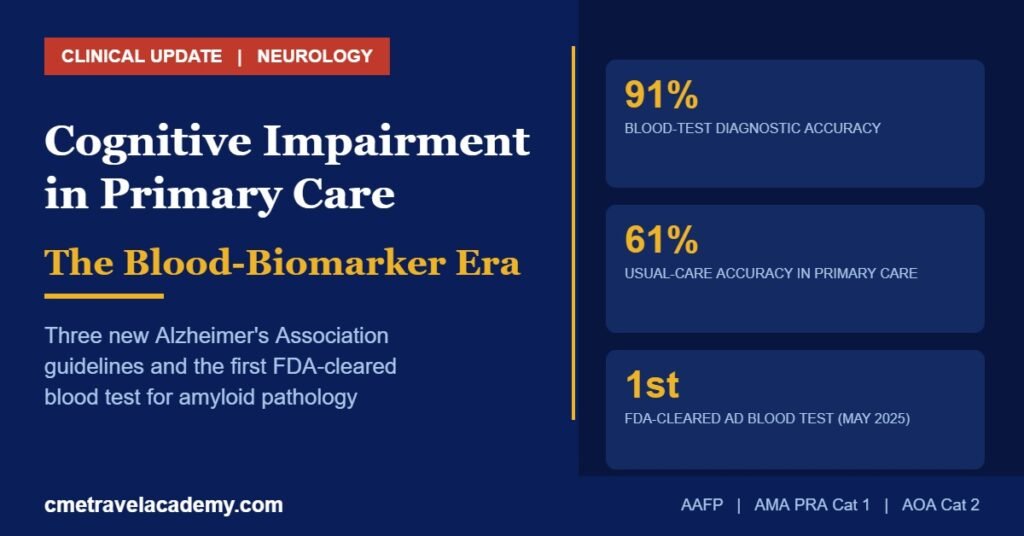
Start with an honest premise: unstructured clinical judgment is not good enough for this diagnosis. In a prospective study of 1,213 patients evaluated for cognitive symptoms, published in JAMA in 2024, primary care physicians reached a correct Alzheimer’s diagnosis 61% of the time with their standard workup. Dementia specialists managed 73%. A plasma panel built on the p-tau217 ratio, the Amyloid Probability Score 2 reported by the PrecivityAD2 test, reached 91% in both settings. That is not an indictment of clinicians. The diagnosis is hard without a biological marker, because depression, sleep apnea, polypharmacy, and hearing loss all open with the same complaint.
Be precise, too, about the task. The U.S. Preventive Services Task Force still finds insufficient evidence to recommend for or against screening asymptomatic adults 65 and older. That is an “I” statement, not a recommendation against evaluation. The distinction that matters clinically is between screening a well person and evaluating a symptomatic one, and Medicare already builds in a foothold: detection of cognitive impairment is a required element of the Annual Wellness Visit, and a cognitive assessment and care-plan service is separately billable once a concern surfaces. If you build chronic disease workflows around visits like these, our page on value-based chronic disease care covers the operational side.
Three Documents That Rewired the Workup
1. DETeCD-ADRD: a structured evaluation, not a screening mandate
The Alzheimer’s Association guideline on the Diagnostic Evaluation, Testing, Counseling, and Disclosure of suspected Alzheimer’s Disease and Related Disorders, mercifully abbreviated DETeCD-ADRD, drew on 7,374 publications, 133 of which met inclusion criteria, and shipped with an executive summary written specifically for primary care. Its contribution is process, not a new test: establish that a cognitive-behavioral syndrome exists, characterize severity and functional impact, work the differential including reversible contributors, obtain structural imaging, and only then consider biomarkers. Counseling and disclosure are treated as plannable steps, not an afterthought at the end of a rushed visit. A companion paper catalogs the validated clinical assessment instruments the guideline relies on.
2. Cognitive assessment: a forthcoming guideline, and what its evidence review found
The Association’s guideline on brief cognitive instruments in primary care is still in development, but the systematic review behind it was presented at AAIC 2025. It assessed the diagnostic accuracy of ten instruments (the 5-Cog, AD8, GPCOG, IQCODE, Mini-Cog, Memory Impairment Screen, MoCA, QDRS, RUDAS, and SLUMS) in ambulatory adults aged 55 and older, across literature published from 1999 to 2024. The headline is less a single winner than the gap between structured and unstructured assessment: validated instruments meaningfully outperform clinical impression. Mini-Cog and MoCA remain sound choices, and informant tools such as the AD8 capture what the patient cannot.
3. Blood-based biomarkers: the first clinical practice guideline
The most consequential document arrived at AAIC 2025: the first evidence-based clinical practice guideline on blood-based biomarker testing in suspected Alzheimer’s disease. It covers the best-evidenced markers (plasma p-tau217, p-tau181, p-tau231, the p-tau217 to non-p-tau217 ratio, and the Aβ42:Aβ40 ratio) and sets performance thresholds rather than endorsing brands. A test with at least 90% sensitivity and 75% specificity may be used for triage; one with at least 90% sensitivity and 90% specificity may substitute for amyloid PET or CSF biomarkers. It is scoped to specialized care settings, but that framework is what primary care will need as these assays diffuse outward.
Upcoming CME Conference
New York City CME Conference
October 12-13, 2026 · 12 AMA PRA Category 1 Credits™
Dementia and cognitive impairment alongside heart failure, diabetes, hypertension, CKD, asthma, COPD, obesity, and depression. Morning sessions at the Hyatt Centric Times Square. Afternoons free. From $995, with military, resident, and student discounts.
Reserve Your Spot →What the Blood Test Actually Does, and What It Does Not
On May 16, 2025, the FDA cleared the Lumipulse G pTau217/β-Amyloid 1-42 plasma ratio, the first blood-based biomarker test cleared for Alzheimer’s disease. The indication is narrow and worth memorizing: adults aged 55 and older presenting with signs and symptoms of cognitive decline, in a specialized care setting. Concordance with amyloid PET or CSF biomarkers was 91.7% for positive and 97.3% for negative results. The FDA was explicit that this is neither a screening test nor a standalone diagnostic.
A negative result therefore carries real weight. With negative percent agreement near 97%, it argues strongly against amyloid pathology in a symptomatic patient and redirects the workup toward vascular disease, Lewy body pathology, depression, or medication effects. Given how often cerebrovascular disease drives the picture, our review of vascular contributors to cognitive decline is a useful companion read.
The intermediate zone is also real. A 2025 Nature Medicine study of a fully automated plasma p-tau217 platform (n=1,767) found 85% accuracy in primary care and 89 to 91% in secondary care using a single cutoff, rising to 92 to 94% with a two-cutoff strategy, at the cost of leaving 12 to 17% of patients in an indeterminate band requiring confirmatory testing. Decide in advance what happens to those patients. Performance in asymptomatic and medically complex populations remains unestablished, which is why current guidance stays scoped to symptomatic patients.
Which test can you actually order?
Two different regulatory routes are in play, and the distinction matters at the ordering screen. The Lumipulse assay is an FDA-cleared in vitro diagnostic, which means it runs on a Fujirebio analyzer that your laboratory has to have installed. PrecivityAD2, from C2N Diagnostics, is a mass-spectrometry laboratory-developed test billed under CPT 0503U and sent out to a central lab. It has not been FDA cleared, though C2N filed for clearance in October 2025 and that submission is still pending. In its clinical validation study the APS2 produced an AUC of 0.94 and roughly 88% agreement with amyloid PET, and C2N extended the intended-use age down to 50 in August 2025.
Logistics decide this more often than performance does. PrecivityAD2 is orderable in all 50 states, but the specimen has to be centrifuged, aliquoted, and frozen within about two hours and shipped on dry ice, which is a genuine obstacle for an office without a processing lab down the hall. Anthem becomes the first US payer to cover it under a medical policy on October 1, 2026; it is not covered under an established Medicare policy today. Meanwhile Labcorp has launched the Roche Elecsys pTau181 assay nationally, and it is the only blood test so far FDA-cleared with an indication for initial assessment in the primary care setting, with a high negative predictive value that suits it to ruling out rather than ruling in. The honest summary is that the market is moving faster than the guidelines: apply the Alzheimer’s Association performance thresholds to whatever your reference lab offers, rather than assuming any single brand is the answer.
Practice Pearls
Should I order a blood biomarker on an asymptomatic patient who is worried about family history? No. These tools are validated in patients with cognitive complaints. Ordered on a worried but asymptomatic 62-year-old, a plasma biomarker generates anxiety and an uninterpretable number. Anchor testing to a reported change in function.
Which brief cognitive test should my practice use? Pick one and use it consistently. Mini-Cog if your constraint is time, MoCA if you need sensitivity to mild impairment. Pair it with an informant tool such as the AD8, and document the score every visit so you have a trajectory rather than a snapshot.
Does a positive amyloid result mean I can skip the rest of the workup? No. DETeCD-ADRD defines a Tier 1 set to obtain in almost every patient: TSH, vitamin B12, homocysteine, CBC with differential, a complete metabolic panel including calcium, magnesium, and liver function tests, ESR, and CRP, plus structural imaging with brain MRI without gadolinium, or non-contrast CT if MRI is unavailable or contraindicated. Note two things clinicians working from the classic reversible-dementia panel often get wrong: folate sits in Tier 2, not Tier 1, and syphilis serology does too. RPR and HIV are Tier 2 tests, ordered on the basis of the individual risk profile rather than reflexively, with treponemal confirmation by FTA-ABS at Tier 3. That has been the direction of travel since the AAN stopped endorsing routine syphilis screening in dementia in 2001, though with US syphilis rates at their highest since the 1950s it is worth keeping a lower threshold to order it than you might have had a decade ago. Depression screening and a hard look at anticholinergics and benzodiazepines still apply as well. A positive amyloid result does not exclude a coexisting treatable contributor. See our review of depression management in primary care, the most common mimic you will meet. Cardiometabolic risk matters too, as our coverage of obesity and the oral GLP-1 era makes clear.
When is the biomarker actually worth ordering? When the answer will change what you do. That usually means mild cognitive impairment or mild dementia in a patient who would consider disease-modifying therapy. It rarely means advanced dementia with a clear clinical picture.
How should I handle disclosure? Plan it before you order. Ask what the patient wants to know and who they want in the room, at the visit where you order rather than the one where you deliver. Bring the care partner into the plan as well: the CMS GUIDE model, launched in July 2024 with 390 participating organizations, pays for dementia care coordination, caregiver education, and respite.
When to Refer for Anti-Amyloid Therapy
Lecanemab received traditional FDA approval in July 2023 and donanemab followed in July 2024. Donanemab is indicated for early symptomatic Alzheimer’s disease; lecanemab’s label directs that treatment be initiated at the stage of mild cognitive impairment or mild dementia, the population studied in its trials. Neither is a primary care medication. The realistic primary care role is recognition, accurate staging, and timely referral. Timing matters, because eligibility closes as the disease advances.
Two safety points belong in the conversation. Amyloid-related imaging abnormalities (ARIA) are the class’s most clinically significant adverse event, the most common adverse reaction with donanemab, while infusion-related reactions are more frequent with lecanemab (26%, versus 14% ARIA-H and 13% ARIA-E in its label). ARIA rates rise sharply with APOE ε4 dose: in the lecanemab trial, 45% of homozygotes versus 19% of heterozygotes and 13% of non-carriers. Appropriate use recommendations call for APOE genotyping before initiation, and the European Medicines Agency went further, restricting lecanemab to patients with no more than one ε4 allele. The FDA did not. A baseline brain MRI and confirmed amyloid pathology are prerequisites under every approved pathway.
The Bottom Line
The diagnostic ceiling in cognitive impairment has lifted. A structured evaluation framework, a validated brief instrument used consistently, and, in the right symptomatic patient, a blood-based biomarker now make it possible to say something specific and biologically grounded to a family that has been waiting for an answer. None of that removes the clinical work. It raises the value of doing it well, because these tests are only as good as the patient you apply them to.
This is exactly the material that erodes without reinforcement, which is why every CME Travel Academy conference pairs its sessions with a 12-month spaced-repetition curriculum and one-page point-of-care references. Join us in New York City on October 12-13, 2026 or in Las Vegas on December 18-19, 2026 for 12 AMA PRA Category 1 Credits™ including 1 hour of Ethics CME. Mornings only, afternoons free, from $995. Cannot travel? CME Live: Your Location earns identical accredited credit from anywhere, and our on-demand library is open year-round. Browse all upcoming CME conferences or our guideline-driven primary care CME to plan your year.