By Dr. Anush S. Pillai, DO, FAAFP | Reviewed by CME Travel Academy Faculty
6 min read · Reviewed October 2026
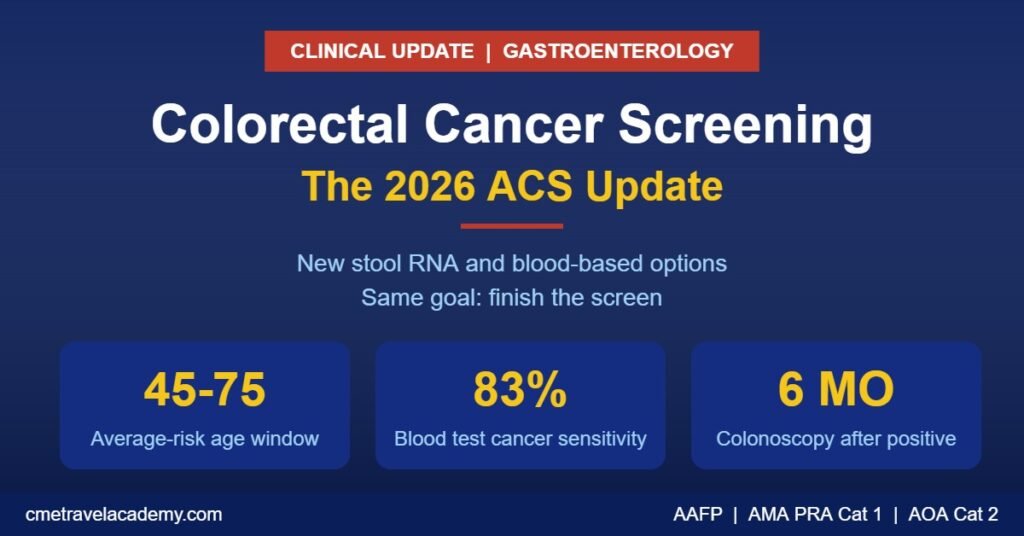
For years, the hardest part of colorectal cancer screening was not choosing a test. It was getting the patient to complete one. On May 27, 2026, the American Cancer Society (ACS) published its first major guideline update in years in CA: A Cancer Journal for Clinicians, and it leans into that reality. The guideline keeps screening at ages 45 to 75 for average-risk adults, adds a stool RNA test, and, for the first time, places a blood-based test on the menu for patients who will not do anything else.
If you practice family medicine, internal medicine, or any form of primary care, this update changes your conversations at the point of care. It is also one of the preventive topics we address in our 20-hour online course. Here is what changed, what did not, and how to apply it on Monday morning.
In this article
Why this update matters now
The ACS release notes that more than 20 million eligible Americans, roughly one in three adults, have not been screened as recommended. It also reports that colorectal cancer is now the leading cancer killer of adults under 50. Meanwhile, five-year survival exceeds 90% when disease is found early. The gap between those facts is a completion problem, and the new guideline is built to narrow it.
The USPSTF recommendation remains your anchor for coverage and quality measures: Grade A for ages 50 to 75, Grade B for ages 45 to 49, and Grade C (selective screening) for ages 76 to 85. The ACS update sits comfortably alongside it, and the CDC screening overview is a handy patient-facing reference.
What changed in the 2026 ACS guideline
Average-risk adults still start at 45 and continue through 75 if life expectancy exceeds 10 years, and the ACS now advises against screening after age 85. People at increased or high risk may need to start earlier, screen more often, or use specific tests. The full ACS recommendations page lays out the details.
The test menu and intervals now look like this:
✓ Annual home stool tests. High-sensitivity guaiac (gFOBT) or fecal immunochemical test (FIT), every year.
✓ Stool DNA or RNA every 3 years. Multitarget stool DNA (including the next-generation version) and, newly added, multitarget stool RNA (ColoSense).
✓ Visual exams. Colonoscopy every 10 years, flexible sigmoidoscopy every 5 years, or CT colonography every 5 years.
✓ Blood-based test. The tumor-DNA blood test (Shield) is newly added, with a defined and limited role.
One rule did not budge: a positive stool or blood-based test requires a follow-up colonoscopy, preferably within 6 months, to complete screening. A positive noninvasive test is not a finished screen.
Where the blood test fits, and where it does not
The blood test deserves careful framing, because patients will ask about it. In the ECLIPSE study, published in the New England Journal of Medicine and indexed on PubMed, the assay detected about 83% of colorectal cancers but only about 13% of advanced precancerous lesions. Compared with FIT and stool DNA, it misses more stage I cancers and more advanced adenomas, which is why modeling predicts less reduction in incidence and mortality.
The ACS therefore recommends it only for people who decline or do not complete the preferred tests. Think of it as a safety net, not a first choice. A patient who accepts a blood draw today and would otherwise get nothing is better served than one who defers colonoscopy for another five years. A patient who would complete a FIT kit should still get the FIT kit.
Upcoming CME Conference
Las Vegas CME Conference at Caesars Palace
December 18-19, 2026 and April 2-3, 2027 · 12 AMA PRA Category 1 Credits including 1 hour Ethics
Fall Sale: $895 for the December 2026 CME dates (regular $995), ending October 31. The 12-hour agenda covers asthma, hypertension, CKD, COPD, chronic coronary disease, dementia, heart failure, type 2 diabetes, obesity, depression and ethics, with afternoons free. Also open: New Orleans, February 2027 CME (Feb 19-20), and CME Live: Your Location.
Putting it into practice
A few habits turn the guideline into higher completion rates.
✓ Offer a choice, and say which is preferred. Lead with colonoscopy or an annual FIT, then stool DNA or RNA, and mention the blood test only after a patient declines the others. Document the refusal.
✓ Close the loop on every kit. FIT only works if it is returned every year. Track kits sent, kits returned, and abnormal results that never reached colonoscopy.
✓ Do not repeat a positive stool test. Send the patient to colonoscopy, ideally within 6 months.
✓ Separate screening from diagnosis. Rectal bleeding, iron deficiency anemia, or unexplained weight loss calls for diagnostic colonoscopy, not a screening kit or a blood test.
✓ Revisit family history. A first-degree relative with advanced neoplasia, or a known hereditary syndrome, moves the patient out of the average-risk pathway.
Screening is also one of the best topics for spaced-repetition learning, because the intervals, risk tiers, and follow-up rules are easy to forget between patient visits. For comparison with other screening topics, see our recent posts on anxiety screening in primary care and MASLD screening.
Top 5 Takeaways: Quick Answers
1. What ages does the 2026 ACS guideline cover for average-risk adults?
Screening starts at 45 and continues through 75 if life expectancy is more than 10 years. The ACS advises against screening after 85.
2. Which tests and intervals are recommended?
Annual high-sensitivity gFOBT or FIT; multitarget stool DNA or RNA every 3 years; colonoscopy every 10 years; flexible sigmoidoscopy or CT colonography every 5 years.
3. When should the blood-based test be used?
Only for patients who decline or do not complete a preferred test, because it is less sensitive for stage I cancers and advanced precancerous lesions.
4. What happens after a positive stool or blood test?
The patient needs a colonoscopy, preferably within 6 months. The screening is not complete until that happens.
5. Does the USPSTF agree on the starting age?
Yes. The USPSTF gives Grade B for ages 45 to 49 and Grade A for ages 50 to 75, with Grade C for ages 76 to 85.
Conclusion: Make Completion the Goal
The 2026 ACS update does not reinvent colorectal cancer screening. It makes completion the goal and gives you more ways to reach patients who have been saying no. Offer the best test the patient will actually finish, close the loop on every abnormal result, and keep the blood test in its lane.
Want to go deeper on screening and prevention? Colorectal cancer screening is addressed in our 20-hour online course, which also covers well male and well female care, osteoporosis, and the major chronic diseases, with 12 months of access. Our in-person conferences focus on the core chronic conditions: asthma, hypertension, CKD, COPD, chronic coronary disease, dementia, heart failure, type 2 diabetes, obesity, depression, and ethics. The Las Vegas CME conference at Caesars Palace runs December 18-19, 2026 (the Fall Sale price of $895 ends October 31) and again April 2-3, 2027. The New Orleans CME conference follows February 19-20, 2027, and the Walt Disney World CME conference is open for July 30-31, 2027. Prefer to stay put? CME Live: Your Location brings the conference agenda to your screen. Each conference offers 12 AMA PRA Category 1 Credits including 1 hour of Ethics, with mornings for learning and afternoons free, the ideal CME vacation.