
By Dr. Anush S. Pillai, DO, FAAFP | Reviewed by CME Travel Academy Faculty
7 min read · Reviewed October 2026
Obstructive sleep apnea (OSA) sits quietly underneath many of the chronic diseases you already manage: resistant hypertension, atrial fibrillation, type 2 diabetes, heart failure, and MASLD. By the AASM’s estimates, tens of millions of US adults have it and most are undiagnosed. For years our toolbox was CPAP, an oral appliance, or surgery. Since December 2024 there is a fourth option: a weekly injection that treats the disease and its most common driver, excess weight, at the same time.
This post walks through the SURMOUNT-OSA evidence, who qualifies, how to prescribe tirzepatide safely alongside CPAP, and where the other therapies still fit. It is the kind of cross-specialty topic we teach in our morning-only sessions at every CME Travel Academy conference.
Why Sleep Apnea Belongs in Your Chronic Disease Workflow
OSA is not a standalone sleep complaint. It worsens blood pressure control, promotes arrhythmia, and travels with obesity and insulin resistance, which is why it appears as a screening domain in the cardiovascular-kidney-metabolic framework we covered in our CKM staging post. If a patient with obesity and hypertension is still uncontrolled on three drugs, a sleep study deserves a spot on the differential.
Clinically, think of OSA when you see loud snoring, witnessed apneas, nonrestorative sleep, morning headaches, or daytime sleepiness, especially with a large neck circumference or BMI of 30 or higher. A validated tool such as STOP-Bang helps triage who needs testing. Note that the USPSTF gives a Grade I (insufficient evidence) to screening asymptomatic adults, so the right approach is symptom-driven testing rather than blanket screening. Confirm the diagnosis with a home sleep apnea test or in-lab polysomnography and record the apnea-hypopnea index (AHI): 5 to 14 is mild, 15 to 29 moderate, and 30 or higher severe.
The Evidence: SURMOUNT-OSA
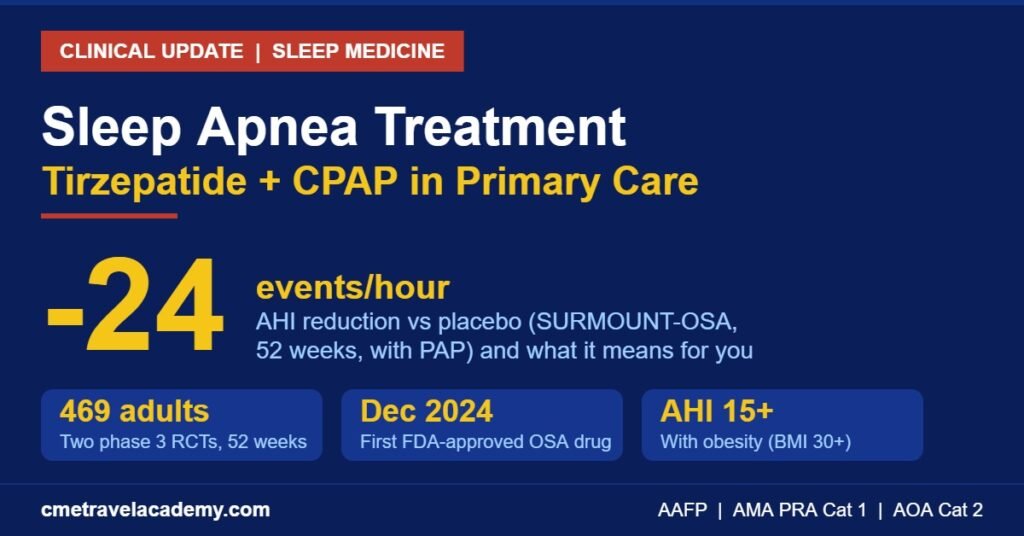
The pivotal data come from SURMOUNT-OSA, published in the New England Journal of Medicine in 2024 (see also the PubMed record). Investigators ran two phase 3, double-blind trials of maximum tolerated tirzepatide (10 or 15 mg weekly) versus placebo for 52 weeks in adults with moderate-to-severe OSA and obesity. One trial enrolled participants who were not using PAP therapy; the other enrolled participants already on it. Together they included 469 adults.
The primary endpoint was the change in AHI at week 52. Without PAP, AHI fell by 25.3 events per hour on tirzepatide versus 5.3 on placebo, a treatment difference of 20.0 events per hour. Among PAP users, the fall was 29.3 versus 5.5, a difference of 23.8 events per hour. Both comparisons reached P<0.001. Key secondary endpoints also improved, including body weight, hypoxic burden, high-sensitivity CRP, and blood pressure. Adverse events were mostly gastrointestinal and mild to moderate, in line with other incretin-based therapies.
On that evidence the FDA approved Zepbound (tirzepatide) on December 20, 2024 for moderate-to-severe OSA in adults with obesity, the first drug ever approved for the condition. The agency granted it Fast Track, Priority Review, and Breakthrough Therapy designations.
Conference Spotlight: New York City, late spring 2027
Earn 12 AMA PRA Category 1 Credits™ including 1 hour of Ethics at our New York City conference. Morning sessions only, afternoons free for the city. 2027 dates and pricing coming soon; join the waitlist to hear first. Prefer to stay home? Join live with CME Live: Your Location.
Who Is a Candidate, and How to Prescribe
Mirror the trial population. The best candidates have a documented AHI of 15 or higher and a BMI of 30 or higher, with or without CPAP. Before starting, review the label contraindications and warnings:
- ✓ Contraindication. Personal or family history of medullary thyroid carcinoma or MEN 2.
- ✓ Warnings. Pancreatitis, gallbladder disease, and acute kidney injury from volume depletion.
- ✓ Lifestyle pairing. Use with a reduced-calorie diet and increased physical activity, as the label requires.
Per the label, start at 2.5 mg weekly and increase by 2.5 mg every four weeks as tolerated toward a 10 or 15 mg maintenance dose. Counsel on nausea, diarrhea, and vomiting, and encourage small meals and hydration. If you want a refresher on the incretin class, our oral GLP-1 obesity post covers the weight-management side, and the MASLD post covers the liver benefits that often overlap in these same patients.
Coverage is the practical hurdle. The AASM’s clinician guidance on prescribing tirzepatide for sleep apnea notes that insurer policies vary and many require prior authorization, so document the sleep study, the AHI, and the BMI in the chart up front.
Where CPAP, Oral Appliances, and Nerve Stimulation Still Fit
Tirzepatide is an adjunct, not a replacement. The AASM is explicit that CPAP should not be stopped without reassessment. A patient who loses substantial weight may need repeat testing and a pressure adjustment, and some will eventually step down, but that decision should follow data, not a prescription pad. Keep CPAP as first-line for severe disease and for symptomatic patients while weight comes off.
Mandibular advancement devices remain a reasonable option for mild-to-moderate OSA or CPAP intolerance, and hypoglossal nerve stimulation is available for selected CPAP-intolerant patients who meet device-specific AHI and BMI criteria. Refer to sleep medicine or ENT when first-line therapy fails, when anatomy is unusual, or when the diagnosis is unclear. Do not forget the basics: alcohol and sedative avoidance near bedtime, positional therapy, and counseling about drowsy driving.
Practice Pearls: Top 5 Takeaways
- Who should get tirzepatide for sleep apnea? Adults with moderate-to-severe OSA (AHI of 15 or higher) and obesity, matching the SURMOUNT-OSA population and the FDA indication.
- How large is the benefit? AHI fell by about 20 to 24 events per hour more than placebo at 52 weeks, with benefit in both PAP users and non-users.
- Does tirzepatide replace CPAP? No. Treat it as an adjunct and reassess with repeat testing before reducing or stopping CPAP.
- Should I screen every adult for OSA? The USPSTF found insufficient evidence (Grade I) for screening asymptomatic adults, so test patients with symptoms or high pretest risk, such as resistant hypertension.
- What do I check before prescribing? Confirm the AHI with a sleep study, rule out medullary thyroid cancer or MEN 2 history, screen for pancreatitis and gallbladder risk, and plan for prior authorization.
Bringing It Into Practice
Sleep apnea is a textbook example of why chronic disease care works best when we connect the dots across specialties. The newest data give primary care a real pharmacologic option, and the safest way to use it is alongside the established CPAP and referral pathways.
If you want to practice these decisions with faculty and colleagues, join us at the New York City CME Conference, late spring 2027, the Las Vegas conference, December 18 to 19, or the New Orleans conference, February 19 to 20, 2027. Each offers 12 AMA PRA Category 1 Credits™ including 1 hour of Ethics, mornings of CME with afternoons free, and our 12-month spaced-repetition curriculum. Can’t travel? CME Live: Your Location and our online on-demand courses earn the same accredited credit, and our free point-of-care references put the key numbers one page away at the bedside. Clinics can also explore value-based care CME for your team. Our programs carry AAFP Prescribed, AMA PRA Category 1 Credit™, and AOA Category 2 credit, with military, resident, and student discounts available.