
By Dr. Anush S. Pillai, DO, FAAFP | Reviewed by CME Travel Academy Faculty
6 min read · Reviewed September 2026
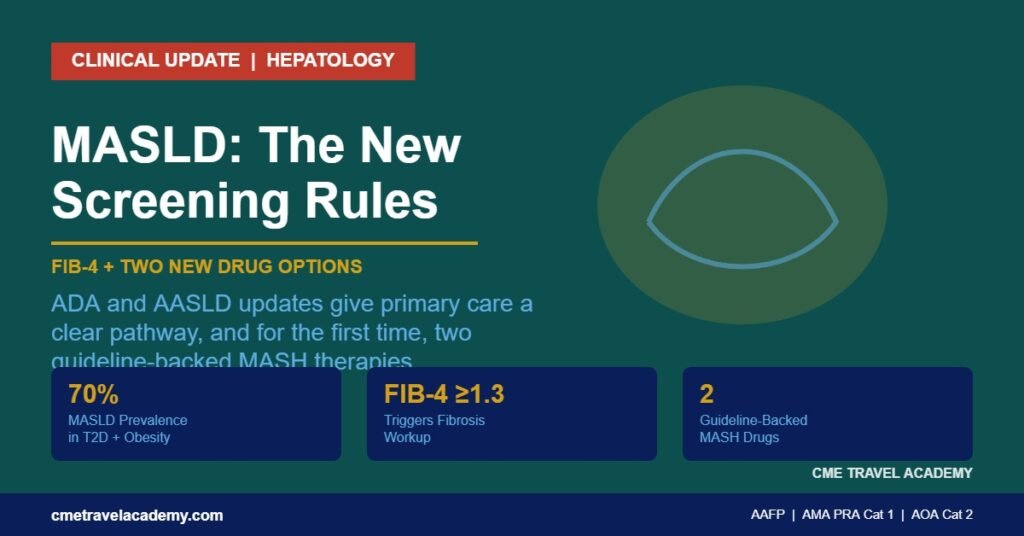
Metabolic dysfunction-associated steatotic liver disease, MASLD, quietly became one of the most common chronic conditions walking through a primary care door. Renamed from NAFLD in the 2023 multi-society nomenclature consensus, it now affects an estimated one in three US adults, and up to seven in ten patients who also carry a diagnosis of type 2 diabetes and obesity. For years the condition sat in a clinical blind spot: too common to refer everyone to hepatology, too consequential to ignore, and without a clear primary care pathway for who needed a closer look. That changed over the past year. The American Diabetes Association published a formal screening and diagnosis pathway for MASLD in October 2025, and by the end of that year a second drug had joined resmetirom with its own FDA approval for MASH with fibrosis. Here is what primary care needs to know, and do differently, now.
Why MASLD Belongs on Your Cardiometabolic Radar
MASLD is not a standalone diagnosis. It shares a risk-factor engine with the conditions primary care already manages daily: obesity, type 2 diabetes, hypertension, and dyslipidemia. Readers who followed our recent coverage of CKM syndrome staging and oral GLP-1 therapy for obesity will recognize the pattern. The liver is simply the organ MASLD makes visible, and untreated steatohepatitis with fibrosis, called MASH, can progress silently to cirrhosis, hepatocellular carcinoma, and liver-related death, often without a single symptom until fibrosis is already advanced. Cardiovascular disease, not liver failure, remains the leading cause of death in MASLD, one more reminder that liver risk and cardiometabolic risk belong on the same problem list, not in separate silos.
The New Screening Pathway (ADA, October 2025)
ADA’s October 2025 guidance targets adults with type 2 diabetes or prediabetes, particularly those with obesity or other cardiometabolic risk factors or established cardiovascular disease. For this population, ADA now recommends skipping ultrasound confirmation of steatosis altogether, even when liver enzymes are normal, and proceeding directly to fibrosis risk stratification using the FIB-4 index, a calculation most EHRs can generate automatically from labs a primary care visit already orders: age, AST, ALT, and platelet count.
- FIB-4 below 1.3: low probability of advanced fibrosis in most patients; repeat every 1 to 2 years. In a patient with type 2 diabetes and obesity, do not treat this as fully reassuring on its own: ADA’s guidance notes that at-risk MASH can still be present, and recommends a closer look when FIB-4 falls between 1.0 and 1.3 alongside multiple cardiometabolic risk factors.
- FIB-4 1.3 to 2.67: indeterminate. Order a second-tier test (vibration-controlled transient elastography / FibroScan, or the Enhanced Liver Fibrosis / ELF test) to clarify fibrosis stage.
- FIB-4 above 2.67: high probability of advanced fibrosis. Refer to hepatology.
- Age changes the math: FIB-4 is not validated below age 35, and in adults 65 and older a higher cutoff, roughly 1.9 to 2.0 rather than 1.3, is used to preserve specificity; applying the standard threshold in an older patient will over-refer.
One caution worth building into your workflow: FIB-4’s overall accuracy drops in patients with diabetes and obesity, the exact population this pathway targets, and the literature is not settled on which direction the error runs. ADA’s own guidance leans toward the more dangerous failure mode: a falsely low, falsely reassuring FIB-4 that under-calls advanced fibrosis, which is why it recommends a closer look when the score falls between 1.0 and 1.3 in a patient with type 2 diabetes and multiple cardiometabolic risk factors. That is not a reason to abandon the algorithm. It is a reason to treat a low-normal or indeterminate FIB-4 in this group, and especially in an older patient, as a genuine trigger for a closer look rather than automatic reassurance, and to repeat testing over time rather than anchor on a single value. Some experts also question the overall yield of systematic fibrosis screening in type 2 diabetes, pointing to a high false-positive referral burden against a modest absolute rate of major liver events over ten years; that debate does not change ADA’s current recommendation, but it is useful context for how confidently to counsel a patient with an abnormal result.
Two Guideline-Endorsed Drug Therapies, for the First Time
Until recently, MASH management meant lifestyle counseling and little else. That changed with two approvals now both reflected in AASLD practice guidance for patients with MASH and stage F2 to F3 fibrosis, whether confirmed on biopsy or by noninvasive equivalent.
Resmetirom (Rezdiffra) earned accelerated FDA approval in 2024 as the first drug indicated for noncirrhotic MASH with moderate to advanced fibrosis. It is an oral, liver-directed thyroid hormone receptor-beta agonist, studied in the MAESTRO-NASH phase 3 trial, and it works independently of weight loss.
Semaglutide (as Wegovy) earned its own accelerated FDA approval on August 15, 2025, for noncirrhotic MASH with moderate to advanced fibrosis, the same F2-F3 population and the same regulatory pathway as resmetirom, based on the ESSENCE trial, published in the New England Journal of Medicine in June 2025, which showed that 72 weeks of semaglutide produced significant improvement in steatohepatitis and fibrosis compared with placebo. AASLD folded that approval into its practice guidance in November 2025. For a patient already on, or an appropriate candidate for, a GLP-1 receptor agonist for type 2 diabetes or obesity, an F2-F3 MASLD diagnosis is now one more reason to reach for that same drug class rather than write an additional, unrelated prescription.
Neither drug requires a hepatologist to initiate in every case, but confirming fibrosis stage before starting either one does.
Upcoming CME Conference
New York City
October 12-13, 2026 · 12 AMA PRA Category 1 Credits™
Cover MASLD alongside heart failure, diabetes, CKM syndrome, and more. Morning sessions. Afternoons free.
Reserve Your Spot →Practice Pearls for the Primary Care Visit
- Screen at the point of an existing visit. Any patient with type 2 diabetes or prediabetes, especially with obesity or other cardiometabolic risk factors, is a FIB-4 candidate using labs already in a standard metabolic panel; a separate visit or new lab order usually is not required.
- Do not let incidental steatosis go unstudied. An abdominal ultrasound or CT ordered for an unrelated reason that mentions hepatic steatosis is an invitation to calculate FIB-4, not a finding to file away.
- Lead with lifestyle regardless of drug eligibility. A 7 to 10 percent body weight reduction remains the single most effective intervention for MASH histology, and is the foundation both resmetirom and semaglutide are layered onto, not a substitute for it.
- Recheck rather than refer and forget. A FIB-4 in the indeterminate range, or a low-normal FIB-4 in a patient with diabetes and obesity, deserves a repeat interval or elastography rather than a one-time note in the chart.
- Coordinate rather than duplicate. If a patient already qualifies for a GLP-1 receptor agonist for diabetes, obesity, or cardiovascular risk reduction, document the MASLD indication alongside it rather than treating it as a separate prescribing decision.
Conference Spotlight
Turn this into 12 months of retained knowledge, not one afternoon of slides. Our cardiometabolic curriculum, including MASLD, CKM syndrome, and GLP-1 therapy, uses a 12-month spaced repetition curriculum and one-page point-of-care references you can use at the bedside starting day one, alongside our full online, on-demand CME library. Join us in New York City (Oct 12-13, 2026) or from anywhere via CME Live: Your Location. Registration starts at $995; military, resident, and student discounts available.
View All 2026 Conferences →Top 5 Takeaways
1. Who should be screened for MASLD in primary care?
Adults with type 2 diabetes or prediabetes, particularly those with obesity or other cardiometabolic risk factors or established cardiovascular disease, per ADA’s October 2025 guidance. Ultrasound confirmation of steatosis is not required before calculating FIB-4 in this group, even when liver enzymes are normal.
2. What labs does FIB-4 require, and what do the cutoffs mean?
Age, AST, ALT, and platelet count. Below 1.3 is low risk in most patients and can be rechecked every 1 to 2 years, though a result between 1.0 and 1.3 still warrants a closer look in a patient with type 2 diabetes and multiple cardiometabolic risk factors; 1.3 to 2.67 is indeterminate and should prompt elastography or ELF testing; above 2.67 warrants hepatology referral. The cutoffs also shift with age.
3. Why might FIB-4 be less reliable in this population?
FIB-4’s overall accuracy drops in patients with diabetes and obesity, though the literature is divided on the direction of the error. ADA’s own guidance highlights the risk of a falsely low result in this group and recommends a closer look when FIB-4 falls between 1.0 and 1.3 in a patient with type 2 diabetes and multiple cardiometabolic risk factors.
4. What are the two guideline-endorsed drug options for MASH with fibrosis?
Resmetirom (Rezdiffra), FDA-approved in 2024 for F2-F3 fibrosis based on the MAESTRO-NASH trial, and semaglutide (Wegovy), FDA-approved in August 2025 for the same F2-F3 population based on the ESSENCE trial, then folded into AASLD practice guidance that November.
5. Does a GLP-1 receptor agonist already prescribed for diabetes or obesity cover the MASLD indication?
It can serve both purposes in an eligible patient, but the MASH fibrosis stage should still be documented and confirmed, since monitoring goals differ from a diabetes or weight-management indication alone.
Conclusion
MASLD moved from an incidental imaging finding to a condition with a defined screening pathway and, for the first time, two guideline-backed drug therapies, all within about a year. For primary care, the shift means the labs are probably already in the chart, the algorithm is a calculation rather than a referral, and a meaningful share of patients already on a GLP-1 receptor agonist for diabetes or obesity may be getting liver benefit they were never specifically prescribed for. If you want the full cardiometabolic picture, including CKM staging, GLP-1 sequencing, and this MASLD pathway, in one accredited, spaced-repetition curriculum, join us in New York City on October 12-13, 2026, or in Las Vegas on December 18-19, 2026. Both conferences earn 12 AMA PRA Category 1 Credits, including 1 hour of Ethics.
Related CME Articles