
By Dr. Vimal George, MD | Reviewed by CME Travel Academy Faculty
8 min read · Reviewed July 2026
In this article:
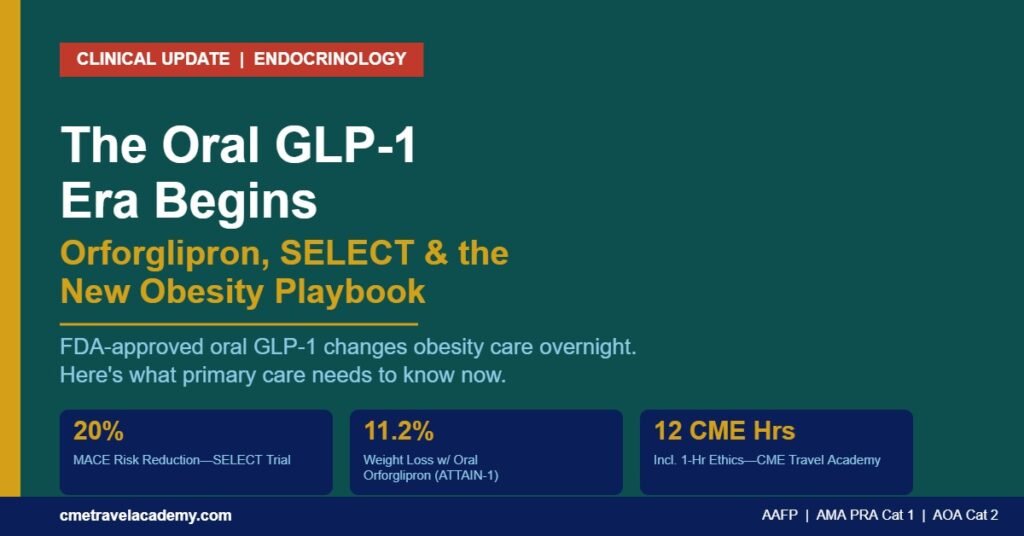
On April 1, 2026, the FDA approved orforglipron — marketed as Foundayo — the first oral GLP-1 receptor agonist patients can take any time of day, with no fasting and no water restrictions. For a drug class that has already rewritten diabetes and cardiovascular care, this is more than a formulation tweak. It removes the single biggest adherence barrier in oral incretin therapy and puts a genuinely convenient, guideline-supported obesity treatment within reach of a routine primary care visit. Layer in the SELECT trial’s finding that semaglutide cut major cardiovascular events by 20 percent in patients with obesity and established cardiovascular disease — even without diabetes — and it becomes clear that obesity pharmacotherapy has quietly become cardiovascular medicine. This review walks through what changed, what the evidence shows, and how to sequence therapy for the patients already on your schedule this week.
Obesity Is Now a Cardiovascular Diagnosis
For decades, obesity was treated in clinic as a risk factor to be managed alongside “real” cardiovascular disease — worth a mention, rarely a prescription. The SELECT trial changed that calculus. In 17,604 patients with pre-existing cardiovascular disease and overweight or obesity but no diabetes, once-weekly semaglutide 2.4 mg reduced the composite of cardiovascular death, nonfatal MI, or nonfatal stroke by 20 percent (HR 0.80, 95% CI 0.72–0.90) over a mean follow-up of roughly 40 months, alongside a 9.4 percent reduction in body weight. What makes SELECT practice-changing rather than merely reassuring is the mediation analysis: an estimated 35 to 55 percent of the cardiovascular benefit was independent of weight loss itself, suggesting a direct vascular and anti-inflammatory effect of GLP-1 receptor agonism. A companion 2025 American College of Cardiology scientific statement on obesity management in adults with heart failure reinforces the same message for the primary care clinician: weight is a modifiable, treatable driver of cardiovascular outcomes, not a lifestyle footnote to document and move past. For patients already carrying an ASCVD diagnosis, that reframes a GLP-1 prescription as secondary prevention.
Orforglipron Changes the Access Equation
Until this spring, every oral GLP-1 option carried real friction. Oral semaglutide (Rybelsus) is a peptide formulated with an absorption enhancer that requires dosing on an empty stomach with no more than four ounces of plain water, followed by a 30-minute fast before any other food, beverage, or oral medication — a routine that quietly erodes adherence over months. Orforglipron is structurally different: a small-molecule, nonpeptide GLP-1 receptor agonist that behaves pharmacologically like a standard oral tablet, with no food or water restrictions and no fixed time of day. In ATTAIN-1 (n=3,127, no diabetes), orforglipron produced dose-dependent weight loss of 7.5 to 11.2 percent at 72 weeks versus 2.1 percent with placebo, with meaningful improvements in waist circumference, blood pressure, and lipids. ATTAIN-2 (n=1,613, type 2 diabetes) showed weight reductions of 5.1 to 9.6 percent versus 2.5 percent with placebo, plus significant gains across prespecified cardiometabolic endpoints including HbA1c. For patients who are needle-averse, traveling frequently, or simply more likely to stay adherent to a pill than a weekly injection, orforglipron is the first oral option that doesn’t ask them to trade convenience for a meaningfully worse side-effect or efficacy profile. If you want a deeper dive into how this fits alongside GLP-1 use in type 2 diabetes, the ADA Standards of Care remains the authoritative source for sequencing GLP-1 therapy against SGLT2 inhibitors and other pillar drugs when diabetes, not obesity alone, is the primary indication.
Upcoming CME Conference
New York City — October 12–13, 2026
12 AMA PRA Category 1 Credits™
Cover obesity pharmacotherapy alongside heart failure, diabetes, CKD, hypertension, and more. Morning sessions only — afternoons free. From $995 per clinician; $100 off military, $200 off resident physicians.
Injectable Incretins Still Set the Efficacy Ceiling
Oral convenience does not yet match injectable potency, and clinicians should set expectations accordingly. Tirzepatide remains a dual GIP/GLP-1 agonist with a higher efficacy ceiling than semaglutide: head-to-head data from SURMOUNT-5 showed tirzepatide achieving greater percentage weight change and higher rates of patients reaching 10, 15, 20, and even 25 percent total body weight loss at 72 weeks compared with semaglutide. Retatrutide, a triple GIP/GLP-1/glucagon receptor agonist still working through late-phase development, has posted the most striking numbers yet — 24.2 percent weight loss at 48 weeks in early data, approaching outcomes historically reserved for bariatric surgery, with the TRANSCEND-T2D program also reporting a robust 2-point HbA1c reduction in patients with type 2 diabetes. For your highest-BMI patients, or those with inadequate response to semaglutide or oral orforglipron, injectable tirzepatide remains the more potent first-line option today. Oral therapy is best framed not as a lesser substitute but as an important on-ramp: a lower-friction entry point for patients who would otherwise decline treatment altogether, and a maintenance option once initial weight-loss targets are met.
Medicare Now Covers Obesity Treatment: The GLP-1 Bridge Program
Access, not just efficacy, has been the rate-limiting step in obesity pharmacotherapy — and that changed materially this month. On July 1, 2026, CMS opened the Medicare GLP-1 Bridge, a short-term Section 402 demonstration (now extended through December 31, 2027) that for the first time lets Medicare Part D beneficiaries obtain GLP-1 therapy specifically for obesity, a use Medicare has historically been barred by statute from covering. Eligible medications are Foundayo, Wegovy (injection or tablet), and the KwikPen formulation of Zepbound, available at a flat $50 copayment per 30-day supply. To qualify, a patient must meet one of three clinical thresholds: BMI ≥35; BMI ≥30 with heart failure, uncontrolled hypertension, or chronic kidney disease; or BMI ≥27 with prediabetes, a prior heart attack or stroke, or symptomatic peripheral artery disease. The prescriber submits a prior authorization attestation that is processed centrally through Humana on CMS’s behalf, separate from the patient’s individual Part D plan. Raise this proactively with Medicare-age patients who’ve been paying cash or going without: it’s a temporary bridge, not a permanent Part D benefit, and CMS has already put the longer-term BALANCE Model that was meant to follow it in 2027 on indefinite hold. The $50 copay also doesn’t count toward the Part D deductible or out-of-pocket maximum, and Low-Income Subsidy protections don’t apply to it — a real gap for the lowest-income beneficiaries.
Practice Pearls: Sequencing Therapy in Clinic
Translating this evidence into Monday-morning practice comes down to a handful of decision points:
- ✓ Confirm candidacy correctly. BMI ≥30 kg/m², or ≥27 kg/m² with a weight-related comorbidity (hypertension, T2D, OSA, established ASCVD, HFpEF), meets criteria for pharmacotherapy under current obesity-medicine guidance.
- ✓ Titrate slowly and set expectations. GI side effects (nausea, early satiety, occasional constipation) are dose-dependent and most pronounced during escalation; slower titration schedules meaningfully improve tolerability and completion rates.
- ✓ Choose based on the whole patient, not just the scale. A patient with established ASCVD and obesity is a stronger candidate for semaglutide, given the SELECT trial’s direct outcomes data; a patient prioritizing maximum weight loss with tolerable injection burden may be better served by tirzepatide; a needle-averse or frequently traveling patient may most benefit from oral orforglipron.
- ✓ Treat this as chronic disease management, not a course of therapy. Weight regain after discontinuation is well documented; counsel patients up front that these are long-term medications, analogous to antihypertensives, not a bridge to a drug-free state.
- ✓ Don’t manage obesity in isolation. Screen concurrently for the cardiovascular-kidney-metabolic overlap our recent CKD coverage addressed — uACR, eGFR, and lipid panels belong in the same visit as the prescription.
- ✓ Screen Medicare patients for Bridge eligibility. Many Medicare-age patients don’t know obesity-specific GLP-1 coverage exists now; check the BMI/comorbidity criteria and submit the prior authorization attestation yourself rather than waiting for the patient to ask.
Frequently Asked Questions
Why is obesity now considered a cardiovascular diagnosis, not just a risk factor?
The SELECT trial showed a 20% reduction in major adverse cardiovascular events with semaglutide in patients with obesity and known ASCVD but no diabetes, with 35–55% of the benefit occurring independent of weight loss itself — evidence of a direct cardiovascular effect.
What does orforglipron (Foundayo) change about oral GLP-1 therapy?
FDA-approved April 2026, orforglipron is the first oral GLP-1 that requires no fasting and no water restriction, unlike oral semaglutide — a genuine adherence advantage for primary care patients who struggle with the older dosing routine.
Are injectable GLP-1s still more effective than oral options?
Yes. Tirzepatide (SURMOUNT-5) and investigational retatrutide (24.2% weight loss at 48 weeks) outperform oral agents on percentage weight loss and remain the more potent first-line choice for the highest-need patients.
How should clinicians choose between semaglutide, tirzepatide, and orforglipron?
Match the agent to the patient rather than the headline trial number: established ASCVD favors semaglutide given SELECT’s outcomes data, maximum weight loss with tolerable injections favors tirzepatide, and needle aversion or frequent travel favors oral orforglipron.
Does Medicare cover GLP-1 medications for obesity in 2026?
Yes, temporarily. The Medicare GLP-1 Bridge (July 1, 2026–December 31, 2027) covers Foundayo, Wegovy, and Zepbound (KwikPen) for obesity at a $50 monthly copay for eligible Part D beneficiaries who meet BMI and comorbidity criteria, via a prior authorization your practice submits.
Conclusion
The last twelve months have moved obesity pharmacotherapy from an emerging interest to a core primary care competency, and the pace of change shows no sign of slowing. If you want to go deeper than a single article allows — with case-based teaching, point-of-care references, and direct Q&A with faculty who are still seeing these patients in clinic — CME Travel Academy’s 2026 conference season continues with New York City on October 12–13 and Las Vegas on December 18–19, both covering obesity alongside heart failure, diabetes, hypertension, and CKD, with 12 AMA PRA Category 1 Credits™ including one hour of Ethics. Can’t travel? CME Live: Your Location delivers the identical live faculty and credit from wherever you’re sitting. However you get there, this is exactly the kind of guideline-moving update worth an afternoon of structured learning — and a lot more useful than reading the package insert alone.