
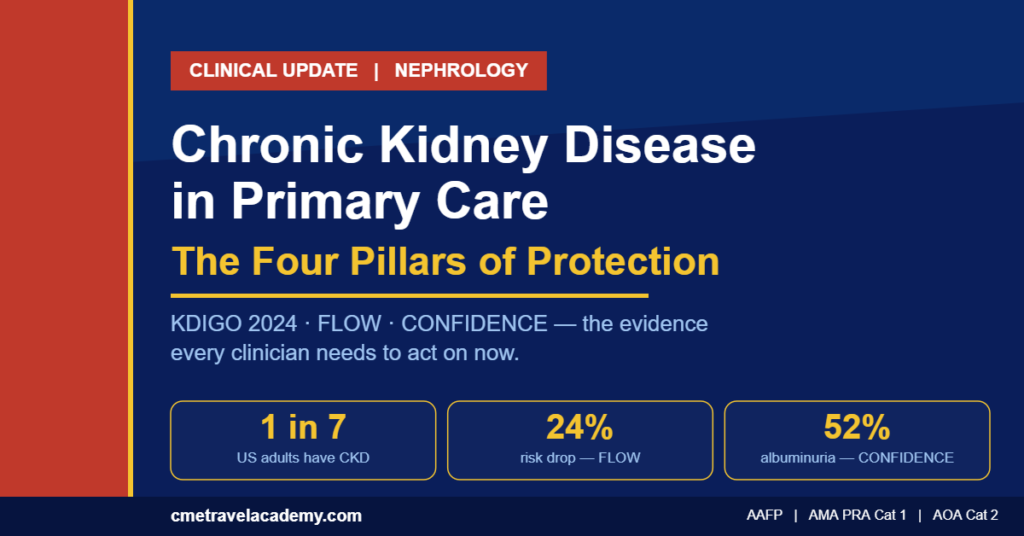
Chronic kidney disease (CKD) affects roughly one in seven American adults, yet up to 9 in 10 of the people living with it don’t know they have it. For most of these patients, the diagnosis won’t be made in a nephrology clinic — it will be made, or missed, in primary care. That makes the family physician, internist, nurse practitioner, and physician assistant the real front line of kidney protection.
The encouraging news is that CKD care has changed more in the past three years than in the previous three decades. The KDIGO 2024 Clinical Practice Guideline for the Evaluation and Management of CKD, together with landmark trials such as FLOW and CONFIDENCE, has handed outpatient clinicians a clear, evidence-based playbook to slow progression, cut cardiovascular events, and keep patients off dialysis. This post distills what every primary care clinician needs to know — and how CME Travel Academy can help you put it into practice. If you also manage the diabetes, hypertension, and lung disease that so often accompany CKD, see our companion updates on the 2026 ADA/AACE diabetes guidelines, the 2025 AHA/ACC hypertension guidelines, and the GINA 2026 asthma update — plus the 2026 GOLD COPD report — for the same practical, guideline-aligned approach.
Why CKD Belongs on Every Primary Care Problem List
CKD rarely travels alone. It clusters with type 2 diabetes, hypertension, obesity, and heart failure so tightly that the American Heart Association now frames the overlap as cardiovascular-kidney-metabolic (CKM) syndrome. Managing one of these conditions in isolation almost always means under-treating the others — which is exactly why chronic-disease care delivers its biggest returns when it is coordinated, the philosophy behind our value-based care program for clinics.
CKD is staged in two dimensions, not one: kidney function by eGFR (the G categories, G1–G5) and kidney damage by albuminuria (the A categories, A1–A3). The familiar KDIGO “heat map” combines them into a single risk picture. A patient with a normal eGFR but a urine albumin-to-creatinine ratio (uACR) of 250 mg/g is not low risk — albuminuria independently predicts both kidney failure and cardiovascular death. Despite this, the spot uACR remains one of the most under-ordered tests in primary care. If you take one structural change from this article, make it this: order an eGFR and a spot uACR together, at least annually, in every patient with diabetes, hypertension, or established cardiovascular disease.
KDIGO 2024: What Actually Changed
The 2024 KDIGO guideline remains the most current KDIGO Clinical Practice Guideline for the Evaluation and Management of CKD — the benchmark international standard until the next KDIGO revision. It is broad, but a handful of updates are genuinely practice-shifting for outpatient care:
- SGLT2 inhibitors move front and center. KDIGO recommends an SGLT2 inhibitor for adults with CKD and an eGFR ≥ 20 mL/min/1.73 m² who have a uACR ≥ 200 mg/g or heart failure, and for essentially all patients with type 2 diabetes and CKD at that threshold. Continue it even as eGFR falls below 20, unless dialysis begins or it isn’t tolerated.
- Finerenone earns a formal role. A nonsteroidal mineralocorticoid receptor antagonist (finerenone) is suggested for adults with type 2 diabetes, eGFR > 25, normal serum potassium, and persistent albuminuria (uACR ≥ 30 mg/g) despite a maximally tolerated RAS inhibitor.
- A lower blood-pressure target. KDIGO endorses a systolic target of < 120 mm Hg when tolerated, using standardized office measurement — a reminder that how you measure matters as much as the number.
- Statins and RAS inhibitors remain foundational. Most adults over 50 with CKD warrant a statin, and ACE inhibitors or ARBs should be titrated to the maximum tolerated dose when albuminuria is present.
The “Four Pillars” of Kidney-Protective Therapy
It helps to think of modern kidney protection as four layered pillars rather than a stepwise sequence: (1) a renin-angiotensin system inhibitor (ACE inhibitor or ARB) at the maximum tolerated dose; (2) an SGLT2 inhibitor; (3) the nonsteroidal MRA finerenone; and (4), increasingly, a GLP-1 receptor agonist. Each works through a distinct mechanism, and their benefits are largely additive — which is why the newest evidence is about combining them earlier, not choosing between them.
A US Primary-Care Companion: The 2025 VA/DoD Guideline
While KDIGO sets the global standard, the 2025 U.S. Department of Veterans Affairs and Department of Defense Clinical Practice Guideline for the Primary Care Management of CKD (published in Annals of Internal Medicine) is the newest, explicitly primary-care-oriented playbook in the United States. Developed with the GRADE method, it distills 23 recommendations and reinforces the same core moves: a strong recommendation to combine the spot uACR with eGFR to predict progression, and updated pharmacologic guidance endorsing ACE inhibitors or ARBs, SGLT2 inhibitors, GLP-1 receptor agonists, nonsteroidal MRAs, and statins. For clinicians who want a concise, U.S.-context summary that mirrors KDIGO, it is an excellent companion document.
New Evidence: FLOW and CONFIDENCE
The FLOW trial (New England Journal of Medicine, 2024) randomized 3,533 adults with type 2 diabetes and CKD to semaglutide or placebo on top of a RAS inhibitor. It was stopped early for efficacy: semaglutide reduced the risk of the primary composite of major kidney events, cardiovascular death, and all-cause death by 24%, and meaningfully slowed the annual decline in eGFR. Those results, echoed by the ADA Standards of Care, are what elevated the GLP-1 receptor agonist into a genuine fourth pillar of kidney protection.
The 2025 CONFIDENCE trial asked a practical question: should finerenone and an SGLT2 inhibitor be started together rather than one at a time? Simultaneous initiation of finerenone and empagliflozin produced a 52% median reduction in albuminuria at six months — roughly 30% more than either agent alone — with no unexpected safety signals. The takeaway for the clinic is simple: when a patient qualifies for both, you generally don’t have to wait.
Learn it once, retain it all year. CME Travel Academy turns updates exactly like these into bedside-ready practice. Our live conferences deliver 12 AMA PRA Category 1 Credits™ (including 1 hour of Ethics), morning-only sessions with afternoons free, a one-page point-of-care reference, and a 12-month spaced-repetition curriculum so the four pillars stick.
Join us at Walt Disney World, July 17–18, 2026 (from $895) or New York City, October 12–13, 2026 (from $995) — or earn the same credits live from anywhere through our CME Livestream. Military, resident, and student discounts available.
Practice Pearls for the Outpatient Clinic
Translating the guideline into a busy schedule comes down to a few habits:
- ✓ Screen with both numbers. An eGFR alone misses early disease. Pair it with a spot uACR annually in anyone with diabetes, hypertension, or cardiovascular disease.
- ✓ Expect — and tolerate — an initial eGFR dip. Both RAS inhibitors and SGLT2 inhibitors can drop eGFR by up to ~30% on initiation. This is hemodynamic, not nephrotoxic; it stabilizes and predicts long-term benefit.
- ✓ Mind the potassium. Before starting finerenone, confirm a normal serum potassium and eGFR > 25, then recheck at about four weeks.
- ✓ Don’t stop SGLT2 inhibitors too soon. Continue them as eGFR falls below 20 unless dialysis is starting — the cardiovascular benefit persists.
- ✓ Know when to refer. Send to nephrology for eGFR < 30, a rapid or unexplained decline, uACR > 300 mg/g with falling function, refractory hyperkalemia, or CKD of uncertain cause.
Top 5 Takeaways
- Test in pairs. Order an eGFR and a spot uACR together, at least yearly, in every at-risk patient — albuminuria is a risk marker even when eGFR looks normal.
- Start an SGLT2 inhibitor early for CKD with eGFR ≥ 20 and uACR ≥ 200 mg/g, heart failure, or type 2 diabetes; continue it below 20 unless dialysis begins.
- Add finerenone for residual albuminuria (uACR ≥ 30) in type 2 diabetes on a maximally tolerated RAS inhibitor, with potassium and eGFR monitoring.
- Reach for a GLP-1 receptor agonist. FLOW showed semaglutide cut major kidney and cardiovascular events by 24% — a true fourth pillar.
- Combine confidently. CONFIDENCE supports starting finerenone and an SGLT2 inhibitor together for greater albuminuria reduction; tolerate the expected early eGFR dip and refer when red flags appear.
Bringing It Into Your Practice
CKD is common, costly, and — more than ever — modifiable from primary care. The four pillars give you a concrete framework, and KDIGO 2024 plus FLOW and CONFIDENCE give you the evidence to act early and combine therapies with confidence. The clinicians who internalize this now will prevent a meaningful share of the dialysis and cardiovascular events their patients would otherwise face.
Want to earn accredited CME while you master these updates? CME Travel Academy offers AAFP Prescribed, AMA PRA Category 1™, and AOA Category 2 credit through evidence-based, zero-commercial-bias conferences led by actively practicing physicians. Explore our 2026 conferences at Walt Disney World and New York City, earn from anywhere with our CME Livestream, or start today with online on-demand courses. For a wider look at the year ahead, see our guide to the best CME conferences of 2026.