
By Dr. Vimal George, MD | Reviewed by CME Travel Academy Faculty
7 min read · Reviewed July 2026
Roughly one in four strokes in the United States is a recurrence — about 185,000 of the roughly 795,000 strokes that occur annually — and recurrence risk is highest in exactly the window when a patient re-enters primary care. In contemporary, treated cohorts, 90-day recurrence runs on the order of 4–5%; in untreated or undertreated patients it can run substantially higher, with the steepest part of the curve in the first two weeks. By the time the neurology follow-up ends and the patient is back in your clinic for a routine visit, the medication list, blood pressure log, and lipid panel are often the last real opportunity to close that risk window.
The 2021 AHA/ASA Guideline for the Prevention of Stroke in Patients With Stroke and TIA remains the backbone of that visit, but the evidence base has moved substantially since then — new data on anticoagulation timing after cardioembolic stroke, dual antiplatelet duration, and lipid intensity have all sharpened what “aggressive secondary prevention” should actually look like in 2026. This guide walks through the guideline, the trials that have refined it, and the prescribing decisions that matter most at that first post-stroke visit.
The First 90 Days: Why Timing Drives Everything
Recurrent stroke risk is not evenly distributed across time. Patients with a high-risk TIA (ABCD2 score ≥4) or a minor, non-disabling ischemic stroke (NIHSS ≤3–5) face their steepest recurrence curve in the first two to four weeks, which is exactly why the 2021 AHA/ASA guideline frames secondary prevention as a time-sensitive intervention rather than a routine medication refill. For primary care, that means the first post-discharge visit is not the moment to defer antiplatelet, statin, or blood-pressure decisions to “whenever neurology follows up” — it is the visit where a meaningful share of the recurrence risk is actually being determined.
A working ABCD2 score (age, blood pressure, clinical features, duration of symptoms, diabetes) at that visit, even calculated retrospectively, helps confirm whether the patient qualifies for short-course dual antiplatelet therapy, which meaningfully benefits only the highest-risk subgroup and carries real bleeding risk in everyone else.
Antithrombotic Therapy: Matching the Regimen to the Mechanism
For noncardioembolic ischemic stroke or TIA, the 2021 AHA/ASA guideline supports monotherapy with aspirin (50–325 mg daily), clopidogrel (75 mg daily), or aspirin plus extended-release dipyridamole as first-line, long-term secondary prevention — chosen largely on tolerability and cost rather than the clear superiority of one agent over another.
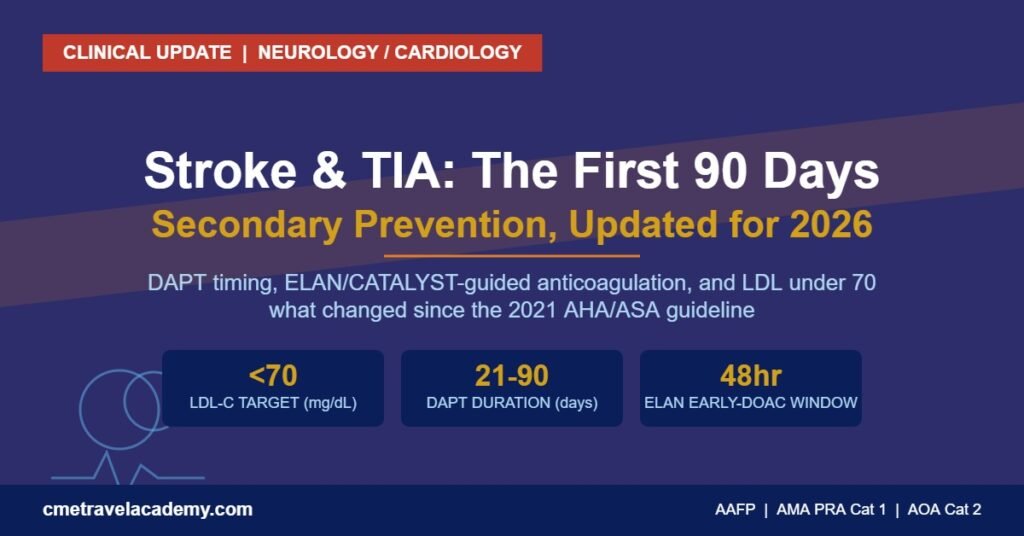
Short-course dual antiplatelet therapy (DAPT) is where the evidence has tightened considerably. In patients with a minor stroke (NIHSS ≤3) or high-risk TIA (ABCD2 ≥4), the POINT and CHANCE trials support aspirin plus clopidogrel started early after symptom onset — within 12 hours in POINT, within 24 hours in CHANCE — continued for 21–90 days per the 2021 AHA/ASA guideline, then de-escalated to single-agent therapy (a 2026 NEJM Clinical Practice review by Furie and Kelly favors trimming that window to a narrower 21–30 days, so it’s worth checking your local stroke service’s current practice). For a larger minor-to-moderate stroke (NIHSS ≤5) or a high-risk TIA, ticagrelor plus aspirin for 30 days is a reasonable alternative per the THALES trial, which also showed particular benefit in a prespecified subgroup with symptomatic intracranial or extracranial stenosis ≥30% (a subgroup finding, not a trial eligibility criterion). In all cases, continuing DAPT beyond 90 days — or adding a third antiplatelet agent — measurably increases hemorrhage without a corresponding reduction in recurrent ischemic events, so the de-escalation date deserves its own line in the chart.
For cardioembolic stroke due to atrial fibrillation, the timing question has shifted meaningfully since the 2021 guideline. The ELAN trial (NEJM, 2023) randomized more than 2,000 patients to early direct oral anticoagulant (DOAC) initiation — within 48 hours for minor-to-moderate stroke, day 6–7 for major stroke — versus later initiation, and found no excess of symptomatic intracranial hemorrhage with earlier dosing, with a signal toward fewer recurrent ischemic events (1.4% vs 2.5% at 30 days). That signal has since been confirmed at the level of a formal meta-analysis: the CATALYST individual-participant-data meta-analysis (Lancet, 2025) pooled ELAN with the TIMING, OPTIMAS, and START trials (n=5,441) and found early DOAC initiation (within 4 days) significantly reduced the 30-day composite of recurrent ischemic stroke, symptomatic intracranial hemorrhage, or unclassified stroke (OR 0.70, 95% CI 0.50–0.98). Many stroke services have moved away from the older “1-3-6-12 day” rule of thumb toward earlier DOAC initiation guided by infarct size rather than a fixed calendar — it’s worth confirming with the treating neurologist which approach was used before assuming the old rule still applies to a given patient.
Upcoming CME Conference
Walt Disney World CME Conference — Orlando, FL
July 17–18, 2026 · 12 AMA PRA Category 1 Credits™
Cover chronic coronary disease and stroke-risk topics alongside heart failure, diabetes, hypertension, CKD, and COPD. Morning sessions. Afternoons free.
Reserve Your Spot →Lipid Management: How Low, and With What
High-intensity statin therapy is the default for atherosclerotic-mechanism stroke or TIA, a conclusion driven largely by the SPARCL trial, in which atorvastatin 80 mg reduced recurrent stroke by 16% and major cardiovascular events by 20% compared with placebo. That benefit came with a trade-off worth naming in the chart: SPARCL also showed a small but real increase in hemorrhagic stroke (HR 1.66), which is part of why LDL-lowering intensity should still be individualized in patients with a prior hemorrhagic component. The 2021 AHA/ASA guideline sets an LDL-C target below 70 mg/dL for stroke or TIA of atherosclerotic origin, and — since the guideline authors themselves note that most ASCVD patients in practice meet very-high-risk criteria — clinicians should expect the newer 2026 ACC/AHA dyslipidemia guideline’s lower goal of below 55 mg/dL to apply to a large share of these patients, not just a narrow subgroup.
When maximally tolerated statin therapy doesn’t reach goal, the guideline supports adding ezetimibe first, then a PCSK9 inhibitor or inclisiran, rather than accepting an LDL well above target. This is also where statin intolerance deserves a genuine workup rather than a permanent discontinuation — intermittent dosing, a different statin, or bempedoic acid can often get a patient back on therapy that measurably reduces recurrence risk.
Conference Spotlight: Cardiology & Stroke-Risk Topics at CME Travel Academy
Both the Disney World (July 17–18) and New York City (Oct 12–13) conferences include a dedicated Chronic Coronary Disease session covering antiplatelet therapy and lipid targets — 12 AMA PRA Category 1 Credits™ including 1 hour of Ethics, morning-only sessions (7:30am–1:30pm) with afternoons free, and a CME Live: Your Location option for clinicians who can’t travel. Registration from $995, with $100 off for military and $200 off for resident physicians.
Blood Pressure, Carotid Disease, and Intracranial Stenosis
Blood pressure targets after stroke are individualized to timing and mechanism, but once a patient is out of the acute period, the 2021 guideline and subsequent AHA/ACC hypertension guidance converge on a target below 130/80 mmHg for most patients, achieved gradually rather than in the first days after the event.
For patients with symptomatic carotid stenosis of 70–99%, carotid endarterectomy performed within two weeks of the event remains the guideline-preferred intervention in surgically appropriate candidates, with carotid artery stenting as an alternative in higher-surgical-risk patients; the benefit narrows considerably for stenosis in the 50–69% range and essentially disappears below 50%. Intracranial atherosclerotic stenosis is a separate and frequently mismanaged category: the SAMMPRIS trial found that aggressive medical management — dual antiplatelet therapy for 90 days, high-intensity statin to an LDL target below 70 mg/dL, and blood pressure control — produced fewer 30-day strokes than percutaneous angioplasty and stenting, which is why stenting is now reserved for patients who fail maximal medical therapy rather than offered as a first-line option.
Practice Pearls for the Post-Stroke Follow-Up Visit
A few checks make the first post-discharge visit genuinely protective rather than a formality: confirm the antithrombotic mechanism and de-escalation date are documented in the chart, not just “on aspirin”; verify a high-intensity statin was actually started (not just recommended) and schedule a follow-up lipid panel at 4–12 weeks; screen for atrial fibrillation with extended monitoring in embolic stroke of undetermined source, since occult AF changes the entire antithrombotic strategy; and treat A1c, tobacco use, and physical activity with the same urgency as the prescription pad. Clinicians who want the full evidence base behind these decisions — including the guideline-directed therapy overlap with our recent heart-failure four-pillars update — can find both woven into our primary care CME curriculum.
Top 5 Takeaways
- Timing is treatment. The highest recurrence risk is in the first 90 days — start DAPT, statins, and BP management at the first post-discharge visit, not at the next neurology appointment.
- Match DAPT to risk, then stop. Aspirin plus clopidogrel (or ticagrelor plus aspirin for higher-risk presentations) for 21–90 days per the 2021 guideline, then de-escalate — continuing beyond 90 days raises bleeding risk without added benefit.
- AF-related stroke: earlier anticoagulation looks safe. ELAN and the newer CATALYST meta-analysis both support earlier DOAC initiation than the old “1-3-6-12” rule for most patients; confirm the approach used with neurology.
- Treat lipids aggressively. LDL-C <70 mg/dL is the baseline target for atherosclerotic stroke/TIA; very-high-risk patients may need <55 mg/dL per the newer dyslipidemia guideline — add ezetimibe or a PCSK9 inhibitor rather than accepting an above-goal LDL.
- Intracranial stenosis: medicine beats metal. Aggressive medical therapy outperforms stenting for symptomatic intracranial atherosclerotic disease — reserve stenting for medical-therapy failures.
Frequently Asked Questions
When should dual antiplatelet therapy start after a minor stroke or high-risk TIA, and how long should it continue?
Per the POINT and CHANCE trials, aspirin plus clopidogrel should start early — within 12 hours (POINT) to 24 hours (CHANCE) — after a minor stroke (NIHSS ≤3) or high-risk TIA (ABCD2 ≥4). The 2021 AHA/ASA guideline supports continuing for 21–90 days then de-escalating to a single agent, though a 2026 NEJM Clinical Practice review (Furie & Kelly) favors a narrower 21–30 day course.
How soon should anticoagulation start after an ischemic stroke caused by atrial fibrillation?
The 2023 ELAN trial found no excess intracranial hemorrhage with earlier DOAC initiation (within 48 hours for minor-to-moderate stroke, day 6–7 for major stroke). The 2025 CATALYST meta-analysis (pooling ELAN, TIMING, OPTIMAS, and START; n=5,441) confirmed a significant reduction in recurrent ischemic events with early initiation (within 4 days), supporting earlier initiation than the traditional “1-3-6-12 day” rule for most patients.
What LDL-C target should primary care aim for after an atherosclerotic stroke or TIA?
The 2021 AHA/ASA guideline recommends an LDL-C goal below 70 mg/dL, with the newer 2026 ACC/AHA dyslipidemia guideline recommending below 55 mg/dL for very-high-risk patients; add ezetimibe, then a PCSK9 inhibitor, if a maximally tolerated statin doesn’t reach goal.
Is carotid stenting or endarterectomy preferred for symptomatic carotid stenosis?
Carotid endarterectomy within two weeks of the event is guideline-preferred for symptomatic 70–99% stenosis in surgically appropriate candidates, with stenting reserved as an alternative for higher-surgical-risk patients.
Should intracranial arterial stenosis be treated with a stent?
No — the SAMMPRIS trial found aggressive medical management (dual antiplatelet therapy, high-intensity statin, blood pressure control) outperformed stenting, so stenting is reserved for patients who fail maximal medical therapy.
Conclusion
Secondary stroke prevention is one of the highest-yield conversations in primary care — the absolute risk reduction from getting antithrombotic therapy, lipid management, and blood pressure control right in the first 90 days is larger than almost anything else done in that visit. Staying current on a guideline that keeps accumulating new trial data, though, is its own kind of workload. That’s exactly the gap CME Travel Academy is built to close: stroke, TIA, and atrial fibrillation secondary prevention are part of the cardiovascular and complete chronic-disease online curriculum taught by practicing physicians Dr. Vimal George and Dr. Anush Pillai, with a one-page point-of-care reference and 12 months of spaced-repetition follow-up so the guideline actually sticks.
Join us live at the Walt Disney World CME Conference in Orlando, July 17–18, 2026 (seats are limited), or the New York City CME Conference, October 12–13, 2026 — both earn 12 AMA PRA Category 1 Credits™, including 1 hour of Ethics, with mornings in session and afternoons free. Our Las Vegas CME Conference (December 18–19, 2026) is also now open for registration. Can’t travel? The same faculty and content are available via CME Live: Your Location. Military, resident, and medical-student discounts are available on every format — email info@cmetravelacademy.com for details.