
By Dr. Anush S. Pillai, DO, FAAFP | Reviewed by CME Travel Academy Faculty
9 min read · Reviewed August 2026
For more than twenty years, the boxed warning on menopausal hormone therapy has shaped how primary care clinicians counsel patients, often steering conversations away from a treatment that, for many healthy women, is both effective and safe. That changed on November 10, 2025, when the FDA announced it was initiating removal of the broad boxed warnings from hormone therapy products containing estrogen, and on February 12, 2026, the agency approved the first round of updated labels reflecting the change. For clinicians who trained in the shadow of the 2002 Women’s Health Initiative headlines, this is a genuine practice-changing moment, and one many patients will ask about before their next visit. This post walks through what actually changed, what did not, and how to translate the new labeling into a conversation grounded in The Menopause Society’s 2022 hormone therapy position statement and the risk-stratified evidence behind it.
Clinical Context: Why the Boxed Warning Existed, and Why It’s Changing
The boxed warning traces back to the Women’s Health Initiative (WHI), a large randomized trial halted early in 2002 after investigators reported a statistically non-significant increase in breast cancer diagnoses among hormone therapy users. Two details got lost in the media coverage that followed: the average participant age was 63, more than a decade past typical natural menopause, and the hormone formulation studied is no longer in common use. Prescribing fell by more than half within a few years and never fully recovered, even as later reanalysis and two decades of subsequent research pointed to a very different risk picture for women who start therapy earlier in the menopause transition.
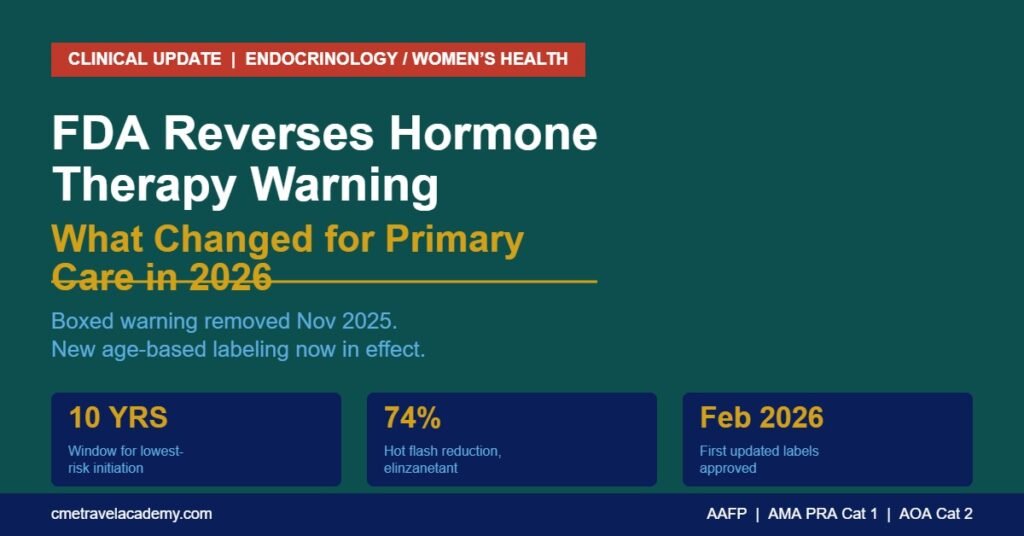
That reanalysis is the foundation of what is now widely called the timing hypothesis: the benefit-risk balance of hormone therapy depends heavily on how close a woman is to menopause onset when she starts. Following a 2025 FDA expert panel and a public comment period, HHS and the FDA announced they would remove boxed-warning language tied to cardiovascular disease, breast cancer, and probable dementia from systemic estrogen products, while explicitly preserving the endometrial cancer warning for estrogen-alone systemic products used in women with a uterus. On February 12, 2026, the agency approved the first labeling updates carrying this change through, with an age-specific framework: initiate systemic hormone therapy within 10 years of menopause onset, generally before age 60, for the most favorable benefit-risk profile.
It is worth being precise about what this is and is not: a relabeling of existing, FDA-approved products based on a fuller reading of the evidence, not approval of a new drug class, and not a declaration that hormone therapy is risk-free. The Menopause Society’s official response reflects that nuance. The Society explicitly endorsed removing the warning from low-dose vaginal estrogen, calling it a likely deterrent to a safe, effective therapy for genitourinary syndrome of menopause. On systemic therapy it was more measured, reiterating that risk is genuinely lower for younger, healthy women closer to menopause onset and higher in older women farther out, with medical history and shared decision-making still doing the real work in each case.
Key Guideline Updates: What’s Actually New in the Label
Three changes matter most for day-to-day prescribing.
The removed risk language covers cardiovascular disease, breast cancer, and probable dementia for systemic estrogen-containing products. This does not mean these risks have been proven to be zero; it means the FDA no longer considers a blanket boxed warning, applied identically to a 52-year-old and a 71-year-old, scientifically justified given the totality of evidence, including data the original 2002 warning predates.
The endometrial cancer warning stays in place for systemic estrogen-alone products in women with a uterus, because unopposed estrogen still measurably increases endometrial cancer risk in that population. Progestogen co-therapy remains standard of care for these patients, and this part of the label is unchanged.
The new labeling also drops the older instruction to use “the lowest effective dose for the shortest duration,” replacing it with age- and timing-based guidance: initiation within 10 years of menopause onset or before age 60 for systemic products carries the most favorable risk-benefit profile, and, per The Menopause Society’s existing position statement, appropriately selected women can continue therapy beyond age 65 with ongoing counseling and periodic reassessment rather than an arbitrary stop date.
The FDA also cited supporting effect sizes worth knowing: up to a 50% reduction in cardiovascular disease risk, a 35% reduction in Alzheimer’s disease risk, and a 50-60% reduction in fracture risk among women who initiate therapy within that early window. These numbers will show up in patient-facing media coverage, and clinicians should be ready to contextualize them: they come from a mix of randomized and observational data in younger, recently menopausal women, describing an association within a specific window, not a universal guarantee.
Alongside the label change, the FDA cleared two new options: the first generic version of conjugated estrogens (branded Premarin) in more than three decades, which should meaningfully improve access and affordability, and a new non-hormonal treatment for moderate-to-severe vasomotor symptoms. That approval joins an already-expanding non-hormonal category. Fezolinetant, a neurokinin-3 (NK3) receptor antagonist approved in 2023, reduces hot flash frequency by roughly 60% in trial populations and requires baseline and periodic liver enzyme monitoring (Elendu et al., Ann Med Surg 2025). Elinzanetant, a dual NK3/NK1 antagonist approved in 2025, reduced moderate-to-severe hot flashes by nearly 74% at 12 weeks in trials and also improved sleep disturbance, an outcome NK3-only agents do not reliably address. Both are options worth knowing well for patients who cannot or choose not to use hormone therapy, including many breast cancer survivors on anti-estrogen therapy.
Upcoming CME Conference
New York City CME Conference
October 12-13, 2026 · 12 AMA PRA Category 1 Credits™
Menopause intersects directly with the chronic disease topics covered at every CME Travel Academy conference, including heart failure, hypertension, CKD, and depression. Build the cardiometabolic and mental-health framework this label change touches. Morning sessions. Afternoons free.
Reserve Your Spot →Conference Spotlight
Menopause doesn’t arrive in isolation. It overlaps directly with the chronic disease topics covered at every CME Travel Academy conference, including heart failure, hypertension, CKD, and depression, all of which shift in presentation and management around the menopause transition. Every session earns AMA PRA Category 1 Credit™, including one hour of Ethics, runs mornings only with afternoons free, and includes a one-page point-of-care reference plus 12 months of spaced-repetition follow-up. Registration starts at $895–$995, with $100 off for military and $200 off for resident physicians. Can’t travel? CME Live: Your Location earns the identical credits from anywhere.
Practice Pearls: Applying This at the Point of Care
Risk-stratify before you counsel. A healthy 53-year-old, two years past her final period, with hot flashes and no personal or family history of breast cancer or unprovoked VTE, is a very different conversation than a 68-year-old more than a decade past menopause with cardiovascular risk factors. The label change was built around this distinction; your counseling should be too.
Genitourinary syndrome of menopause deserves its own conversation, separate from vasomotor symptoms. Low-dose vaginal estrogen has minimal systemic absorption, does not require progestogen co-therapy per The Menopause Society’s 2022 position statement, and is now explicitly supported by the FDA’s own boxed-warning removal. It remains underprescribed relative to how common and treatable GSM actually is.
Don’t assume every patient wants hormone therapy just because the label softened. Some patients will be relieved to hear the new information; others will remain, reasonably, cautious given personal or family history. Fezolinetant and elinzanetant give you real, effective non-hormonal alternatives to offer rather than a binary yes-or-no choice.
Reassess, don’t set a hard stop date. The old “shortest duration” instruction is gone from the label. Continuation past 65 is appropriate for some patients with ongoing symptom burden and a reassessed, favorable risk profile; document that reassessment at each renewal rather than defaulting to an arbitrary cutoff.
Expect questions this year. Direct-to-consumer coverage of this label change has been extensive, and patients are arriving at appointments having already read about it. A concise, evidence-grounded explanation, distinguishing what changed (the label and its risk language) from what didn’t (individualized risk assessment still matters), will go a long way toward a productive visit.
Top 5 Takeaways
- On November 10, 2025, the FDA initiated removal of boxed-warning language tied to cardiovascular disease, breast cancer, and probable dementia from systemic estrogen hormone therapy products; the first updated labels were approved February 12, 2026.
- The endometrial cancer warning remains for estrogen-alone systemic products in women with a uterus; progestogen co-therapy is still standard of care in that population.
- New labeling favors initiating systemic hormone therapy within 10 years of menopause onset or before age 60, replacing the older “lowest dose, shortest duration” instruction with individualized, ongoing reassessment.
- The Menopause Society’s 2022 position statement remains the operative clinical framework: benefits generally outweigh risks for healthy, symptomatic women under 60 within 10 years of menopause, and appropriately selected patients can continue therapy beyond 65.
- Non-hormonal options have matured alongside the label change: fezolinetant (NK3 antagonist, ~60% hot flash reduction, requires liver enzyme monitoring) and elinzanetant (dual NK3/NK1 antagonist, ~74% reduction at 12 weeks, also improves sleep) are strong choices for patients who cannot or prefer not to use hormone therapy.
Conclusion
The FDA’s decision to remove the boxed warning is the most significant regulatory shift in menopause care in over two decades, and it arrives at a moment when patient interest in hormone therapy is already rising. Translating that shift into good individualized care, not blanket prescribing in either direction, is where primary care expertise matters most. Staying current on guideline-level detail like this, alongside the chronic disease topics that make up most of a primary care CME panel, is exactly what CME Travel Academy’s conferences are built for. Our New York City conference (October 12-13, 2026) and Las Vegas conference (December 18-19, 2026) both offer 12 AMA PRA Category 1 Credits™, including one hour of Ethics CME, morning sessions with afternoons free, and a 12-month spaced-repetition curriculum to keep the material sharp long after the conference ends. Can’t travel? CME Live: Your Location earns identical credit from anywhere, and our group CME for your clinic option brings the faculty to you.
Related CME Articles