
By Dr. Vimal T. George, MD, MSc | Reviewed by CME Travel Academy Faculty
7 min read · Reviewed November 2026
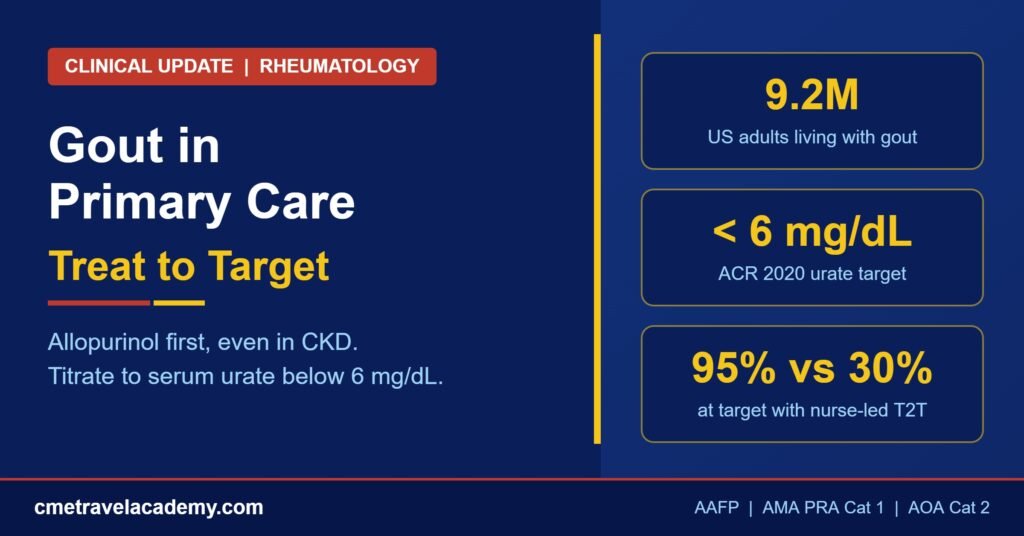
Gout is the most common inflammatory arthritis in adults, and it is almost entirely a primary care disease. About 9.2 million US adults have it, yet only about one in three takes urate-lowering therapy, according to NHANES data published in Arthritis & Rheumatology. Many get a prednisone burst, feel better, and never reach a urate target. Gout travels with the conditions we manage every day, including hypertension, CKD, diabetes, and heart failure, and the fix is cheap and well proven. This post covers gout management in primary care the way the evidence supports it: treat to target, start low and go slow with allopurinol, and protect the heart and kidneys along the way. Want accredited CME on gout itself? It is available through Custom CME, CME Live: Your Location, and our online on-demand courses.
The Clinical Context: Gout Is a Cardiometabolic Disease
Gout is better understood as a marker of cardiometabolic risk than as a joint problem. A large case-control and self-controlled study in JAMA (Cipolletta et al., 2022) found that patients who had a cardiovascular event were nearly twice as likely to have had a gout flare in the prior 60 days (adjusted odds ratio 1.93), with the risk still elevated at 61 to 120 days (OR 1.57).
Hyperuricemia also clusters with reduced kidney function, diuretic use, insulin resistance, and excess weight. That overlap is why gout belongs in the same conversation as the cardiovascular-kidney-metabolic (CKM) syndrome and the four pillars of kidney protection.
Key Guideline Updates: What the ACR Asks of Primary Care
The backbone remains the 2020 American College of Rheumatology Guideline for the Management of Gout (FitzGerald et al.), summarized on the ACR gout guideline page. Its core message: dose urate-lowering therapy (ULT) to a number, not a fixed dose.
Who should start urate-lowering therapy
- ✓ Strongly recommended: one or more subcutaneous tophi, radiographic damage from gout, or frequent flares (2 or more per year).
- ✓ Conditionally recommended: more than one prior flare but fewer than 2 per year.
- ✓ After a first flare: ULT is generally not advised, except when the patient has CKD stage 3 or worse, serum urate above 9 mg/dL, or kidney stones.
How to treat
Allopurinol is the preferred first-line agent for all patients, including those with CKD stage 3 or higher. Start low (no more than 100 mg daily, and lower in CKD) and titrate to a serum urate below 6 mg/dL. Give anti-inflammatory prophylaxis with colchicine, an NSAID, or low-dose prednisone for 3 to 6 months when ULT begins. Starting ULT during a flare is acceptable. Test for HLA-B*5801 before allopurinol in patients of Southeast Asian descent (for example Han Chinese, Korean, or Thai) and in African American patients, who carry a higher risk of severe hypersensitivity.
When feasible, switch hydrochlorothiazide to another antihypertensive, favor losartan for its modest uricosuric effect, and keep indicated low-dose aspirin.
Treat to target works, especially with a team
In a randomized trial in The Lancet (Doherty et al., 2018), 517 patients received nurse-led education with treat-to-target ULT or usual GP care. At 2 years, 95% of the nurse-led group had a serum urate below 6 mg/dL versus 30% with usual care, and flares and tophi also favored the nurse-led group. In the VA STOP Gout trial in NEJM Evidence (O’Dell et al., 2022), 80% of 940 participants reached target with either allopurinol or febuxostat, and allopurinol was noninferior for flare control, including in stage 3 CKD. The lesson for internal medicine CME and family medicine CME alike: a protocol and follow-up schedule matter more than the drug.
Where to Earn CME on Gout, and the Conditions That Travel With It
Gout is offered through Custom CME, CME Live: Your Location, and our online on-demand library. The comorbidities that drive gout are the backbone of our Las Vegas CME conference at Caesars Palace on December 18-19, 2026, with the same agenda again on April 2-3, 2027: hypertension, CKD, type 2 diabetes, obesity, heart failure, and more. Earn 12 AMA PRA Category 1 Credits including 1 hour of Ethics in two morning sessions, then enjoy the Strip every afternoon. Registration is $995 per clinician, with discounts for military, resident physicians, and students. Or join us for February 2027 CME in New Orleans on February 19-20.
✓ 12 CME hours including 1 hour of Ethics
✓ Mornings only, 7:30 am to 1:30 pm, afternoons free
✓ 12-month spaced-repetition curriculum and one-page point-of-care references
Allopurinol or Febuxostat? The Cardiovascular Question
The CARES trial in NEJM (White et al., 2018) randomized 6,190 patients with gout and established cardiovascular disease. Febuxostat was noninferior to allopurinol for major adverse cardiovascular events, but all-cause death (hazard ratio 1.22) and cardiovascular death (HR 1.34) were higher with febuxostat. The FDA added a boxed warning to the febuxostat prescribing information in 2019 and limited it to patients who cannot take or do not respond to allopurinol. The European FAST trial in The Lancet (Mackenzie et al., 2020), with 6,128 older patients, found no excess cardiovascular events or deaths with febuxostat (HR 0.85). The practical answer: allopurinol first, with febuxostat as a second line after a risk discussion.
A bonus from SGLT2 inhibitors
SGLT2 inhibitors lower serum urate. In a cohort of 295,907 adults with type 2 diabetes in the Annals of Internal Medicine (Fralick et al., 2020), new users of an SGLT2 inhibitor had a 36% lower rate of incident gout than new users of a GLP-1 receptor agonist (HR 0.64). It is not an indication on its own, but it is another reason to reach for an SGLT2 inhibitor in patients with diabetes, CKD, or heart failure who also have gout.
Practice Pearls: Dosing That Gets Patients to Target
- Allopurinol: start 100 mg daily (50 mg in CKD stage 4 or worse). Increase by 100 mg every 2 to 5 weeks (50 mg steps in CKD) until serum urate is below 6 mg/dL. The FDA maximum is 800 mg daily, and doses above the old creatinine clearance limits are acceptable when titrated slowly.
- Flare prophylaxis: colchicine 0.6 mg once or twice daily for 3 to 6 months after starting ULT, adjusted for kidney function and CYP3A4 inhibitors such as clarithromycin.
- Acute flare: low-dose colchicine (1.2 mg, then 0.6 mg an hour later), an NSAID, or a short course of oral prednisone. Do not stop ULT during a flare.
- Monitoring: check serum urate every 2 to 5 weeks during titration, then every 6 months once at goal.
Frame ULT like a statin: a daily, long-term medicine that prevents damage patients cannot see. Limiting alcohol, sugary drinks, and organ meats helps, but rarely reaches target alone. Clinics that want a nurse-led titration protocol can build one through our value-based care program for chronic disease.
Top 5 Takeaways
- Treat to a number. Titrate ULT to a serum urate below 6 mg/dL, not to a fixed dose.
- Allopurinol first, including in CKD stage 3 or higher. Start low and go slow.
- Prevent the titration flare with 3 to 6 months of colchicine or another anti-inflammatory.
- Screen for HLA-B*5801 in Southeast Asian and African American patients before allopurinol.
- Think cardiometabolic. Flares raise short-term cardiovascular risk, so manage blood pressure, kidneys, and diabetes alongside the urate.
Gout FAQ
What is the target serum urate for gout?
The 2020 ACR guideline recommends titrating urate-lowering therapy to a serum urate below 6 mg/dL for most patients with gout.
Can I use allopurinol in patients with CKD?
Yes. Allopurinol is first line even in CKD stage 3 or worse. Start at a lower dose and titrate slowly while checking urate and kidney function.
Should I start urate-lowering therapy during a flare?
The ACR conditionally supports starting ULT during a flare, with anti-inflammatory coverage, rather than waiting until the flare resolves.
Is febuxostat safe in patients with heart disease?
CARES found higher cardiovascular and all-cause death with febuxostat, which carries an FDA boxed warning. FAST was reassuring, but allopurinol remains preferred in patients with cardiovascular disease.
Bring It Back to Your Practice
Gout management in primary care comes down to a target, a titration plan, and a follow-up visit. For CME on gout itself, choose Custom CME for your group, CME Live: Your Location, or our online on-demand courses. For the chronic diseases that travel with gout (hypertension, CKD, diabetes, heart failure), join us in person for December 2026 CME in Las Vegas, February 2027 CME in New Orleans, or April 2027 CME back in Las Vegas. Each is a true CME vacation: 12 AMA PRA Category 1 Credits (AAFP Prescribed, AOA Category 2), mornings of learning, and afternoons that are yours. Planning CME travel with the family? Our Walt Disney World conference returns July 30-31, 2027. You can also earn credits from home with CME Live: Your Location, or as a team with group CME for your clinic.