
By Dr. Anush S. Pillai, DO, FAAFP | Reviewed by CME Travel Academy Faculty
7 min read · Reviewed November 2026
No single intervention in primary care does more for heart, lung, kidney, and vascular outcomes than helping a patient stop smoking. Tobacco still causes nearly half a million deaths in the United States every year, according to the CDC, and most adults who smoke say they want to quit. Yet many visits end with brief advice and no prescription. The evidence has moved well past “just try the patch.” Varenicline is now the preferred first-line drug, combination therapy beats monotherapy, and a new medication, cytisinicline, has completed phase 3 trials and is working its way back through the FDA after a manufacturing-related setback in June 2026. This post walks family medicine and internal medicine clinicians through what works today, with dosing you can use at your next visit. Smoking drives many of the conditions taught at our primary care CME conferences, from COPD and chronic coronary disease to CKD and hypertension.
The Clinical Context: A Grade A Service We Underdeliver
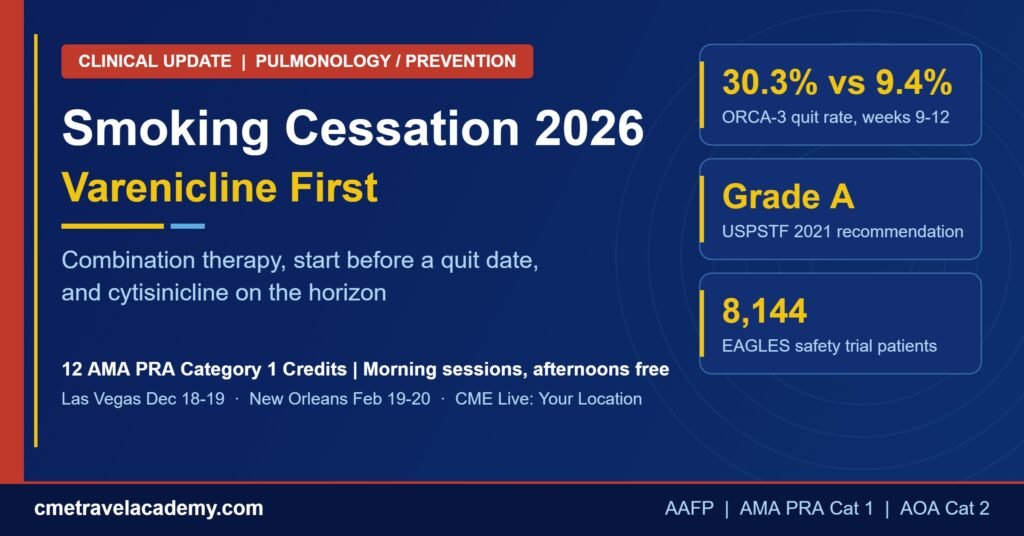
The 2021 USPSTF recommendation on tobacco cessation gives a Grade A to asking every adult about tobacco use, advising them to stop, and offering both behavioral support and FDA-approved pharmacotherapy to nonpregnant adults who smoke. For pregnant patients, behavioral intervention is Grade A, while the evidence on pharmacotherapy is insufficient (an I statement). The Task Force also found insufficient evidence to recommend e-cigarettes as a cessation tool, which matters when patients ask whether switching to vaping counts as quitting.
The gap is not knowledge but follow-through. Counseling plus medication roughly doubles to triples the odds of quitting compared with willpower alone, and the combination works better than either piece by itself. Even three minutes of counseling is billable (CPT 99406 for 3 to 10 minutes, 99407 for more than 10), and a warm handoff to the free quitline at 1-800-QUIT-NOW adds structured follow-up without adding visit time.
Key Guideline Updates: Varenicline First, and Start Now
The most practice-shaping document remains the American Thoracic Society clinical practice guideline on initiating pharmacologic treatment in tobacco-dependent adults (Leone et al., 2020). Its recommendations are clear and practical:
- Varenicline over the nicotine patch, and varenicline over bupropion, for adults starting treatment.
- Varenicline plus the patch over varenicline alone (conditional).
- Varenicline over e-cigarettes as a cessation aid (conditional).
- Start varenicline now, even in patients not yet ready to quit, rather than waiting for a quit date.
- Extended treatment beyond 12 weeks over the standard 6 to 12 week course.
- Varenicline for patients with psychiatric conditions, including depression, anxiety, schizophrenia, and substance use disorders.
Cardiology agrees. The 2018 ACC Expert Consensus Decision Pathway on tobacco cessation treats tobacco use as a chronic, relapsing condition and endorses varenicline and combination nicotine replacement therapy (NRT) as first-line options in patients with cardiovascular disease.
Neuropsychiatric safety is settled
Many clinicians still hesitate over varenicline because of the old boxed warning. The EAGLES trial in The Lancet randomized 8,144 adults, about half with a psychiatric diagnosis, and found no significant increase in neuropsychiatric adverse events with varenicline or bupropion compared with the patch or placebo. Varenicline produced the highest quit rates. The FDA removed the boxed warning in December 2016. Monitor mood as you would with any patient making a big change, but do not withhold the most effective drug.
Conference Spotlight: December 2026 CME at Caesars Palace
The conditions smoking makes worse are the backbone of our Las Vegas CME conference at Caesars Palace on December 18-19, 2026 (same agenda April 2-3, 2027): COPD, chronic coronary disease, heart failure, hypertension, CKD, type 2 diabetes, and more. Earn 12 AMA PRA Category 1 Credits including 1 hour of Ethics in two morning sessions, with afternoons free on the Strip. Registration is $995, and during the Thanksgiving and Cyber Monday Sale (November 26-30, 2026) the December dates drop to $895. Military and resident discounts apply. Prefer jazz to blackjack? Our February 2027 CME in New Orleans runs February 19-20. Staying home? CME Live: Your Location delivers the same credits by livestream.
✓ 12 CME hours including 1 hour of Ethics
✓ Mornings only, 7:30 am to 1:30 pm, afternoons free
✓ 12-month spaced-repetition curriculum and one-page point-of-care references
What’s Next: Cytisinicline and the ORCA-3 Trial
Cytisinicline is a plant-derived partial agonist at the same nicotinic receptor that varenicline targets, and it has been used for decades in parts of Europe. The phase 3 ORCA-3 trial in JAMA Internal Medicine (Rigotti et al., 2025) randomized 792 adults at 20 US sites to 3 mg three times daily for 6 or 12 weeks, or placebo, all with behavioral support. Biochemically verified abstinence in weeks 9 to 12 was 30.3% with the 12-week course versus 9.4% with placebo (odds ratio 4.4). Continuous abstinence through week 24 was 20.5% versus 4.2%. There were no treatment-related serious adverse events.
In June 2026 the FDA issued a complete response letter for cytisinicline, citing manufacturing inspection findings at a third-party facility and incomplete labeling rather than efficacy or safety concerns, according to the sponsor. Achieve Life Sciences has said it plans to resubmit in the fourth quarter of 2026, which could put a decision in the first half of 2027. It is not available in US pharmacies yet, so keep your patients on proven therapy now and watch for it next year.
Practice Pearls: Dosing That Works
- Varenicline: 0.5 mg daily on days 1 to 3, 0.5 mg twice daily on days 4 to 7, then 1 mg twice daily for 12 weeks. Add another 12 weeks for patients who quit. Reduce to a maximum of 0.5 mg twice daily if creatinine clearance is below 30 mL/min. Take with food and water to limit nausea.
- Combination NRT: a 21 mg patch for patients smoking more than 10 cigarettes a day, plus a short-acting gum, lozenge, or inhaler for cravings. Underdosing is the most common reason NRT fails.
- Bupropion SR: 150 mg daily for 3 days, then twice daily, starting 1 to 2 weeks before the quit date. Avoid in seizure disorders and eating disorders.
Cessation is also a door to prevention. Adults 50 to 80 with a 20 pack-year history who smoke now or quit within 15 years qualify for annual low-dose CT under the USPSTF lung cancer screening recommendation. Patients with COPD, peripheral artery disease, or a prior stroke gain the most from quitting, so connect the conversation to the diagnoses covered in our posts on GOLD 2026 COPD guidelines, peripheral artery disease in primary care, and stroke secondary prevention. Clinics building a team-based cessation workflow can see our value-based care program for chronic disease.
Top 5 Takeaways
- Treat every adult who smokes. USPSTF gives counseling plus FDA-approved medication a Grade A.
- Lead with varenicline, and add a nicotine patch when you want more effect.
- Do not wait for readiness. Starting varenicline before a quit date is guideline-endorsed.
- Psychiatric illness is not a contraindication. EAGLES settled the safety question.
- Watch for cytisinicline. ORCA-3 showed strong quit rates, and an FDA decision could come in 2027.
Smoking Cessation FAQ
What is the first-line medication for smoking cessation in primary care?
The ATS recommends varenicline over the nicotine patch and over bupropion, and suggests adding the patch to varenicline for greater effect.
Is varenicline safe in patients with depression or other psychiatric conditions?
Yes. The EAGLES trial found no significant increase in neuropsychiatric adverse events, and the FDA removed the boxed warning in 2016.
Is cytisinicline FDA approved?
Not yet. The FDA issued a complete response letter in June 2026 citing manufacturing and labeling issues, and the sponsor plans to resubmit in late 2026.
Should I recommend e-cigarettes to help patients quit?
The USPSTF found insufficient evidence for e-cigarettes as a cessation tool, and the ATS suggests varenicline over e-cigarettes. Offer FDA-approved medication and counseling first.
Bring It Back to Your Practice
Smoking cessation in primary care works best as a routine, not a speech: ask, prescribe, follow up, and repeat. To earn accredited family medicine CME and internal medicine CME on the chronic diseases tobacco makes worse, join us for December 2026 CME in Las Vegas, February 2027 CME in New Orleans, or April 2027 CME back in Las Vegas. Each is a true CME vacation: 12 AMA PRA Category 1 Credits, AAFP Prescribed and AOA Category 2, two mornings of learning, and afternoons that are yours. CME travel with the family? Our Walt Disney World conference returns July 30-31, 2027. You can also earn credits from home with CME Live: Your Location, at your own pace in our online on-demand courses, or as a team with group CME for your clinic.