
By Dr. Anush S. Pillai, DO, FAAFP | Reviewed by CME Travel Academy Faculty
7 min read · Reviewed September 2026
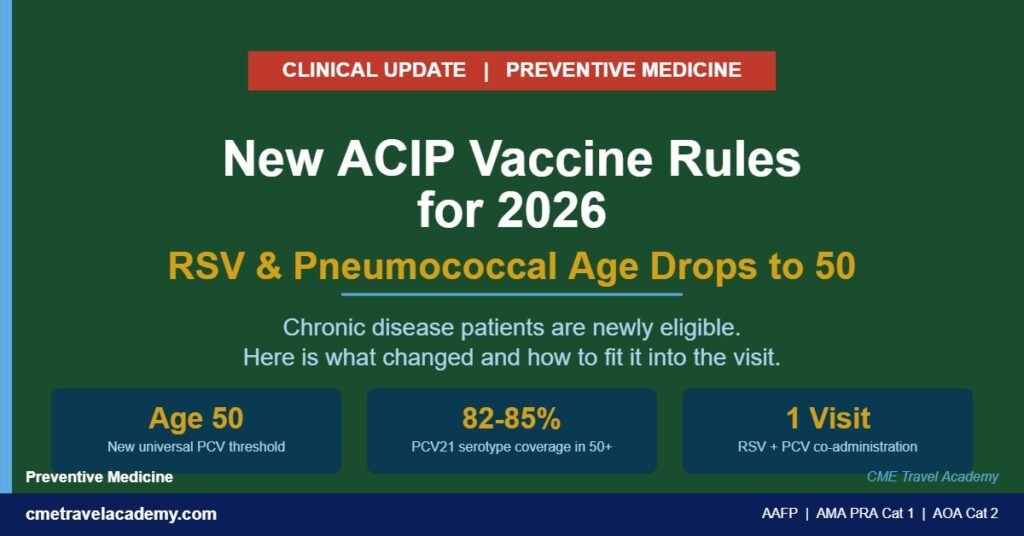
Two of the most consequential adult immunization updates in years arrived quietly in 2025, and most primary care visits still are not capturing them. The Advisory Committee on Immunization Practices lowered the age threshold for universal pneumococcal conjugate vaccination from 65 to 50, and separately expanded risk based RSV vaccination down to age 50. Neither change made headlines the way a new GLP-1 indication does, but both land squarely on the patients who fill a typical primary care panel: adults with diabetes, heart failure, COPD, and chronic kidney disease, all of whom carry a materially higher risk of severe outcomes from both pathogens. This piece walks through what changed, who now qualifies, which vaccine to reach for, and how to fold the conversation into a visit that is already full.
Why Vaccination Status Deserves a Second Look in Chronic Disease Care
Adults with chronic cardiopulmonary, renal, and metabolic disease are not just more likely to catch RSV or invasive pneumococcal disease. They are far more likely to be hospitalized or die from it. CDC surveillance data show that hospitalization risk for medically attended RSV illness rises sharply in adults with COPD, asthma, heart failure, diabetes, chronic kidney disease, chronic liver disease, immunocompromising conditions, and severe obesity. Pneumococcal disease follows a similar pattern: the same comorbidities that bring patients back for a hypertension or CKD follow up are the ones that convert a routine pneumonia into an ICU admission. That overlap is exactly why this update matters more to a primary care panel than to the general population, and it is worth building into the same visit where you are already reviewing a patient’s chronic kidney disease four pillars or heart failure GDMT.
RSV Vaccination: The Age Threshold Just Moved Again
Since 2023, RSV vaccination in adults has expanded age band by age band. Adults 75 and older were the first group recommended for a single dose. Adults 60 to 74 with qualifying risk conditions followed. On April 16, 2025, the Advisory Committee on Immunization Practices voted to extend the same risk based recommendation down to adults 50 to 59, using the identical qualifying conditions already in place for the 60 to 74 group (see the CDC’s RSV vaccine guidance for adults).
The qualifying risk conditions are broad enough to capture a large share of a chronic disease panel: chronic cardiovascular disease including heart failure and coronary artery disease, chronic lung or respiratory disease including COPD and moderate to severe asthma, end stage renal disease or dialysis dependence, diabetes complicated by chronic kidney disease, neuropathy, retinopathy, or other end organ damage, or requiring insulin or an SGLT2 inhibitor, neurologic or neuromuscular conditions that impair airway clearance, chronic liver disease, chronic hematologic conditions, severe obesity with BMI of 40 or higher, moderate or severe immune compromise, and residence in a nursing home. A 50 year old with insulin dependent type 2 diabetes and stage 3 CKD now qualifies for RSV vaccination on the same visit where you might be titrating an SGLT2 inhibitor.
Two practical points worth flagging to patients and colleagues. First, RSV vaccination is currently a single dose with no booster recommended, so once a patient has received it, the conversation is closed unless ACIP revisits dosing. Second, ACIP has not yet issued a recommendation for adults 18 to 49, even though the FDA has approved use of Pfizer’s Abrysvo and Moderna’s mResvia in that age group for patients at increased risk. That gap is expected to be revisited at a future ACIP meeting, so it is worth a mental placeholder rather than a hard rule.
Pneumococcal Vaccination: Universal Coverage Now Starts at 50
The pneumococcal update is, if anything, the bigger practice changer. In October 2024, ACIP voted to lower the age for universal, risk independent pneumococcal conjugate vaccination from 65 to 50, and the recommendation was finalized in the January 9, 2025 MMWR (Kobayashi et al., MMWR Morb Mortal Wkly Rep. 2025;74(1):1-8). Any PCV naive adult 50 or older, regardless of health status and regardless of an unclear prior vaccination history, now qualifies for a single dose. The CDC’s pneumococcal vaccine recommendations page lays out the updated schedule in full.
In practice, that single dose is PCV15, PCV20, or PCV21. If PCV15 is used, a dose of PPSV23 is needed one year later to complete the series. If PCV20 or PCV21 is used, no additional dose is needed; vaccination is complete. The two newer conjugate vaccines are not interchangeable in coverage. PCV21 (Capvaxive) was designed around the serotypes actually causing invasive disease in adults and covers roughly 82 percent of invasive pneumococcal disease in adults 50 and older in national surveillance data, compared with roughly 54 percent for PCV20. PCV21 carries eleven serotypes not found in PCV20, responsible for roughly 37 percent of invasive disease in this age group, while PCV20 carries nine serotypes not in PCV21 responsible for roughly 8 percent. There are no head to head efficacy trials between the two, so this is a coverage comparison rather than a proven clinical outcome difference, but it is a reasonable tiebreaker when a patient has no strong reason to prefer one product.
For adults 19 to 49 with qualifying risk conditions, chronic heart, lung, liver, or kidney disease, diabetes, alcoholism, smoking, cochlear implant, cerebrospinal fluid leak, or immunocompromise, the pneumococcal recommendation is unchanged from the prior risk based schedule. The 2024-2025 update did not touch that younger risk based group; it only expanded the universal, no questions asked recommendation at the top of the age range.
Fitting Both Into an Already Full Visit
The operational win here is that RSV and pneumococcal vaccines can be co-administered at the same visit with no minimum interval required, and both can be given alongside influenza and COVID-19 vaccination during the same fall visit where you are already discussing seasonal illness. For a 55 year old with COPD and hypertension who has never had a pneumococcal vaccine, one well organized visit can close both gaps: a single PCV dose plus a single RSV dose, done.
A workflow that has worked well in practices we have trained through our primary care CME courses is to build vaccination status into the same chronic disease review template already used for A1c, blood pressure, and renal function checks, so the prompt appears automatically rather than depending on memory during a fifteen minute visit.
Conference Spotlight
New York City CME Conference
October 12-13, 2026 · Hyatt Centric Times Square · 12 AMA PRA Category 1 Credits™
Bring your team up to speed on the guidelines that actually change Monday’s visits, alongside heart failure, diabetes, CKD, COPD, and hypertension sessions. Morning sessions only, afternoons free to explore the city. Registration is $995 per clinician, with $100 off for military and veterans and $200 off for resident physicians. Can’t travel that week? The same faculty and same 12 credits are available through CME Live: Your Location from wherever you are.
View New York City Conference Details →Documentation and the Conversation Itself
A short, direct framing tends to work better than a lengthy risk explanation. For a patient with COPD or heart failure, something close to “your lung disease puts you at higher risk of being hospitalized if you catch pneumonia or RSV, and there are now vaccines that lower that risk significantly” covers the clinical rationale in one sentence. Documentation should capture the specific risk condition driving eligibility, not just “chronic disease,” the product given (PCV20 vs. PCV21 vs. the PCV15/PPSV23 sequence), and the date, since state immunization registries and future ACIP updates may hinge on knowing exactly which product a patient received.
For patients who are vaccine hesitant, it is worth noting that RSV vaccination remains a single dose with a well established safety record now several years into post-marketing surveillance, and that pneumococcal conjugate vaccines have decades of use in the pediatric and adult populations behind them. Neither is a new technology in the way mRNA vaccines were in 2021; both are incremental expansions of long-standing vaccine platforms into a broader age range.
Top 5 Takeaways
- Universal pneumococcal vaccination now starts at age 50, not 65. Any PCV naive adult 50 or older qualifies for a single dose regardless of health status.
- RSV risk based vaccination now extends to age 50. The qualifying conditions (COPD, heart failure, diabetes with end organ damage or insulin/SGLT2i use, CKD, chronic liver disease, immunocompromise, severe obesity) are the same ones already used for the 60 to 74 age band.
- PCV21 covers a substantially broader share of invasive pneumococcal disease serotypes in adults 50 and older than PCV20 in national surveillance data, though no head to head efficacy trial exists between the two.
- RSV and pneumococcal vaccines can be co-administered at the same visit as each other and alongside influenza and COVID-19 vaccination, with no minimum interval required.
- Ages 19 to 49 with chronic disease risk factors remain on the prior risk based pneumococcal schedule, and ACIP has not yet issued an RSV recommendation for adults under 50.
Conclusion
Vaccination status is one of the few chronic disease interventions that takes under two minutes to deliver and prevents a hospitalization outright rather than just lowering a number on a lab panel. With both the RSV and pneumococcal age thresholds now at 50, a large share of any primary care or internal medicine panel became newly eligible sometime in the last eighteen months, often without the patient or the chart flagging it. Building a five second vaccination check into the same visit template used for chronic disease management closes that gap without adding a separate appointment.
If you want the full guideline-to-clinic breakdown, along with the other 2025-2026 updates reshaping chronic disease management, join us at the New York City CME Conference this October, our Las Vegas CME Conference December 18-19, 2026, or our New Orleans CME Conference February 19-20, 2027. All three conferences award 12 AMA PRA Category 1 Credits, including a dedicated Ethics hour, are AAFP Prescribed and AOA Category 2 accredited, and include our 12-month spaced repetition curriculum so the material sticks well past the conference itself. Prefer to stay home? CME Live: Your Location delivers the identical sessions and credit from wherever you are, and our Online On-Demand CME library is available anytime for self-paced learning.
Related CME Articles