By Dr. Vimal George, MD | Reviewed by CME Travel Academy Faculty · 7 min read · Reviewed June 2026
Accredited CME: ✓ AMA PRA Category 1 Credit™ ✓ AAFP Prescribed ✓ AOA Category 2 ✓ 12 Credits per Conference
Most clinicians choose a CME provider the way they pick a flight: by price and date. But the provider you pick decides far more than what a weekend costs. It decides whether your credit is actually accepted by your board, whether the content reflects this year’s guidelines or last decade’s, whether the learning survives past the closing slide, and whether your documentation will clear the new real-time reporting systems at renewal. This is a buyer’s guide to choosing the best CME provider in 2026 — the questions to ask, the red flags to avoid, and an honest account of where CME Travel Academy fits. If you already know you want the destination-by-destination rundown, our roundup of the top CME conferences of 2026 is the place to start; this article is about choosing the provider, not the city.
What “Best” Actually Means When You’re Buying CME
There is no single best CME provider for everyone, because clinicians are buying different things. A hospitalist closing an ABIM cycle needs Maintenance of Certification points. A family physician three weeks from a Texas renewal needs an ethics hour and clean documentation that will upload to a tracking system. A new mother who hasn’t taken a real vacation in two years needs mornings of high-yield teaching and afternoons that are genuinely free. The right question is not “who is best?” but “best at what, for whom?” Once you frame it that way, five criteria do most of the sorting: accreditation and accepted credit, freedom from commercial bias, currency of content, retention design, and the quality of the paperwork you walk away with.
The Five Questions to Ask Any CME Provider
1. Is the credit accredited — and accepted by your board?
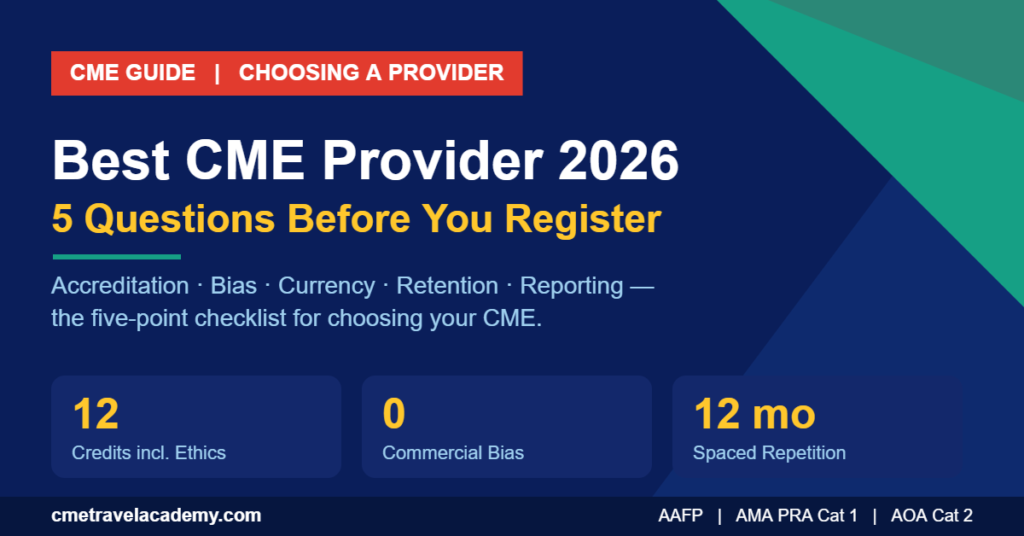
This is the non-negotiable first filter. Credit that isn’t accredited through the ACCME system (or, for family medicine, the AAFP credit system) may not count where it matters. Look for AMA PRA Category 1 Credit™, which is the common currency accepted by virtually every state medical board and by ABFM and ABIM for their continuing-certification requirements. Family physicians should confirm AAFP Prescribed credit, which the AMA accepts as equivalent to AMA PRA Category 1 Credit™ for the Physician’s Recognition Award. Osteopathic physicians should check for AOA Category 2. NPs and PAs can typically apply AMA PRA Category 1 Credit™, with recognition by ANCC, AANP, and AAPA varying by board — always verify with yours. CME Travel Academy is accredited through the AAFP and designates AAFP Prescribed, AMA PRA Category 1 Credit™, and AOA Category 2; the full credit statement spells out exactly what each activity carries.
2. Who pays the provider — pharma, or you?
Commercial support is legal and disclosed, but it shapes what gets taught and what gets emphasized. The cleanest signal of a high-integrity provider is one that takes no industry money at all. CME Travel Academy is 100% commercial-bias-free — no pharma funding, no sponsored sessions, no industry-written content. When the only people paying the faculty are the clinicians in the room, the incentive is to teach what works, including the generic and the “do nothing” option, not what sells.
3. Is the content actually current?
Guidelines move fast. In the last 18 months alone we’ve seen the 2025 AHA/ACC hypertension overhaul, the 2026 ADA and AACE diabetes updates, GINA 2026 for asthma, and KDIGO’s reframing of chronic kidney disease. A great provider rebuilds its curriculum to the current release and ties recommendations back to the landmark trials and effect sizes — number-needed-to-treat, not opinion. Ask when the deck was last revised. “This year” should be the only acceptable answer.
4. Will you remember any of it in March?
Most clinicians forget the majority of conference content within weeks — a well-documented problem with passive lectures. The providers worth paying for engineer against that. CME Travel Academy includes 12 months of spaced-repetition reinforcement after every program, plus one-page point-of-care references built to be opened in clinic on Monday rather than filed and forgotten. Retention design is the difference between credit you earned and knowledge you kept.
5. Does the documentation survive 2026’s reporting rules?
This one is new and underrated. As states move to real-time tracking and pre-verification at renewal, the certificate matters as much as the credit. A provider that hands you clean, category-coded documentation you can upload to CE Broker or your board portal is now a meaningfully better choice than one that emails a vague PDF. We covered this shift in depth in the new CME reporting rules for 2026 — and it’s a big reason “best provider” increasingly means “best paperwork.”
How CME Travel Academy Scores on All Five
Accredited AAFP Prescribed, AMA PRA Category 1 Credit™, and AOA Category 2 — 12 credits per conference, including a 1-hour Ethics session. Zero commercial bias. Curriculum rebuilt to 2025–2026 guidelines. 12 months of spaced repetition and one-page references included free. Clean, category-coded certificates ready to report. Taught by actively practicing physicians — Dr. Vimal George (UT Dell Medical School faculty) and Dr. Anush Pillai (residency director, Harris County AFP President).
Match the Format to How You Actually Work
The best provider for you also offers the format that fits your life, because the credit is identical across all of them. If you want to travel, the in-person conferences deliver 12 hours over two mornings at destinations like Walt Disney World (July 17–18, 2026) and New York City (October 12–13, 2026), from $895. If you’d rather earn from your office or kitchen, CME Livestream carries the same live faculty and Live CME certificate ($695 for 5 hours, $995 for 12). Prefer self-paced? The online on-demand library runs $395–$895. Need something built around your own dates and topics? Custom CME™ starts at $995 and is available for individuals or groups, including residency programs. Resident, military, and student discounts apply across the board.
Where to Go Next — Destinations vs. Provider
Choosing a provider answers “who should I learn from?” Choosing a conference answers “where and when?” They’re different decisions, and we keep them on separate pages on purpose. Once you’ve settled on a provider you trust, head to our definitive, regularly updated guide to the top CME conferences of 2026 for the full destination lineup — Disney World, New York City, Las Vegas, and more — with dates, pricing, and what each city offers after the morning sessions. That post is the authority on the “where”; this one is your checklist for the “who.”
The Bottom Line
The best CME provider in 2026 isn’t the cheapest tab or the prettiest city — it’s the one whose credit your board accepts, whose content is current and bias-free, whose learning sticks, and whose documentation clears modern reporting systems. Run any provider through the five questions above and the field narrows quickly. CME Travel Academy was built to answer all five with a yes: accredited AAFP Prescribed, AMA PRA Category 1 Credit™, and AOA Category 2, 12 credits per conference including Ethics, zero commercial bias, guideline-current curriculum, 12-month retention, and report-ready certificates. Explore the 2026 conferences, earn from anywhere with Livestream, start today with on-demand courses, or design your own with Custom CME™ (individuals or groups, from $995).