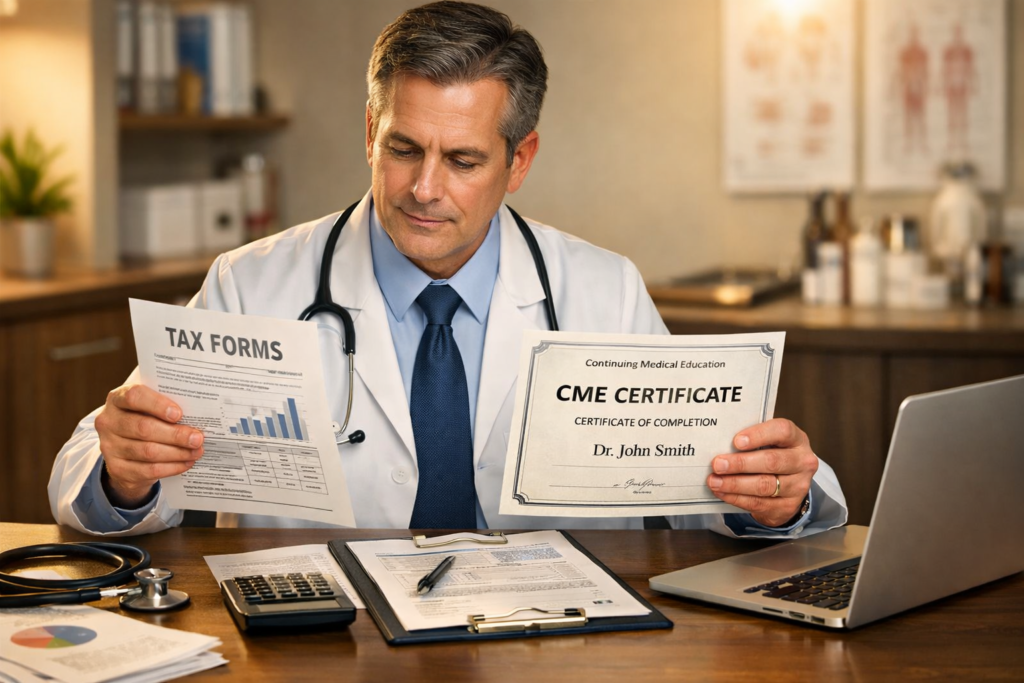
If you’re a physician, nurse practitioner, or physician assistant attending continuing medical education conferences or completing online CME courses, you may be leaving money on the table at tax time. CME expenses are among the most legitimate — and most overlooked — tax deductions available to healthcare professionals.
This guide breaks down exactly what qualifies as a CME tax deduction in 2026, what records you need to keep, and how to make the most of your annual CME investment.
Disclaimer: This article is for informational purposes only and does not constitute tax or legal advice. Consult a qualified tax professional or CPA regarding your specific situation.
Is CME Tax Deductible?
The short answer is yes — for most physicians, CME expenses are tax deductible. However, how you deduct them depends on your employment status.
Self-employed physicians, independent contractors, and LLC owners (including those with their own practice or who receive 1099 income) can deduct CME expenses directly as a business expense on Schedule C of their federal tax return. This is the most straightforward and advantageous scenario.
Employed physicians (W-2 employees) have a more limited path since the Tax Cuts and Jobs Act of 2017 eliminated the employee business expense deduction for most W-2 workers through 2025. However, if your employer reimburses CME expenses through an accountable plan or educational assistance program, those reimbursements are generally tax-free up to $5,250 per year under IRS Section 127.
Physicians with both W-2 and 1099 income — a common scenario — can often deduct CME expenses against their self-employment income. This is worth discussing with your CPA.
What CME Expenses Are Deductible?
For eligible physicians, the following CME-related expenses generally qualify as deductions:
1. Conference Registration Fees
The cost of registering for an accredited CME conference is deductible as an education expense directly related to maintaining your professional license and skills. This includes live in-person conferences, livestream options, and custom CME programs.
2. Online CME Courses
Fees paid for online on-demand CME courses are deductible as professional education expenses. This includes subscription-based platforms and individual course purchases.
3. Airfare and Transportation
Round-trip airfare to and from a CME conference is deductible when the primary purpose of the trip is the conference. Ground transportation — including taxis, rideshares, and rental cars — used for conference-related travel also qualifies.
4. Hotel and Lodging
Lodging expenses during the conference are deductible for the nights required for conference attendance. If you extend your stay for personal reasons, only the conference-related nights qualify.
5. Meals (50% Deductible)
Meals during conference travel are deductible at 50% of the actual cost. Keep receipts and note the business purpose.
6. CME Materials and Resources
Books, journals, reference materials, and point-of-care tools purchased for professional development are generally deductible. This includes subscriptions to medical journals and clinical decision support tools.
7. Professional Dues and Licensing Fees
While not strictly CME, annual dues to professional organizations like the AMA, AAFP, or specialty societies — which often bundle CME — are deductible professional expenses.
What Is NOT Deductible
Not every expense associated with a CME trip qualifies. The IRS draws a clear line between professional and personal expenses:
- Personal vacation days added before or after the conference — non-deductible
- Spouse or family travel expenses — non-deductible unless they are also a qualifying healthcare professional attending the same conference
- Entertainment and leisure activities — theme park tickets, spa services, sightseeing tours
- Alcohol — generally not deductible even at conference meals
- Expenses for CME that qualifies you for a new profession — deductible CME must maintain or improve skills in your current profession, not train you for a new one
The “Primary Purpose” Rule for Conference Travel
This is where physicians often get tripped up. The IRS requires that the primary purpose of a trip be business-related for travel expenses to be deductible. If you attend a 2-day CME conference and spend 5 days at the beach, the IRS may scrutinize whether the trip was primarily personal.
Best practice: Keep documentation showing your conference agenda, attendance records, and CME certificate. The fact that you earned accredited CME credits is strong evidence of business purpose.
The good news — CME Travel Academy conferences are specifically designed with this in mind. Our half-day format means mornings are dedicated to accredited education, while afternoons are free to explore — giving you both legitimate CME documentation and time to enjoy the destination.
How to Document Your CME Deductions
Good recordkeeping is essential. For each CME expense, retain:
- Registration confirmation and receipt
- CME certificate of completion showing credit hours earned
- Conference agenda showing scheduled educational sessions
- Receipts for travel, lodging, and meals
- Credit card or bank statements as backup
The IRS generally requires documentation for any expense over $75, but best practice is to keep all receipts regardless of amount.
Maximizing Your CME Tax Strategy
A few additional strategies worth discussing with your CPA:
1. Bundle CME with necessary travel If you need to travel to a city for other professional reasons — a medical conference, a hospital credentialing meeting, a speaking engagement — adding CME in the same trip can make the travel expenses more clearly deductible.
2. Use a dedicated business credit card for CME expenses Keeping CME expenses on a separate business card simplifies recordkeeping and makes documentation easier at tax time.
3. Ask your employer about CME reimbursement Even W-2 physicians may have access to CME reimbursement through their employer’s education assistance program. Under IRS Section 127, up to $5,250 in employer-provided educational assistance is excludable from your taxable income annually.
4. Consider timing of CME purchases If you’re close to a fiscal year end and have remaining CME budget or deduction capacity, prepaying for next year’s conference registration before December 31 may allow you to accelerate the deduction into the current tax year.
How Much Can Physicians Actually Save?
The savings depend on your tax bracket and total CME spending. Here’s a simple illustration:
| Expense | Amount | After Deduction (37% bracket) |
|---|---|---|
| Conference registration | $995 | ~$627 net cost |
| Airfare (round trip) | $400 | ~$252 net cost |
| Hotel (2 nights) | $600 | ~$378 net cost |
| Meals (50% deductible) | $200 | ~$163 net cost |
| Total | $2,195 | ~$1,420 net cost |
A physician in the top tax bracket effectively pays about 35% less for their CME conference after deductions — making a $995 conference registration cost closer to $627 out of pocket.
Frequently Asked Questions
Can I deduct CME if my employer pays for it? No — you can only deduct expenses you personally paid. If your employer reimburses you, the reimbursement is generally tax-free but the expense is not additionally deductible.
Can NPs and PAs deduct CME expenses? Yes — the same rules apply to nurse practitioners and physician assistants. Self-employed NPs and PAs with 1099 income can deduct CME expenses on Schedule C.
What if I attend a CME conference internationally? International CME conferences follow similar rules, though the IRS applies additional scrutiny to foreign travel. The primary purpose test and documentation requirements are the same, but additional rules may apply for trips longer than a week outside the U.S.
Is the CME Travel Academy conference fee fully deductible? For eligible self-employed physicians, yes — the conference registration fee is a deductible professional education expense. Travel, lodging, and 50% of meals are separately deductible as business travel expenses.
Ready to Invest in Your CME — and Your Tax Strategy?
CME Travel Academy offers AMA PRA Category 1 accredited conferences at premier destinations including Disney World, New York City, and San Diego — all with full documentation for your tax records including registration receipts, conference agendas, and CME certificates.
Our evidence-based, physician-led conferences cover the top chronic diseases in primary care, with a one-year spaced repetition follow-up program to maximize retention. View upcoming conferences and register today.
This article is intended for informational purposes only and does not constitute tax, legal, or financial advice. Tax laws are subject to change. Consult a qualified CPA or tax attorney regarding your individual circumstances.
Links to explore for mor information:
- IRS Publication 970 — Tax Benefits for Education
- IRS Section 127 — Educational Assistance Programs
- IRS Schedule C
- AAFP CME credit information
Want to earn accredited CME while staying current? CME Travel Academy offers evidence-based, zero-commercial-bias conferences led by actively practicing physicians. Earn 12 AMA PRA Category 1 Credits™ (AAFP Prescribed, AOA Category 2) at an upcoming 2026 conference:
- Walt Disney World, Orlando — July 17–18, 2026 (from $895)
- New York City — October 12–13, 2026 (from $995)
- Las Vegas at Caesars Palace — December 18–19, 2026 (from $995)
Morning sessions only, afternoons free. View all 2026 conferences and register →