
By Dr. Anush S. Pillai, DO, FAAFP | Reviewed by CME Travel Academy Faculty
7 min read · Reviewed August 2026
Peripheral artery disease affects more than 8 million adults in the United States, yet it remains one of the most underdiagnosed atherosclerotic conditions seen in primary care. Many patients never report classic claudication, and a normal-feeling pulse on exam is not reassurance enough. The 2024 ACC/AHA/Multisociety Guideline for the Management of Lower Extremity Peripheral Artery Disease, the first comprehensive update since 2016, gives primary care physicians, nurse practitioners, and physician assistants a clearer roadmap: who to test, how to interpret an ankle-brachial index correctly, especially in patients with diabetes, and which medical therapies now carry the strongest evidence for preventing both cardiovascular and limb events. A companion 2026 ACC/AHA Performance and Quality Measures document has since sharpened exactly what payers and quality programs will expect to see documented. This article walks through what changed, what to screen for, and how to build a defensible, evidence-based PAD workflow in a busy primary care CME panel.
Why PAD Deserves a Second Look in 2026
PAD shares risk factors with coronary and cerebrovascular disease (smoking, diabetes, hypertension, dyslipidemia, chronic kidney disease, and age over 65) but is diagnosed far less consistently. Only about half of patients with PAD report classic intermittent claudication; the rest present with atypical leg symptoms or no symptoms at all, discovered only after a limb event or an incidental abnormal pulse exam. The 2024 guideline, published in Circulation and JACC by a multisociety writing committee including the ACC, AHA, AACVPR, APMA, SCAI, and the Society for Vascular Surgery among others, was built to close that gap by giving clinicians a structured, risk-factor-based case-finding strategy rather than leaving detection to chance.
It is worth being explicit about where the evidence stands: the U.S. Preventive Services Task Force still gives universal ABI screening of asymptomatic, average-risk adults an I (insufficient evidence) statement. That is not the ACC/AHA guideline’s position. The 2024 guideline recommends targeted, risk-factor-based case-finding: test adults with exertional leg symptoms, non-healing wounds, or an abnormal pulse exam, and reasonably test asymptomatic patients 65 and older, or 50 and older with diabetes, smoking history, hypertension, or dyslipidemia. That distinction protects against both under-testing high-risk patients and over-reading the USPSTF statement as a reason not to test at all.
Getting the Ankle-Brachial Index Right
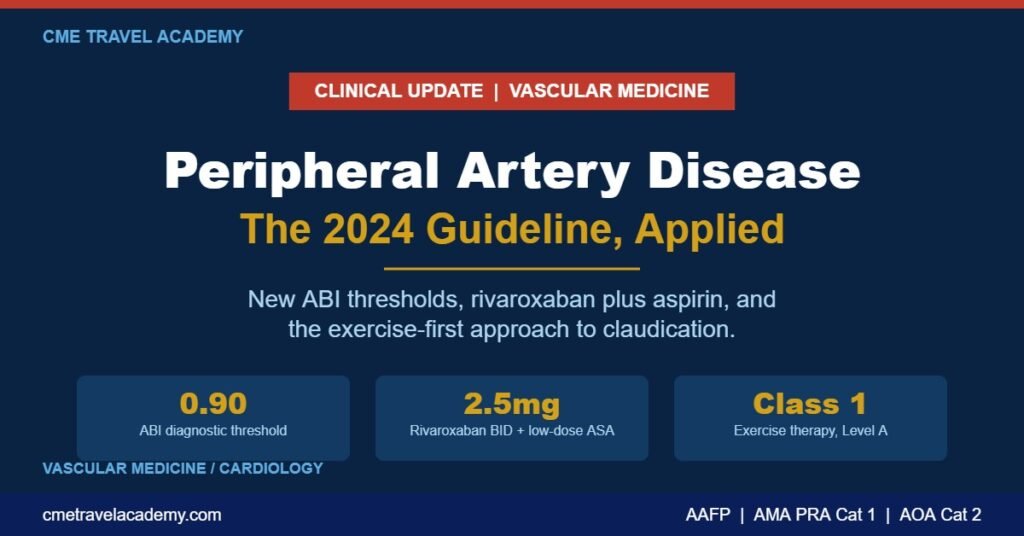
The resting ankle-brachial index remains the guideline’s Class 1 recommended first test to establish a PAD diagnosis in patients with a suggestive history or exam. An ABI of 0.90 or below is diagnostic; 0.91 to 0.99 is borderline and warrants exercise or repeat testing; 1.00 to 1.40 is normal. The detail primary care teams miss most often involves the upper end of that range: an ABI above 1.40 does not mean the vessels are healthy. It usually means they are noncompressible from medial arterial calcification, and it should trigger a toe-brachial index rather than reassurance.
This matters enormously in patients with diabetes or advanced chronic kidney disease, where calcified, noncompressible vessels can produce a falsely normal or even falsely elevated ABI despite significant underlying ischemia. The guideline is direct on this point: never rely on ABI alone in a patient with long-standing diabetes when the clinical suspicion for PAD is high. A toe-brachial index of 0.70 or below is diagnostic and should prompt the same downstream workup and treatment pathway as an abnormal ABI.
Medical Therapy: What Actually Changed
The single biggest shift in the 2024 guideline is the elevation of combination antithrombotic therapy for appropriately selected patients. Low-dose rivaroxaban (2.5 mg twice daily) added to low-dose aspirin (81 mg daily), built on the VOYAGER PAD and COMPASS trial programs, is now recommended to reduce major adverse cardiovascular and limb events in patients with symptomatic PAD who are not at increased bleeding risk, including after revascularization. This is a meaningful departure from dual antiplatelet therapy as the default add-on, and one of the most practice-changing recommendations for primary care physicians managing these patients between vascular visits.
High-intensity statin therapy, targeting at least a 50 percent reduction in LDL cholesterol, is recommended for essentially every patient with PAD regardless of baseline LDL, consistent with the broader move toward risk-based rather than threshold-based lipid management reflected in the newest ACC/AHA dyslipidemia guidance. Antihypertensive therapy, tight glycemic management in diabetes, and structured smoking cessation support round out the foundational medical therapy bundle. For patients with claudication whose walking distance remains limited despite guideline-directed medical therapy, cilostazol carries a Class 1 recommendation to improve walking distance and quality of life, with the standard caveat that it is contraindicated in heart failure.
Conference Spotlight
Vascular and cardiometabolic disease, including PAD, hypertension, dyslipidemia, diabetes, and heart failure, are core curriculum at CME Travel Academy’s in-person conferences. The New York City conference (late spring 2027) offers 12 AMA PRA Category 1 Credits, including 1 hour of Ethics, with morning-only sessions so afternoons stay free. Can’t travel? CME Live: Your Location delivers the identical accredited curriculum by livestream from wherever you are. Registration starts at $995, with discounts available for active-duty military and veterans, resident physicians, and medical students.
View the New York City Conference Agenda →Structured Exercise Comes Before Revascularization
For patients with claudication, supervised exercise therapy or a structured community-based/home-based exercise program with behavioral change support carries the guideline’s strongest recommendation, Class 1, Level of Evidence A, for improving walking performance, functional status, and quality of life. This should be discussed and, where available, prescribed before revascularization is considered in patients whose limiting symptom is claudication rather than tissue loss or rest pain. Revascularization remains a reasonable option (Class 2a) for functionally limiting claudication that persists despite an adequate trial of guideline-directed medical therapy and structured exercise, but the guideline is explicit that exercise therapy is not a placeholder step. It is core, evidence-backed treatment in its own right, and one of the more actionable interventions a primary care team can start the same day as diagnosis.
Foot Care and the Limb-Threatening End of the Spectrum
Chronic limb-threatening ischemia and acute limb ischemia sit at the far end of the PAD spectrum, carrying amputation and mortality risk that primary care clinicians should not underestimate. The guideline devotes a dedicated foot care framework to every clinical PAD subset, reflecting how often preventable tissue loss traces back to a missed early wound check. Annual, structured foot examination in any patient with known PAD, with more frequent checks in diabetes or prior ulceration, is now an explicit expectation rather than an informal add-on. The newer 2026 ACC/AHA Performance and Quality Measures document builds directly on this, formalizing preventive foot care, appropriate lipid-lowering, documented evaluation of health disparities in access to care, and multidisciplinary treatment coordination as measurable quality indicators. Practices that already document a structured foot exam and statin intensity at every PAD visit are well positioned as these measures move into broader reporting programs.
Upcoming CME Conference
Las Vegas CME Conference
December 18-19, 2026 · 12 AMA PRA Category 1 Credits™
Cover peripheral artery disease alongside heart failure, diabetes, COPD, and more. Morning sessions. Afternoons free.
Reserve Your Spot →Top 5 Takeaways
- Use a risk-factor-based case-finding strategy, not universal screening. Test adults with exertional leg symptoms, non-healing wounds, or an abnormal pulse exam, and reasonably test asymptomatic adults 65 and older, or 50 and older with diabetes, smoking history, hypertension, or dyslipidemia.
- An ABI above 1.40 is not reassuring. It usually signals noncompressible, calcified vessels. Order a toe-brachial index, especially in patients with diabetes or advanced CKD, where ABI alone can be falsely normal.
- Consider low-dose rivaroxaban (2.5 mg twice daily) plus low-dose aspirin for patients with symptomatic PAD who are not at increased bleeding risk. This combination now has a strong supportive evidence base for reducing MACE and major adverse limb events.
- Prescribe supervised or structured exercise therapy before or alongside a revascularization discussion for claudication. It carries the guideline’s highest evidence grade, Class 1 Level A, and is one of the most underused tools in primary care.
- Every PAD patient should be on high-intensity statin therapy targeting at least a 50 percent LDL reduction, regardless of baseline LDL, plus a documented annual structured foot exam. Both are now explicit quality measures under the 2026 companion performance document.
Conclusion
PAD is common, frequently silent, and carries cardiovascular and limb risk that rivals or exceeds many conditions primary care teams already screen for reflexively. The 2024 ACC/AHA guideline, sharpened by the 2026 quality measures update, gives clinicians a clear, testable framework: case-find by risk factor, confirm with a correctly interpreted ABI or toe-brachial index, treat aggressively with statins and, where appropriate, low-dose rivaroxaban plus aspirin, and prescribe structured exercise before reflexively referring for revascularization. Building this workflow into a primary care panel is exactly the kind of high-yield, guideline-based skill CME Travel Academy conferences are built around. Join us in New York City in late spring 2027, or in Las Vegas December 18 to 19 at Caesars Palace, both offering 12 AMA PRA Category 1 Credits including Ethics, morning sessions only, with the same accredited content available through CME Live: Your Location for clinicians who cannot travel. Visit cmetravelacademy.com to reserve your seat and start earning CME toward your 2026 requirements.