By Dr. Anush Pillai, DO, FAAFP | Reviewed by CME Travel Academy Faculty · 8 min read · Reviewed June 2026
Accredited CME: ✓ AMA PRA Category 1 Credit™ ✓ AAFP Prescribed ✓ AOA Category 2 ✓ 12 Credits per Conference
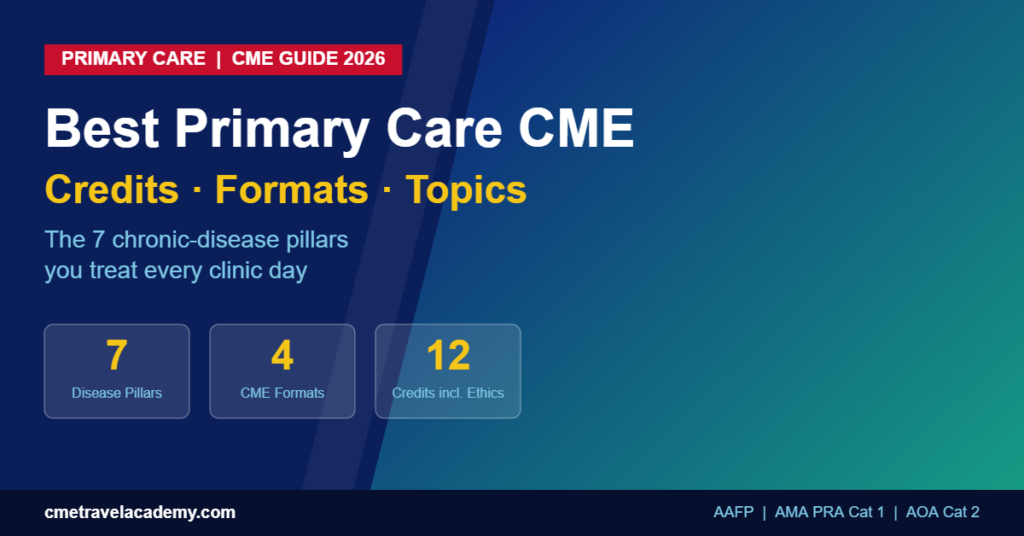
Primary care is where most chronic disease is actually managed — diabetes, hypertension, asthma, COPD, CKD, heart failure, and dyslipidemia are treated in family medicine and internal medicine offices far more often than in subspecialty suites. So the best primary care CME isn’t a grab-bag of lectures; it’s a curriculum built around the conditions you see every clinic day, taught at the level of “what do I do Monday morning.” This guide breaks down what great primary care CME should cover, which credits actually count, how many hours you need, and which format fits how you work. For the destination-by-destination event lineup, our roundup of the top CME conferences of 2026 remains the definitive guide — this article is about the learning, not the location.
What the Best Primary Care CME Actually Covers
The strongest primary care curricula track the guideline releases that change outpatient practice and translate them into decisions you can make at the point of care. That means more than a slide of bullet points — it means knowing which drug to start, in which patient, and why. Here are the seven chronic-disease pillars any serious primary care CME program should cover in 2026, each updated to its current release.
- 🩺 Diabetes — ADA & AACE 2026. The pillar drugs (GLP-1s, SGLT2 inhibitors, finerenone) and when to start each by cardiovascular and renal indication, earlier CGM use, and the weight-management cascade. See our 2026 diabetes guideline summary.
- 🫀 Hypertension — ACC/AHA 2025. Updated BP thresholds, out-of-office measurement, and the move toward early combination therapy. Read the 2025 hypertension update for primary care.
- 🌬️ Asthma — GINA 2026. SABA-only therapy is out; ICS-formoterol AIR therapy is first-line across nearly all steps. See the GINA 2026 update.
- 🫁 COPD — GOLD 2026. The ABE classification, when triple therapy is indicated, and CV-risk integration.
- 🧪 Chronic Kidney Disease — KDIGO 2024. SGLT2i and finerenone in CKD, ACEi/ARB titration, and the cardio-renal-metabolic framework. See CKD in primary care.
- ❤️ Heart Failure — ACC/AHA. The four pillars of GDMT, how to start all four within weeks, and HFpEF management. Read the four pillars of GDMT.
- 📉 Dyslipidemia — ACC/AHA. Statin selection by ASCVD risk, when to add ezetimibe or a PCSK9 inhibitor, and managing statin intolerance.
The thread tying these together is value: high-yield management that moves outcomes and quality metrics, the same philosophy behind our value-based care program for clinics.
Which Credits Actually Count for Primary Care
Before you register for anything, confirm the credit. For primary care clinicians the credits that matter are:
- ✓ AMA PRA Category 1 Credit™ — the universal currency, accepted by virtually every state board and by ABFM and ABIM for continuing certification.
- ✓ AAFP Prescribed Credit — for family physicians; the AMA accepts it as equivalent to AMA PRA Category 1 Credit™ for the Physician’s Recognition Award.
- ✓ AOA Category 2 — for osteopathic physicians.
- ✓ NP & PA recognition — AMA PRA Category 1 Credit™ is widely accepted, with ANCC, AANP, and AAPA recognition varying by board.
CME Travel Academy is accredited through the AAFP and designates all three physician credit types; the full credit statement and a sample certificate show exactly what you’ll receive.
How Many Hours Do Primary Care Providers Need?
It varies by board, but as a rough map: most state medical boards require 20–50 CME hours per year for license renewal; AAFP members need 150 credits every three years; ABFM and ABIM require ongoing CME for continuing certification; and NPs and PAs typically need around 100 credits per certification cycle. Many states also mandate topic-specific hours — ethics, opioid or pain management, medical errors — that must be coded to the right category. With pre-verification now blocking renewals when a single mandated hour is missing (see the 2026 reporting rules), choosing CME that includes an ethics hour and clean category coding has become a practical necessity. Every CME Travel Academy conference includes a dedicated 1-hour Ethics session within its 12 credits.
Earn 12 Primary Care Credits — Including Ethics
Two mornings of high-yield chronic-disease teaching, afternoons free. 12 AMA PRA Category 1 Credits™ (incl. 1 hr Ethics), plus 12 months of spaced-repetition review and one-page point-of-care references. Walt Disney World, July 17–18, 2026 · New York City, October 12–13, 2026. Livestream available. Resident, military, and student discounts apply.
Four Formats — Same Accredited Credit
The best primary care CME meets you where you are. The credit is identical across formats; pick the delivery that fits your schedule.
- In-person conferences — from $895, 12 hours over two mornings at destinations like Disney and NYC, with afternoons free.
- CME Livestream — same live faculty and Live CME certificate from your location; $695 (5h) or $995 (12h).
- Online on-demand — the full chronic-disease course library, $395–$895, at your own pace.
- Custom CME™ — your dates, topics, and location for individuals or groups; from $995.
For a deeper walkthrough of formats, faculty, and FAQs, our primary care CME hub is the full reference.
Looking for the Conference Lineup?
This article is about what to learn and which credits count. If what you really want is a side-by-side of where to earn those credits — Disney World, New York City, Las Vegas, and more, with dates and what each destination offers — that lives in our dedicated, regularly updated roundup of the top CME conferences of 2026. It’s the authoritative event guide; we keep it separate so each page does one job well.
Top 5 Takeaways
- Great primary care CME is built around the seven chronic-disease pillars — diabetes, hypertension, asthma, COPD, CKD, heart failure, and dyslipidemia — updated to current guidelines.
- Confirm the credit: AMA PRA Category 1 Credit™, AAFP Prescribed, or AOA Category 2, with NP/PA recognition checked against your board.
- Know your hours — and your mandated topics; an ethics hour and clean category coding now matter for pre-verification at renewal.
- The format (live, livestream, on-demand, custom) doesn’t change the credit — choose for your schedule.
- For the event lineup, defer to the dedicated top CME conferences of 2026 guide.
The Bottom Line
The best primary care CME in 2026 is current, accredited, retention-built, and matched to the conditions you actually treat. CME Travel Academy was designed for exactly this clinician: physician-led, 100% commercial-bias-free, accredited AAFP Prescribed, AMA PRA Category 1 Credit™, and AOA Category 2, with 12 credits per conference including Ethics, 12 months of spaced repetition, and report-ready certificates. Explore the primary care CME hub, browse on-demand courses, join from anywhere via Livestream, or design your own with Custom CME™ (individuals or groups, from $995).