
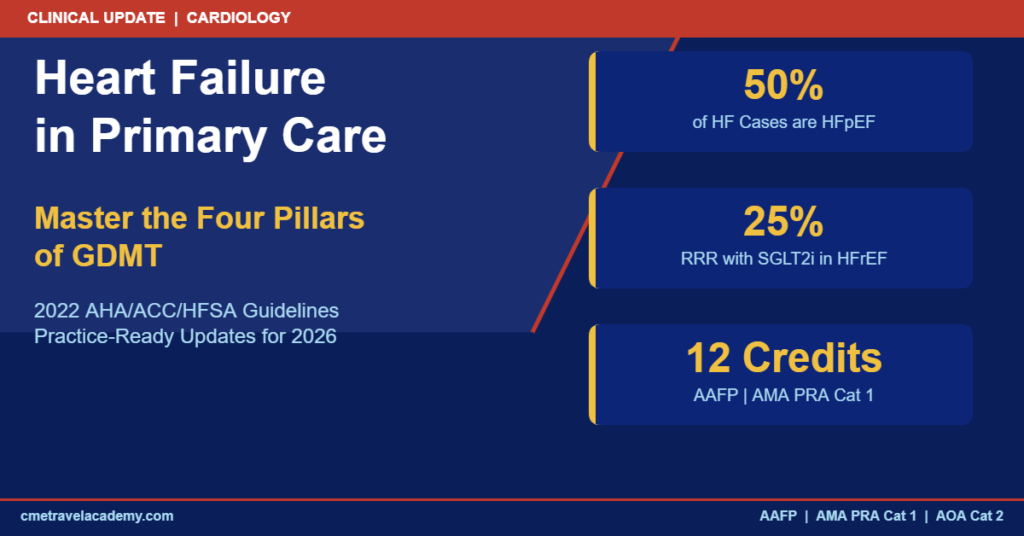
Heart failure affects more than 6.7 million Americans, and that number is climbing. It remains one of the leading causes of hospitalization, readmission, and cardiovascular mortality in the United States — and the vast majority of these patients are first seen, diagnosed, and followed in primary care. Yet despite the existence of four evidence-based medication classes proven to dramatically reduce hospitalizations and death, guideline-directed medical therapy (GDMT) optimization remains stubbornly underutilized in real-world practice.
The 2022 AHA/ACC/HFSA Guideline for the Management of Heart Failure redrew the therapeutic landscape with a clear mandate: get every eligible patient with heart failure with reduced ejection fraction (HFrEF) on all four pillars of GDMT — an ARNI, a beta-blocker, an MRA, and an SGLT2 inhibitor — and do it quickly. Meanwhile, new evidence on SGLT2 inhibitors and GLP-1 receptor agonists is expanding our options for the harder-to-treat HFpEF population, which now accounts for roughly half of all heart failure cases.
This review breaks down what the current guidelines mean for your patient panel, highlights the most actionable 2025–2026 evidence updates, and arms you with the clinical pearls you need to optimize care — whether you’re managing a newly diagnosed HFrEF patient or navigating the complex comorbidities of an obese patient with preserved ejection fraction.
The Heart Failure Burden: Why Primary Care Owns This Disease
More than 80% of patients with heart failure are managed primarily in outpatient primary care and internal medicine settings — not by cardiologists. The consequence of this reality cuts both ways: primary care clinicians have an unparalleled opportunity to implement life-saving GDMT, and they bear a corresponding responsibility to do so proactively.
Heart failure costs the U.S. healthcare system over $43 billion annually, with hospitalizations accounting for the largest share. The 30-day readmission rate remains above 20%, and studies consistently show that inadequate GDMT titration at discharge is a primary driver. The good news: trials like STRONG-HF demonstrated that aggressive, rapid up-titration of GDMT in the 2 weeks following hospitalization can reduce 180-day rehospitalization and death by 34% compared with usual care.
The Heart Failure Society of America and the American College of Cardiology are aligned: delays in GDMT initiation translate directly into preventable deaths. As primary care providers, we are the ones who can close this gap. Interested in earning accredited CME on heart failure and chronic disease management? CME Travel Academy’s 2026 conferences cover all of this and more.
Understanding Heart Failure Classification: Which EF Bucket?
Accurate classification of heart failure by ejection fraction drives everything that follows. The 2022 AHA/ACC/HFSA guidelines recognize four phenotypes:
| Type | LVEF | Key Features |
|---|---|---|
| HFrEF (reduced) | ≤40% | Systolic dysfunction; all four GDMT pillars Class I |
| HFmrEF (mildly reduced) | 41–49% | Growing evidence for GDMT; treat similarly to HFrEF |
| HFpEF (preserved) | ≥50% | Diastolic dysfunction; SGLT2i Class I; GLP-1 RA emerging |
| HFimpEF (improved) | ≥50% (was ≤40%) | Continue all GDMT indefinitely despite LVEF recovery |
A critical 2022 guideline update: patients with HFmrEF are now acknowledged to benefit from many of the same interventions as HFrEF, and the category of HFimpEF (formerly called HFrecEF) reinforces the principle that GDMT should never be discontinued simply because the ejection fraction has recovered — withdrawal risks relapse.
The Four Pillars of GDMT for HFrEF: A Framework for Action
The defining contribution of the 2022 AHA/ACC/HFSA guidelines was to consolidate the evidence into a clear quadruple therapy framework. All four classes carry Class I, Level A recommendations for patients with HFrEF. The goal is simultaneous or rapid sequential initiation at low doses, then up-titration to target doses — not the old sequential “add one drug, wait 3 months” approach that left patients under-treated for years.
Pillar 1: ARNI (Sacubitril/Valsartan) — First Choice Over ACEi/ARB
Sacubitril/valsartan (Entresto) is now the preferred renin-angiotensin system inhibitor for patients with HFrEF — a Class I recommendation — following PARADIGM-HF, which demonstrated a 20% relative risk reduction in cardiovascular death or HF hospitalization versus enalapril. The 2022 guidelines are unambiguous: if a patient is not already on sacubitril/valsartan and can tolerate it, they should be transitioned. Key practical note: allow a 36-hour washout if switching from an ACE inhibitor to avoid angioedema risk.
Target dose: sacubitril/valsartan 97/103 mg twice daily. Monitor potassium, creatinine, and blood pressure during titration. Hold or reduce if symptomatic hypotension (SBP <90 mmHg), K&sup+; >5.5 mEq/L, or eGFR declines >30%.
Pillar 2: Evidence-Based Beta-Blockers
Not all beta-blockers are created equal in heart failure. Only three carry guideline endorsement for HFrEF: carvedilol, metoprolol succinate (not tartrate), and bisoprolol. These agents reduce all-cause mortality by 34% and sudden cardiac death by 44% in landmark meta-analyses. Start at low doses and titrate every 2 weeks as tolerated. A common error is withholding beta-blockers in decompensated heart failure — these can and should be initiated before discharge in stabilized patients.
Pillar 3: Mineralocorticoid Receptor Antagonists (MRA)
Spironolactone and eplerenone reduce CV mortality by approximately 25–30% in HFrEF (RALES and EPHESUS trials). The 2022 guidelines recommend MRA for patients with NYHA Class II–IV HFrEF and eGFR >30 mL/min/1.73m² and K&sup+; <5.0 mEq/L. Spironolactone 25–50 mg daily is most commonly used; eplerenone 25–50 mg daily is preferred in patients with gynecomastia or hormonal side effects. Monitor potassium vigilantly, especially when combined with ARNI and SGLT2i.
Pillar 4: SGLT2 Inhibitors — The Game-Changing Fourth Pillar
The addition of dapagliflozin 10 mg daily or empagliflozin 10 mg daily to the HFrEF regimen was cemented by DAPA-HF (dapagliflozin) and EMPEROR-Reduced (empagliflozin), each demonstrating roughly 25% relative risk reduction in CV death or worsening HF, independent of diabetes status. This was a paradigm shift: for the first time, a medication class developed for diabetes provided robust heart failure benefits in non-diabetic patients.
A landmark 2025 scientific statement from the Heart Failure Association and HFAI reinforced SGLT2 inhibitors across the ejection fraction spectrum. Emerging 2026 comparative data suggests empagliflozin may confer slightly stronger benefits in HFrEF, while dapagliflozin may offer advantages in HFpEF — though both remain Class I for HFrEF.
🏥 Conference Spotlight: Earn CME on Heart Failure at CME Travel Academy
CME Travel Academy’s 2026 conferences cover Heart Failure, Hypertension, CKD, Diabetes, Asthma/COPD, Obesity, and more — evidence-based, physician-led, with zero commercial bias. Earn 12 AMA PRA Category 1 Credits™ including 1 hour of Ethics CME, with morning-only sessions (7:30am–1:30pm) and afternoons free for family and travel.
✅ Walt Disney World, Orlando — July 17–18, 2026 | Hotel block expires June 16! | $995
✅ New York City — October 12–13, 2026 | $995
✅ Las Vegas — December 18–19, 2026 | $995
✅ CME Livestream — earn from any destination | $995
Military discount: $100 off. Resident physicians: $200 off. Register at cmetravelacademy.com/conferences
Heart Failure with Preserved Ejection Fraction (HFpEF): Closing the Treatment Gap
HFpEF now accounts for more than 50% of all heart failure cases in the U.S., driven by the epidemic of hypertension, obesity, and type 2 diabetes. Until recently, no therapy had convincingly demonstrated a mortality benefit in this population. The past two years have changed that narrative.
The EMPEROR-Preserved trial (empagliflozin) and DELIVER trial (dapagliflozin) both demonstrated statistically significant reductions in the composite of CV death or worsening heart failure in HFpEF — earning both agents a Class I recommendation for most HFpEF patients in the 2023 ACC Expert Consensus. For the primary care clinician, this is actionable: if a patient with HFpEF does not have an absolute contraindication to SGLT2 inhibition and has an eGFR ≥20 mL/min/1.73m², they should be on one.
Additional HFpEF-focused management priorities include aggressive blood pressure control (<130/80 mmHg, aligned with the 2025 AHA/ACC hypertension guidelines), management of underlying atrial fibrillation, and diuretics for symptom and volume control. The 2024 European Heart Failure update reinforces these priorities and notes that obesity-specific interventions are emerging as a cornerstone of HFpEF management.
GLP-1 Receptor Agonists: A New Frontier in Obesity-Related HFpEF
The intersection of heart failure and obesity medicine is one of the most rapidly evolving areas in cardiovascular care. HFpEF with obesity is increasingly recognized as a distinct phenotype driven by adipose-mediated inflammation, epicardial fat accumulation, and elevated filling pressures — and it may be uniquely responsive to weight loss.
The STEP-HFpEF trial (semaglutide 2.4 mg weekly) was a landmark: in patients with obesity-related HFpEF, semaglutide produced significant improvements in KCCQ symptom scores, 6-minute walk distance, C-reactive protein, and body weight versus placebo. A 2026 JAMA analysis of semaglutide and tirzepatide in HFpEF with T2D showed a 40% lower risk of HF hospitalization or all-cause mortality compared with sitagliptin — a striking signal that incretin-based therapies may reshape HFpEF management.
The 2025 Canadian Cardiovascular Society guidelines now recommend GLP-1 receptor agonists for symptomatic HFpEF patients with BMI ≥30 kg/m², and U.S. guidelines are expected to follow. For primary care clinicians already prescribing semaglutide for weight loss or T2D in patients with HFpEF, this is another compelling reason to optimize dosing. Consider this a convergence zone: the same patient who benefits from GLP-1 therapy for diabetes or obesity may have layered HFpEF benefits.
Interested in staying ahead of these rapidly evolving guidelines? CME Travel Academy’s online on-demand courses and value-based care program keep your practice current year-round — and our live conferences offer depth that online learning alone can’t replicate.
Practice Pearls: Making GDMT Work in the Real World
Guidelines are only as good as their implementation. Here are the most actionable clinical pearls for primary care GDMT optimization:
🔑 Start low, go slow — but start. Low doses of all four pillars confer most of the benefit. Don’t wait until you reach target doses to initiate the next agent. The survival benefit begins at initiation, not at maximum dose.
📋 Use a checklist at every HF visit. Each visit should confirm: current medications, doses, labs (BMP/CBC within 6 months), and whether any pillar is missing or subtherapeutic. Structured GDMT checklists reduce the therapeutic inertia that leaves patients under-treated.
⚗️ Monitor the BMP strategically. ARNI + MRA + SGLT2i combination can affect K&sup+; and creatinine. Check BMP at baseline, 1–2 weeks after any dose change, and then every 3–6 months. SGLT2 inhibitors actually reduce hyperkalemia risk — a useful counterbalance to ARNI/MRA.
🤝 Low EF ≠ automatic cardiology referral. Newly diagnosed HFrEF with LVEF <35% warrants referral for ICD/CRT evaluation. Stable, optimized patients can be managed effectively in primary care with periodic echocardiographic follow-up.
⚡ Don’t stop GDMT after LVEF recovery. Patients with HFimpEF who discontinue GDMT have a high rate of relapse. The 2022 guidelines explicitly recommend continuing all four pillars indefinitely, even if the echo normalizes.
💊 Prioritize SGLT2i in patients with CKD or T2D. SGLT2 inhibitors provide cardiorenal protection across overlapping disease states — a single agent addressing heart failure, CKD progression, and glycemic control simultaneously. See our prior CKD post for complementary guidance.
Top 5 Takeaways
1. All four GDMT pillars carry Class I recommendations in HFrEF. ARNI (sacubitril/valsartan), evidence-based beta-blocker, MRA (spironolactone/eplerenone), and SGLT2 inhibitor (dapagliflozin or empagliflozin) — initiate all four early and up-titrate as tolerated.
2. SGLT2 inhibitors now span the ejection fraction spectrum. Class I for HFrEF regardless of diabetes; increasingly Class I for HFpEF. If a patient with heart failure has an eGFR ≥20 and no absolute contraindication, they should be on an SGLT2i.
3. Sacubitril/valsartan is the preferred RAS inhibitor. The 2022 guidelines elevate ARNI to first-line over ACEi/ARB. Allow a 36-hour washout when switching from an ACE inhibitor to avoid angioedema.
4. GLP-1 receptor agonists are emerging for obese HFpEF. STEP-HFpEF and the 2026 JAMA semaglutide/tirzepatide analysis show 40% lower risk of HF hospitalization or death in HFpEF patients with obesity and T2D — a convergence zone for primary care.
5. Never stop GDMT after LVEF recovery. Patients with HFimpEF who discontinue therapy relapse at high rates. The 2022 guidelines recommend continuing all four pillars indefinitely, even after echocardiographic normalization.
Earn Accredited CME on Heart Failure and Chronic Disease Management
Heart failure management is evolving rapidly — from the four-pillar GDMT revolution in HFrEF to the emerging role of SGLT2 inhibitors and GLP-1 receptor agonists in HFpEF. Staying current isn’t just professional development: it’s patient safety.
CME Travel Academy offers 12 AMA PRA Category 1 Credits™ including 1 hour of Ethics CME at world-class destinations — covering heart failure, CKD, diabetes, hypertension, obesity, asthma/COPD, and more. Taught by actively practicing physicians with zero commercial bias. Each session includes one-page point-of-care references and a 12-month spaced-repetition curriculum to keep clinical updates sharp all year. Pricing starts at $995 per clinician, with military ($100 off), resident ($200 off), and student discounts available.
Upcoming in-person and livestream options:
🎢 Walt Disney World, Orlando — July 17–18, 2026 | Hotel block expires June 16 — register today!
🗽 New York City — October 12–13, 2026
🎰 Las Vegas — December 18–19, 2026
💻 CME Livestream — earn from any destination worldwide
For further reading, explore our recent posts: Chronic Kidney Disease: The Four Pillars of Kidney Protection, New CME Reporting Rules 2026, and browse the full CME Travel Academy blog. Full accreditation details are available on our credit statement page.