
Few areas of primary care move as fast as type 2 diabetes. Within the first months of 2026, the two most influential bodies in the field issued major updates: the ADA Standards of Care in Diabetes—2026 and the AACE Comprehensive Type 2 Diabetes Management Algorithm — 2026 Update. Together they reshape how we screen, monitor, and treat the patients who fill our schedules every day — and they line up neatly with the other 2026 shifts we have covered, from oral semaglutide and cardiovascular risk to the new ACC/AHA dyslipidemia targets.
For the physicians, NPs, and PAs managing diabetes alongside hypertension, CKD, and obesity, staying current is the difference between reactive and proactive care. Here is a practical, side-by-side read of what changed — and what it means Monday morning.
Continuous Glucose Monitoring Moves to the Center
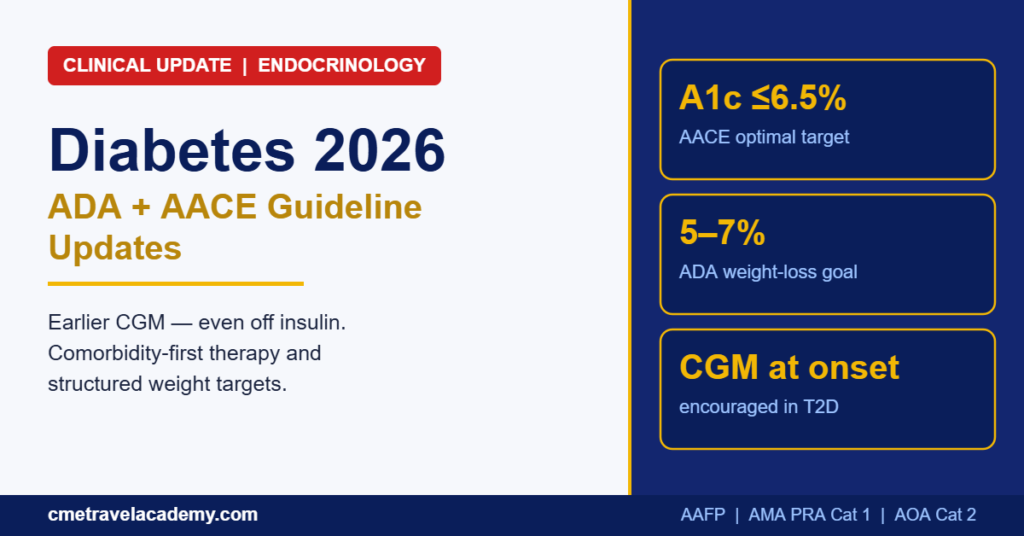
Both guidelines elevate continuous glucose monitoring (CGM). The 2026 ADA Summary of Revisions now supports considering CGM at the onset of diabetes and at any point thereafter — and explicitly includes people with type 2 diabetes on non-insulin therapies. AACE likewise highly recommends CGM to reach glycemic goals. Automated insulin delivery (AID) systems should be available to all adults with type 1 or type 2 diabetes who require insulin, with no C-peptide, autoantibody, or insulin-duration prerequisite before starting a pump or AID. The practical shift for primary care: stop reserving CGM for insulin users — it is now a first-line tool for engagement and titration across the board. Even two weeks of professional CGM data can surface overnight lows, post-prandial spikes, and the dawn phenomenon that a quarterly A1c will never reveal, and patients who watch their own glucose respond in real time often make lifestyle changes that no lecture achieves.
A Comorbidity-First Approach to Therapy
The defining theme of the AACE 2026 algorithm is its comorbidities- and complications-centric framework: drug choice is driven less by A1c alone and more by what else the patient carries — atherosclerotic cardiovascular disease, heart failure, CKD, and obesity. GLP-1 receptor agonists and SGLT2 inhibitors stay front and center for cardiovascular-kidney-metabolic risk, independent of glucose control — the same logic behind the GLP-1 benefit in obese HFpEF we reviewed previously. AACE keeps an optimal A1c of 6.5% or lower, “as close to normal as is safe and achievable,” while the ADA continues to individualize targets. Dedicated risk-reduction algorithms for dyslipidemia and hypertension reinforce a core truth: diabetes care is cardiovascular care, which is exactly why our value-based chronic-disease programs treat these conditions as one.
Conference Spotlight — At our Top Chronic Diseases conferences, Dr. George and Dr. Pillai translate exactly these updates into one-page, point-of-care tools you can use the next day. Join us at Walt Disney World, July 17–18, 2026, or New York City, October 12–13, 2026, for 12 AMA PRA Category 1 Credits™ (including 1 hour of Ethics) — mornings only, afternoons free, from $895. Prefer to stay home? Earn the same credits by livestream from anywhere.
Weight and Nutrition, Formalized
The 2026 ADA Standards sharpen the obesity focus: annual screening for overweight and obesity using BMI plus an additional body-fat measure, and a target of 5–7% weight loss to improve hyperglycemia and cardiometabolic risk. Expanded nutrition guidance highlights Mediterranean-style and low-carbohydrate eating patterns with patient-friendly resources. With GLP-1 and dual GIP/GLP-1 agents now central to both glucose and weight management, the practical line between a “diabetes drug” and an “obesity drug” has effectively dissolved — one of the top chronic-disease themes of 2026.
Beyond Glucose: Mental Health, Hospital Care, and Vaccines
The ADA added guidance on behavioral health screening — diabetes distress and anxiety — and on supporting diabetes technology use in schools and workplaces, plus new perioperative and inpatient glycemic targets. AACE devotes a full section to vaccine recommendations for adults with type 2 diabetes. The message across both documents is the same: diabetes is a whole-person condition, and the visit that ignores mood, context, and prevention is an incomplete one.
Practice Pearls
- Offer CGM earlier — including to type 2 patients not on insulin — and do not gate AID or pumps on C-peptide or antibody status.
- Let comorbidities pick the agent: ASCVD, heart failure, or CKD favors a GLP-1 RA and/or an SGLT2 inhibitor regardless of A1c.
- Screen for overweight and obesity annually and set a concrete 5–7% weight-loss goal.
- Run the cardiovascular bundle at every diabetes review: lipids, blood pressure, and albuminuria.
- Screen for diabetes distress — it moves adherence more than almost any single prescription.
The Bottom Line
The 2026 ADA and AACE updates converge on one idea: treat the patient, not the number. Earlier CGM, comorbidity-driven pharmacotherapy, and structured weight management are now the standard of care, and the cardiometabolic boundaries between diabetes, obesity, heart, and kidney disease have all but disappeared. Keeping pace with this is exactly what CME Travel Academy is built for.
Stay current with evidence-based, physician-led education featuring 12-month spaced-repetition retention and one-page point-of-care references. Explore our 2026 conferences or browse our online on-demand CME and earn accredited credit — AAFP Prescribed, AMA PRA Category 1 Credit™, and AOA Category 2 — while you do it.