By Dr. Vimal T. George, MD, MSc | Reviewed by CME Travel Academy Faculty
5 min read · Reviewed September 2026
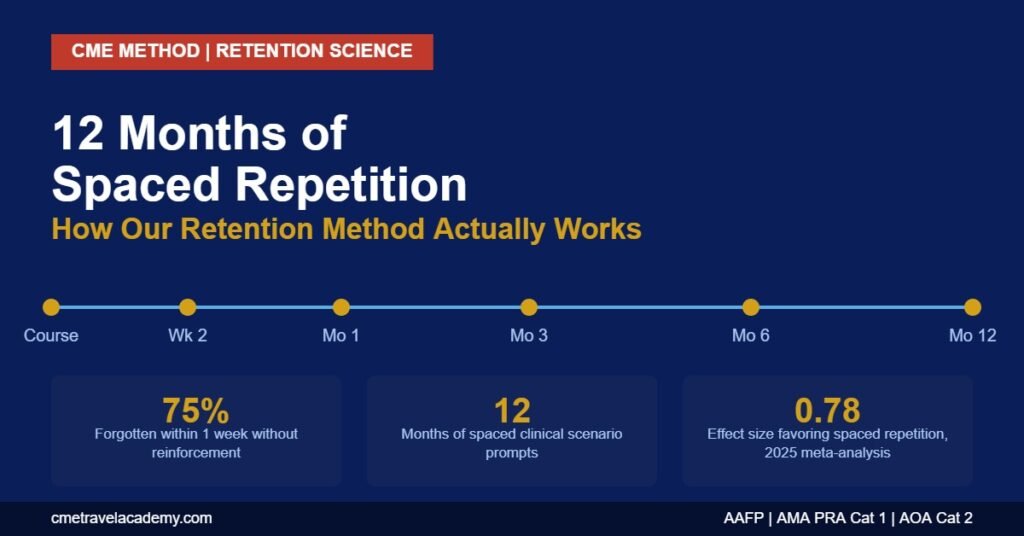
Most CME ends the moment the last slide changes. You sit through the sessions, work through the material, and within a week your brain has quietly discarded most of it. That is not a knock on your memory. It is how memory works: the classic forgetting curve research shows clinicians lose roughly 50 percent of new material within 24 hours and up to 75 percent within a week if nothing reinforces it. CME Travel Academy was built around a direct answer to that problem, and it is worth explaining exactly how it works, not just that it exists, since “spaced repetition” gets used as a buzzword more often than it gets explained.
What Spaced Repetition Actually Is
Spaced repetition is not a single trick. It is a learning schedule: instead of reviewing material once and moving on, you are re-tested on it at deliberately increasing intervals, timed to land right before you would otherwise forget it. Each successful retrieval pushes the next review further out. It is the same principle behind medical school flashcard systems like Anki, and it has decades of cognitive science behind it showing it beats passive re-reading or re-watching a recorded lecture. A 2025 systematic review and meta-analysis in The Clinical Teacher, covering more than 21,000 learners across 13 studies, found a significant and sizable effect favoring spaced repetition over standard studying, and a separate 2024 review in the Journal of Medical Internet Research found that spaced digital education for health professionals improves long-term retention and can change actual clinical behavior, not just test scores.
The version we build into every course pairs two techniques rather than one:
Spaced intervals. After you finish a course, whether at a live conference, through CME Live: Your Location, or in our on-demand library, you do not just walk away with a certificate. For a full 12 months, you receive short clinical-scenario prompts and quiz questions timed at research-backed intervals designed to catch you right before the material fades.
Retrieval practice. The prompts are not passive review. They are interleaved questions that force active recall, presenting a clinical scenario and asking you to apply the guideline rather than simply recognize it. Active recall is consistently the strongest evidence-based learning method in the education literature, well ahead of highlighting or re-reading notes.
How It’s Delivered, Step by Step
This is not a vague promise tacked onto a course description. Here is what actually happens after you finish:
- You finish the course content. Whether that is a conference weekend at Walt Disney World, an evening logging into CME Live: Your Location, or working through modules in the online course library.
- You work through a built-in rapid review. Our 12-hour and 20-hour courses include a rapid review section that revisits content throughout the course itself, your first round of retrieval practice before the 12-month follow-up ever begins.
- The 12-month follow-up begins. Accessible through our Thinkific learning platform or the CME Travel Academy app, whichever you prefer to use day to day.
- Prompts arrive at increasing intervals. Rather than a flat weekly email, spacing widens over the year: more frequent early on, when forgetting happens fastest, then progressively spaced out as the material consolidates.
- Each prompt is a real clinical scenario, not a flashcard fact. A hypertension prompt might ask you to choose the next step for a patient already on two agents, rather than asking you to recite a blood pressure threshold.
- You keep your one-page point-of-care references for every disease state alongside the prompts, so when a scenario jogs your memory, you have the guideline summary and treatment algorithm to pull up in the same place.
Why We Built It This Way
Dr. Anush Pillai and I founded CME Travel Academy in August 2024 after years of sitting through, and giving, traditional CME that followed the same pattern: dense slide decks, occasional commercial influence, and content that evaporated within a week. We wanted the opposite. Our stated goal to attendees has always been direct: we do not just want you to learn something new, we want you to still be using it 12 months from now, at the bedside, with the patient in front of you.
That meant the retention system could not be an afterthought or an upsell. It is included free with every course format we offer, whether you attend an in-person conference, join CME Live: Your Location, or complete an on-demand module, because the credit hour was never really the point. The point is whether you are managing heart failure, diabetes, or CKD differently a year later.
Course Spotlight: Every one of our course formats, including in-person conferences, CME Live: Your Location, and Online On-Demand Courses, includes this same 12-month spaced-repetition follow-up and one-page point-of-care references at no extra cost. It is not an upsell; it is how we define finishing a course.
What This Looks Like in Practice
Across a 12-month cycle for, say, our Top Chronic Diseases in Adults course, that means periodic prompts touching COPD, asthma, heart failure, hypertension and resistant hypertension, coronary artery disease, type 2 diabetes, CKD, and depression, the same topics covered in the original 12-hour course, each resurfacing on its own spaced schedule rather than all at once. You are not re-taking the course. You are being handed small, targeted reminders exactly when the evidence says you are about to need them.
The point-of-care references follow the same logic in a different format: instead of relying on recall alone, you have a one-page summary of the current guideline, treatment algorithm, and medication pearls to open during the actual patient visit. Between the spaced prompts training recall and the reference cards backstopping it, the goal is that the guideline update from your course is still shaping decisions at month eleven, not just month one.
The Bottom Line
If you have taken CME before and felt the content slip away within days, that is the expected outcome of a single-exposure format, not a failure of attention or effort. Spaced repetition with active recall is the more evidence-based alternative, and it is the reason we built it into every course format rather than selling it as an add-on. Explore our Online On-Demand Courses, join us live through CME Live: Your Location, or come learn in person at an upcoming 2026 conference in New York City or Las Vegas. However you attend, the 12 months of spaced repetition that follow are included, not optional.