By Dr. Vimal George, MD | Reviewed by CME Travel Academy Faculty · 8 min read · Reviewed June 2026
Accredited CME: ✓ AMA PRA Category 1 Credit™ ✓ AAFP Prescribed ✓ AOA Category 2 ✓ 12 Credits per Conference
Internists carry a particular kind of CME burden: not just license renewal, but ABIM continuing certification — the program most clinicians still call MOC. That adds a second scoreboard on top of state hours, and the rules for how CME credit converts to MOC points trip people up constantly. This guide is built for the internist: the highest-yield internal medicine CME topics for 2026, how ABIM MOC points actually work (and where clinicians get it wrong), and the formats that let you knock out both requirements at once. For where to earn it in person, our roundup of the top CME conferences of 2026 is the definitive destination guide — this article focuses on the credit mechanics and the medicine.
ABIM MOC, Demystified
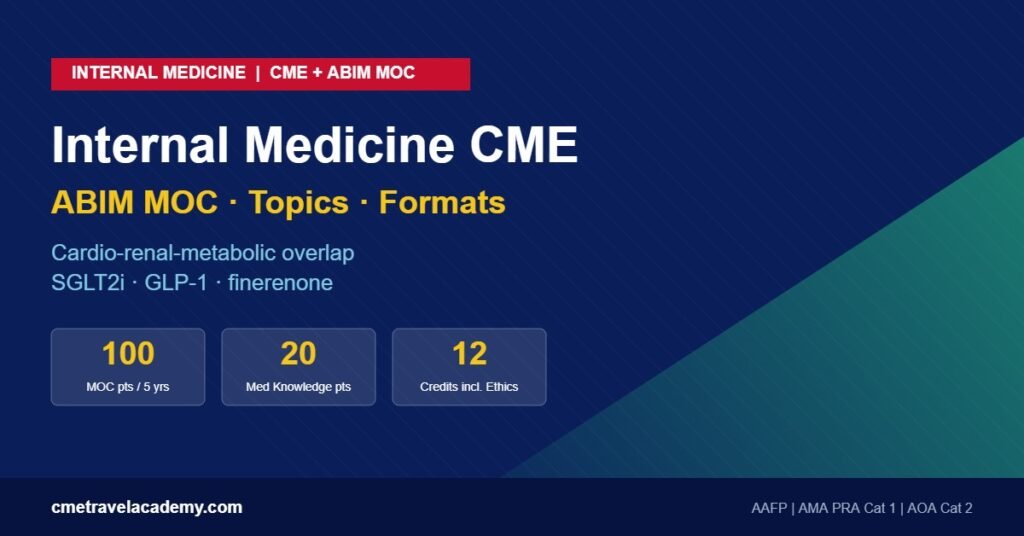
ABIM-certified internists must earn 100 MOC points every five years, with at least 20 of those points in medical knowledge, alongside passing a longitudinal or traditional assessment. The part that confuses people is the relationship between CME credit and MOC points. Here’s the accurate version: an activity earns MOC points only if it has been specifically registered for ABIM MOC by an ACCME-accredited provider and certified for AMA PRA Category 1 Credit™. When an activity is MOC-registered, diplomates earn MOC points equivalent to the AMA PRA Category 1 Credits™ they claim. The practical takeaway: AMA PRA Category 1 Credit™ is the foundation — your state board accepts it and ABIM requires it — but for it to also count as MOC points, confirm the specific activity is registered for ABIM MOC before you assume it does.
💡 Quick check before you register: CME Travel Academy conferences award AMA PRA Category 1 Credit™, which is accepted toward ABIM’s CME requirements. If you specifically need the credit to post as ABIM MOC points, confirm MOC registration for the activity at the time of registration — email info@cmetravelacademy.com and we’ll tell you exactly what a given session carries.
The Internal Medicine Topics That Matter Most in 2026
Internal medicine lives at the intersection of multiple chronic diseases in the same patient — the 68-year-old with diabetes, CKD, heart failure, and dyslipidemia all at once. The highest-value CME for internists isn’t single-disease; it’s how the pillars interact. Three themes dominate the 2026 landscape.
Cardio-renal-metabolic overlap
The biggest shift in internal medicine is the convergence of cardiology, nephrology, and endocrinology around a shared drug toolkit. SGLT2 inhibitors, GLP-1 receptor agonists, and finerenone now span diabetes, chronic kidney disease, and heart failure. Trials like SOUL (oral semaglutide and cardiovascular risk) and the STEP-HFpEF and SUMMIT programs in obese HFpEF have moved these agents from glucose-lowering drugs to organ-protective ones. Knowing which indication drives the choice — and how to layer therapies safely — is the core internal-medicine skill of this decade.
Guideline-directed precision
The 2025 AHA/ACC hypertension guideline, GINA 2026, GOLD 2026 for COPD, and KDIGO 2024 each tightened thresholds and reordered therapy. Internists need the specifics — BP targets, when to start combination therapy, ICS-formoterol AIR therapy, the ABE classification — not the headlines.
Deprescribing and polypharmacy
As regimens grow, the highest-yield internal-medicine move is often subtraction. CME that teaches when to stop a SABA, taper a statin-intolerant patient onto an alternative, or rationalize an eight-drug regimen delivers outcomes that adding another agent can’t.
12 Credits for the Multi-Morbid Patient
Two mornings of high-yield, evidence-based teaching on the chronic diseases internists juggle daily — with NNT and effect sizes, not opinion. 12 AMA PRA Category 1 Credits™ (incl. 1 hr Ethics), 12 months of spaced-repetition review, and one-page point-of-care references. Disney World, July 17–18 · New York City, late spring 2027. Livestream available.
Formats That Fit a Hospitalist or Clinic Schedule
Internists rarely have flexible weeks, so format matters. The credit is identical across all four delivery modes. In-person conferences (from $895) give you 12 hours over two mornings with free afternoons. CME Livestream ($695 for 5 hours, $995 for 12) brings the same live faculty to your location — ideal between hospital blocks. The on-demand library ($395–$895) fits around call. And Custom CME™ (from $995, individuals or groups) lets an individual clinician, hospitalist group, or residency program pick its own dates and topics. For the full breakdown of formats and faculty, see our primary care CME hub, which covers internal medicine in depth.
Don’t Forget the Reporting Layer
Internists juggling MOC and state CME have the most to gain from clean documentation. With states moving to real-time tracking and pre-verification, the certificate’s category coding now matters as much as the credit itself — a theme we cover in the 2026 CME reporting rules. Choose CME that hands you report-ready paperwork and you spare yourself a renewal-week scramble.
Top 5 Takeaways
- ABIM continuing certification requires 100 MOC points every 5 years, including 20 in medical knowledge.
- CME counts as MOC points only when the activity is specifically registered for ABIM MOC — AMA PRA Category 1 Credit™ alone isn’t automatically MOC points, so confirm registration.
- The highest-yield internal medicine CME teaches the cardio-renal-metabolic overlap — SGLT2i, GLP-1s, and finerenone across diabetes, CKD, and heart failure.
- Deprescribing and polypharmacy management often beat adding another drug.
- Pick the format that fits your schedule; the credit is identical, and report-ready documentation matters more than ever.
The Bottom Line
Internal medicine CME in 2026 should do two jobs: teach the overlapping chronic diseases you manage in one patient, and help you satisfy both license and ABIM requirements cleanly. CME Travel Academy delivers evidence-based, 100% commercial-bias-free teaching — 12 AMA PRA Category 1 Credits™ per conference including Ethics, taught by actively practicing physicians, with 12 months of spaced repetition and report-ready certificates. Confirm MOC registration with us for any activity where you need points to post. Explore the 2026 conferences, compare destinations in our top conferences guide, earn from anywhere via Livestream, or start now with on-demand courses.