By Dr. Vimal George, MD | Reviewed by CME Travel Academy Faculty
7 min read · Reviewed June 2026
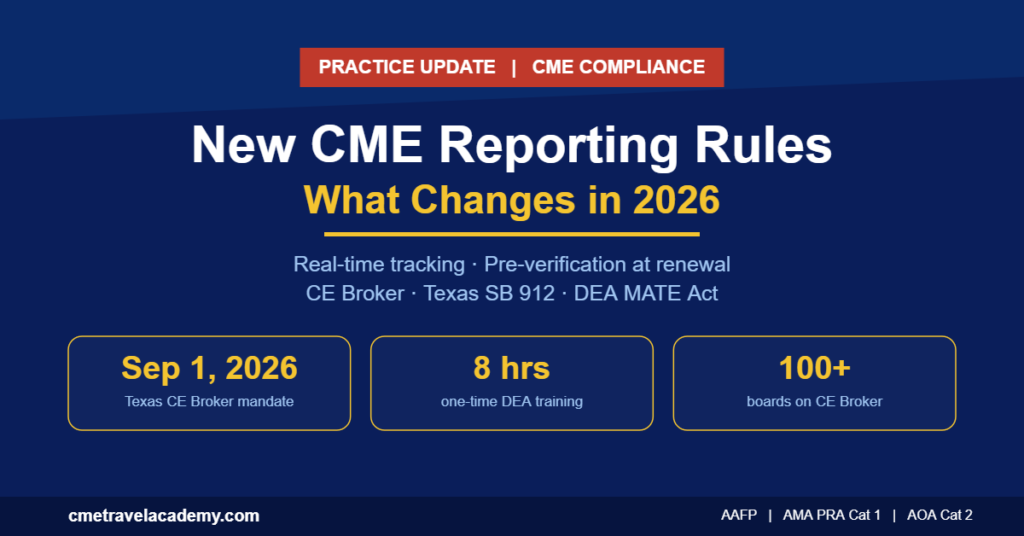
For most clinicians, the number of CME hours you owe hasn’t changed. What is changing — fast — is how you prove those hours. 2026 is bringing the biggest shift in CME reporting in years: a move away from the old “check a box and prove it later if audited” model toward real-time tracking and pre-verification at renewal. Texas and Mississippi are leading the change, and the DEA’s one-time training mandate adds a federal layer on top. This is a practical guide to what’s new, where clinicians get tripped up, and a checklist to stay ahead of your renewal — plus how the right primary care CME keeps you audit-proof all year.
The Big Shift: From “Attest and Audit” to Real-Time Pre-Verification
For decades, license renewal ran on the honor system. You attested that you had completed your required CME, paid your fee, and renewed — and only had to produce certificates if you were later selected for a random audit. That is now being replaced by a hard-stop model. Increasingly, the renewal portal will not let you submit your application or pay until an electronic tracking system shows you are 100% compliant with every specific requirement. Miss a single mandated hour and the system simply won’t let you renew.
The platform driving much of this is CE Broker, which now serves as the official continuing-education tracking system for 100-plus licensing boards across the country. The practical implication is a mindset change: compliance is no longer something you reconcile at renewal — it’s something you keep current in real time.
Texas Leads: Mandatory CE Broker Tracking, September 1, 2026
The clearest example is Texas. Under Senate Bill 912 (passed in 2025), all Texas regulatory agencies — including the Texas Medical Board — must verify continuing-education compliance through a tracking system. Beginning September 1, 2026, physicians and many other Texas licensees must verify their CME through CE Broker (or their board portal) before they can renew. Until that date, CE Broker remains optional for most — the exception being anyone selected for a TMB audit, which is now conducted entirely through the platform. A basic CE Broker account is free, so there is no cost barrier to getting set up early.
Mississippi’s Variation: Verify Through a Tracking Org or Board Certification
Mississippi takes a slightly different route. Effective February 27, 2026, MD and DO physicians no longer submit CME documentation directly to the Board. Instead, per the Mississippi State Board of Medical Licensure, compliance is demonstrated by maintaining an account with a recognized tracking organization (such as ACCME or CE Broker) or by holding active ABMS or AOA board certification. The hours themselves are unchanged — 40 Category 1 credits per two-year cycle — and the rule applies to physicians, not PAs. Helpfully, Mississippi also confirms that the DEA’s one-time eight-hour training satisfies its controlled-substance education requirement.
Stay ahead of pre-verification
Earn 12 AMA PRA Category 1 Credits™ (incl. 1 hr Ethics) with documentation ready to report
Every CME Travel Academy conference gives you downloadable certificates and category-coded credits you can upload to CE Broker or hand to your board on request — plus one-page point-of-care references and 12-month spaced-repetition review. Walt Disney World, July 17–18, 2026 · New York City, October 12–13, 2026. Livestream available.
Reserve Your Spot →Don’t Forget the Federal Layer: The DEA MATE Act
Separate from state CME, the DEA’s MATE Act training requirement applies to nearly every DEA-registered prescriber. Since June 27, 2023, practitioners must attest to a one-time, eight-hour training on treating opioid and other substance use disorders when they complete an initial registration or their next renewal. For clinicians who haven’t yet done it, a 2026 DEA renewal is very likely the deadline. The good news: it’s a one-time obligation, the hours can be accumulated across multiple sessions, and the AMA and other accredited providers offer qualifying courses. Once you’ve attested, you don’t repeat it at future renewals.
Where Clinicians Get Tripped Up: Mandated-Topic Hours
Under the old audit model, a missing topic-specific hour — ethics, opioid or pain management, medical errors, human trafficking, or another state-mandated subject — usually surfaced months later, if at all. Under pre-verification, that same gap becomes a hard stop that blocks your renewal in the moment. Because these mandated subjects vary widely by state and change frequently, confirm your exact requirements against the FSMB’s board-by-board CME overview before each cycle — and make sure the credits you earn are coded to the right category, since tracking systems verify the specific subject, not just the total.
Your 2026 CME Compliance Checklist
- Confirm your board’s system. Check whether your state now uses real-time tracking (CE Broker or a board portal) and note your exact renewal date.
- Open your free account now. A basic CE Broker account is free — set it up and review your current status well before renewal, not during it.
- Map your mandated topics. Use the FSMB overview to list every required subject (ethics, opioid/pain, etc.) and the hours for each.
- Close the DEA MATE gap. If you haven’t completed the one-time eight-hour training, schedule it before your next DEA renewal.
- Choose providers that document well. Favor accredited CME that gives you clear certificates and category coding you can report or upload.
- Don’t wait for renewal month. Pre-verification means a last-minute gap can lock you out — keep compliance current year-round.
Frequently Asked Questions
Did the number of required CME hours change?
For the states leading this shift, no. Texas and Mississippi changed how compliance is reported and verified, not the total hours. Always confirm your own state’s totals via the FSMB overview.
What is “pre-verification” and why does it matter?
Pre-verification means the renewal portal checks your tracked CME before letting you renew. If the system can’t confirm you’re fully compliant — including each mandated topic — you can’t submit your renewal until you fix the gap.
Is CE Broker required everywhere?
Not yet. CE Broker is the official tracking system for 100-plus boards, but requirements vary by state and profession. Texas makes it mandatory for renewal starting September 1, 2026; Mississippi accepts it as one of several recognized verification methods.
Does the DEA eight-hour training need to be repeated?
No. The MATE Act training is a one-time requirement attested at an initial DEA registration or the next renewal on or after June 27, 2023. It does not need to be repeated at later renewals.
The Bottom Line
The CME itself hasn’t gotten harder — but the margin for error at renewal has shrunk. Real-time tracking and pre-verification reward clinicians who stay current and document well, and they punish the last-minute scramble. Get your tracking account in order, map your mandated topics, close any DEA gap, and choose CME that hands you clean documentation.
That’s exactly what CME Travel Academy is built for: accredited, zero-commercial-bias education that earns AAFP Prescribed, AMA PRA Category 1™, and AOA Category 2 credit — 12 credits per conference including an Ethics hour, with certificates ready to report. Explore our 2026 conferences at Walt Disney World and New York City, earn from anywhere with CME Livestream, start now with online on-demand courses, or bring group CME to your clinic. See our full accreditation statement for details.