
By Dr. Vimal George, MD | Reviewed by CME Travel Academy Faculty · 7 min read · Reviewed June 2026
Accredited CME: ✓ AMA PRA Category 1 Credit™ ✓ AAFP Prescribed ✓ AOA Category 2 ✓ 12 Credits per Conference
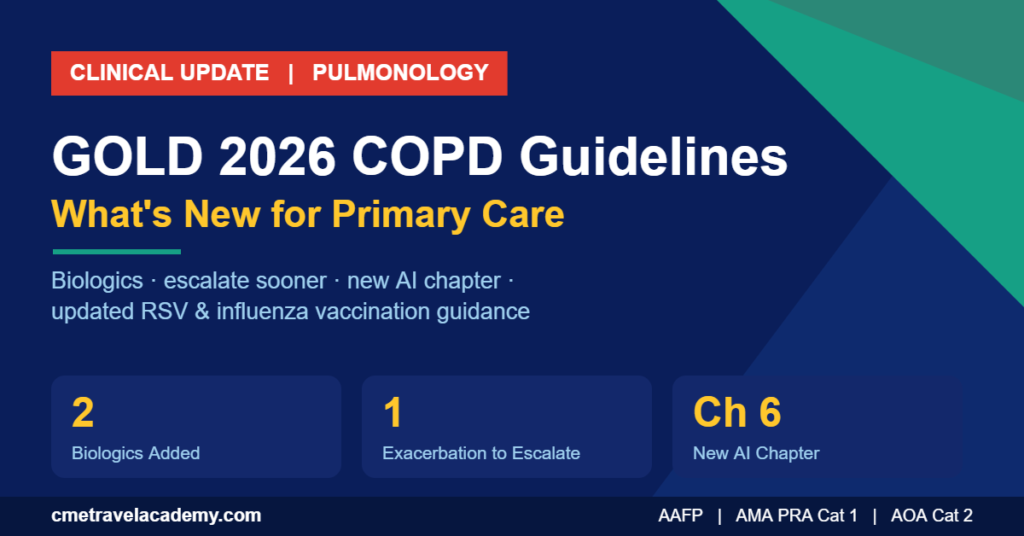
The Global Initiative for Chronic Obstructive Lung Disease (GOLD) released its 2026 report in late 2025, and it brings some of the most consequential shifts in COPD management in years — most notably the arrival of biologic therapy for selected patients, a lower threshold for stepping up treatment, a brand-new chapter on artificial intelligence, and refreshed vaccination guidance. This is a practical, primary-care-focused summary of what changed in GOLD 2026 and what it means Monday morning in clinic. If you want the prior framework for comparison, see our overview of the 2025 GOLD COPD guidelines; this article focuses on the 2026 updates.
1. Biologics Enter COPD Care
The headline change in GOLD 2026 is the formal addition of biologic therapy to the COPD treatment pathway, captured in a new evidence figure (Figure 3.11). For patients already on triple inhaled therapy (LABA + LAMA + ICS) who continue to exacerbate and have an eosinophilic phenotype — generally blood eosinophils ≥ 300 cells/µL — GOLD now supports adding dupilumab or mepolizumab. This reflects an emerging recognition that a subset of COPD is driven by type 2 inflammation, the same biology that has reshaped asthma care under GINA 2026.
The two agents are not interchangeable. In the BOREAS and NOTUS trials, dupilumab (anti–IL-4Rα) reduced moderate-to-severe exacerbations by roughly 30% and improved lung function in patients with eosinophilic COPD and chronic bronchitis. Mepolizumab (anti–IL-5), studied in METREX/METREO and MATINEE, reduced exacerbations more modestly (on the order of 18–21%) without consistent improvement in lung function, symptoms, or quality of life. The practical takeaway: biologics are an add-on for the right, carefully selected patient — not a replacement for optimized inhaler therapy, smoking cessation, or pulmonary rehabilitation.
2. A Lower Threshold to Escalate: One Moderate Exacerbation
GOLD 2026 makes a meaningful shift in when to step up therapy. The report states that a single moderate exacerbation should now prompt consideration of treatment escalation, with the explicit goal of reaching a “low disease activity” state — ideally, no exacerbations at all. This is a more proactive stance than the prior, more cautious approach, and it aligns COPD with the “treat-to-target” philosophy familiar from other chronic diseases. For primary care, it means an exacerbation that previously might have been watched should now trigger a deliberate review of inhaler regimen, adherence, technique, eosinophil count, and candidacy for escalation.
Master COPD and the Other Chronic Diseases — Live in 2026
CME Travel Academy conferences cover COPD, asthma, diabetes, hypertension, CKD, and heart failure — every topic rebuilt to the current guideline release and distilled into point-of-care decisions. 12 AMA PRA Category 1 Credits™ (incl. 1 hr Ethics) over two mornings, with afternoons free. Join us at Walt Disney World (July 17–18, 2026) or New York City (October 12–13, 2026) — or earn from anywhere via livestream.
3. A New Chapter on Artificial Intelligence
For the first time, GOLD 2026 adds a dedicated chapter — Chapter 6: Artificial Intelligence and Emerging Technologies in COPD. It surveys how AI may assist with diagnosis, risk assessment, and prediction of disease progression, while candidly flagging the clinical, data, ethical, and operational limitations that warrant caution before routine use. It’s a signal that COPD care is moving toward more data-driven, personalized management — and a reminder that clinicians, not algorithms, remain accountable for decisions.
4. Updated Vaccination Guidance: RSV and Influenza
GOLD 2026 refreshes its prevention recommendations with the latest RSV and influenza vaccination guidance. Consistent with current CDC advice, RSV vaccination is recommended for adults aged 50 and older and/or those with chronic heart or lung disease — a group that includes most COPD patients. Influenza, pneumococcal, and RSV vaccines all reduce lower respiratory tract infections, a leading trigger of exacerbations. Confirming vaccination status is one of the highest-yield, lowest-effort interventions in a routine COPD visit.
The Management Framework Still Holds
Underneath the 2026 updates, the core COPD framework is unchanged and worth restating. Confirm the diagnosis with spirometry (post-bronchodilator FEV1/FVC < 0.70). Assess with the ABE scheme — symptoms (mMRC/CAT) and exacerbation history. Start most symptomatic patients on LABA + LAMA; reserve ICS for those with exacerbations and higher eosinophils, and reassess ICS where eosinophils are low. Layer in the non-pharmacologic essentials that move outcomes most: smoking cessation, pulmonary rehabilitation, vaccination, and physical activity. GOLD 2026 sharpens the edges of this framework rather than replacing it.
Top 5 Takeaways
- Biologics arrive in COPD. Dupilumab or mepolizumab can be added for triple-therapy patients with eosinophils ≥ 300 cells/µL who keep exacerbating; dupilumab has the stronger evidence.
- Escalate sooner. A single moderate exacerbation should now prompt a step-up review, aiming for a low-disease-activity, exacerbation-free state.
- New AI chapter. GOLD recognizes AI’s potential in diagnosis and prognosis — with clear caveats about its limits.
- Vaccinate. RSV (age ≥ 50 or chronic heart/lung disease), influenza, and pneumococcal vaccines reduce exacerbation-triggering infections.
- Fundamentals first. Spirometry, ABE assessment, LABA+LAMA backbone, smoking cessation, and pulmonary rehab remain the foundation.
The Bottom Line
GOLD 2026 pushes COPD care toward earlier, more personalized intervention — adding biologics for the type-2-inflammation phenotype, lowering the bar to escalate, and formally acknowledging AI’s growing role. For primary care clinicians, the practical wins are identifying eosinophilic patients who keep exacerbating, acting on a single moderate exacerbation, and keeping vaccinations current. Want these updates taught at the point-of-care level, with one-page references you can use in clinic? Explore the 2026 conferences, compare destinations in our top CME conferences of 2026 guide, earn from anywhere via Livestream, or start with on-demand courses.
Sources: Global Initiative for Chronic Obstructive Lung Disease — 2026 GOLD Report; GOLD 2026 Key Changes Summary; CDC RSV Vaccine Guidance for Adults. This article is educational and not a substitute for the full guideline or individual clinical judgment.