
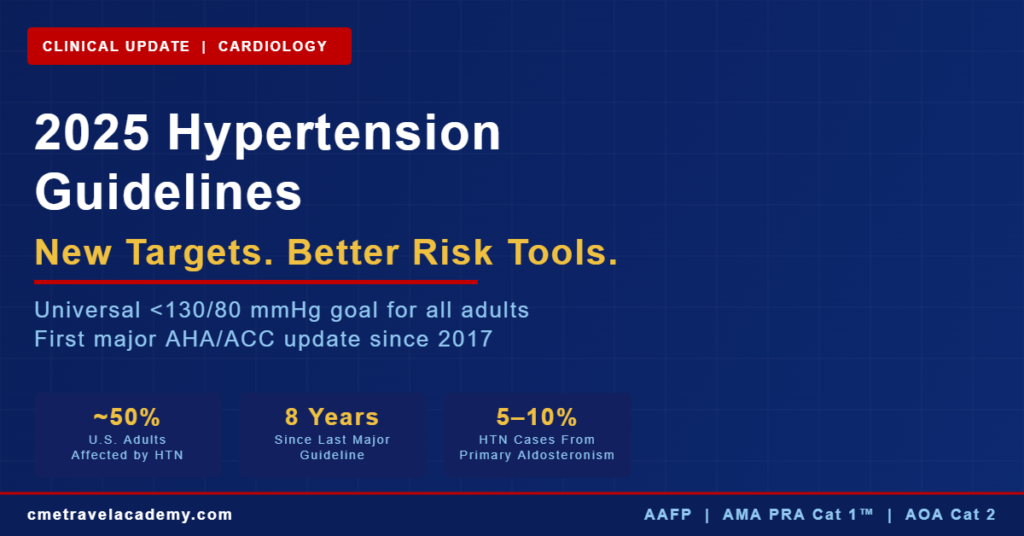
For the first time in eight years, the American Heart Association (AHA) and the American College of Cardiology (ACC) have released a comprehensive overhaul of their hypertension guidelines. The 2025 AHA/ACC Guideline for the Prevention, Detection, Evaluation and Management of High Blood Pressure in Adults arrives at a critical moment: hypertension remains the single most modifiable cardiovascular risk factor, affecting nearly half of all U.S. adults and contributing to more than 500,000 deaths annually. For primary care physicians, nurse practitioners, and physician assistants, this update rewrites several key clinical workflows and demands a fresh look at how we screen, risk-stratify, and treat our patients with elevated blood pressure.
The reassuring news: the changes are evidence-driven, actionable, and designed to move the needle on a disease most of us encounter in virtually every clinic session. Here is a practical breakdown of what is new, what is different, and what it means for your practice starting today.
Why This Guideline Update Is a Landmark Moment
The previous ACC/AHA hypertension guidelines, published in 2017, already represented a seismic shift — lowering the definition of hypertension to ≥130/80 mmHg and reclassifying tens of millions of Americans virtually overnight. The 2025 update builds on that foundation with three major structural changes: a new cardiovascular risk calculator, expanded kidney disease screening, and revised treatment thresholds that eliminate the prior tiered approach for lower-risk patients. Collectively, these changes mean a patient you managed comfortably under the 2017 framework may now require a different conversation — or a different prescription.
One Universal Treatment Target: < 130/80 mmHg
One of the most clinically impactful changes in the 2025 guideline is the establishment of a single, universal treatment target of < 130/80 mmHg for virtually all adults with hypertension. Prior guidelines created a tiered approach: lower-risk patients with stage 1 hypertension could remain at 140/90 mmHg before medications were initiated, and patients with a history of ischemic stroke carried separate targets. The 2025 update consolidates these into one unambiguous goal.
The evidence base for this consolidation is compelling. Data from the SPRINT trial and subsequent meta-analyses consistently demonstrate that intensive blood pressure control reduces the risk of major adverse cardiovascular events, heart failure hospitalization, and all-cause mortality. The guideline does acknowledge individualized exceptions — institutionalized elderly patients, those with limited life expectancy, and pregnant individuals — but for the typical ambulatory primary care patient, the message is clear: get to 130/80 and stay there.
Out With the Pooled Cohort Equations: Meet PREVENT
Perhaps the most technically significant change is the replacement of the Pooled Cohort Equations (PCEs) with the AHA’s newer PREVENT (Predicting Risk of cardiovascular disease EVENTs) calculator. The PCEs, introduced in 2013, were widely criticized for overestimating cardiovascular risk in certain populations and for incorporating race as a biological variable in ways many clinicians and patients found problematic.
PREVENT was developed using contemporary, diverse datasets and integrates additional variables including statin use, kidney function (eGFR and urine albumin-to-creatinine ratio), and social determinants of health. It estimates both 10-year and 30-year total cardiovascular disease risk — including heart failure, not just ASCVD. For primary care practice, this is a meaningful upgrade: it produces more accurate, individualized risk estimates and supports more nuanced treatment conversations.
The practical implication: recalculate your borderline-risk patients using the PREVENT calculator (available at tools.acc.org/PREVENT). Some will be reclassified to higher risk; others to lower. Let the updated data inform your next visit.
Two New Screening Mandates: Kidneys and Aldosterone
Two expanded screening recommendations stand out as immediately practice-changing.
Urine albumin-to-creatinine ratio (uACR) for all hypertensive patients. The 2025 guideline recommends measuring uACR in every patient with hypertension — not only those with diabetes or established CKD. This reflects robust evidence that microalbuminuria is both a marker of target organ damage and an independent predictor of cardiovascular events. Adding uACR to your standard hypertension workup is a low-cost, high-yield step that can meaningfully alter risk stratification and downstream management.
Expanded primary aldosteronism (PA) screening. The guideline now recommends screening for PA in all patients with stage 2 hypertension (≥140/90 mmHg) or treatment-resistant hypertension — a significant expansion from prior recommendations that targeted only specific subgroups. PA is strikingly underdiagnosed: conservative estimates suggest it accounts for 5–10% of all hypertension cases. Initial screening via a plasma aldosterone-to-renin ratio (ARR) is a routine lab draw. Identifying PA matters enormously — targeted treatment with aldosterone antagonists or surgical adrenalectomy is often curative or dramatically effective, and these patients carry disproportionately elevated cardiovascular risk when untreated.
Lifestyle Updates, GLP-1 Receptor Agonists, and When to Start Medications
Lifestyle modification remains the bedrock of hypertension management. The 2025 guideline reaffirms the DASH (Dietary Approaches to Stop Hypertension) dietary pattern and explicitly endorses potassium-containing salt substitutes as an effective and accessible blood pressure intervention — a practical, low-cost recommendation that is easy to communicate to patients.
A significant pharmacotherapy addition: the guideline now includes GLP-1 receptor agonists (GLP-1 RAs) as a treatment consideration for hypertensive patients with overweight or obesity. GLP-1 RAs lower blood pressure through multiple mechanisms — including weight reduction, natriuresis, and direct vasodilatory effects. Given that the majority of hypertensive adults in primary care carry excess weight, this guidance has broad practical relevance and aligns with the growing use of semaglutide and related agents for cardiometabolic risk reduction.
For stage 1 hypertension (BP 130–139/80–89 mmHg), the updated guideline recommends considering pharmacotherapy initiation after 3–6 months of lifestyle modification regardless of calculated 10-year ASCVD risk. This removes the prior threshold-based barrier and brings more patients into consideration for early treatment. Patients with established cardiovascular disease, diabetes, or CKD warrant pharmacologic intervention at stage 1 without waiting for the lifestyle trial.
Practice Pearls: Five Things to Do This Week
- Switch to the PREVENT calculator. Update your practice’s CVD risk estimation workflow. Recalculate patients near treatment decision thresholds — some will cross from watchful waiting to medication territory.
- Add uACR to your hypertension panel. Make it a standing order alongside the BMP and urinalysis for all new hypertension diagnoses and annual follow-ups.
- Screen for primary aldosteronism in stage 2 and resistant hypertension. Order an ARR before adding a fourth antihypertensive. You may find a treatable cause you’ve been masking.
- Revisit your stage 1 hypertension patients. Those who have been on lifestyle modification for 3–6 months without achieving goal may now qualify for pharmacotherapy under the new framework.
- Consider GLP-1 RAs in hypertensive patients with BMI ≥ 27–30. The overlapping cardiovascular benefit profiles — blood pressure reduction, weight loss, MACE reduction — make this an evidence-aligned, guideline-supported conversation.
The Bottom Line
Hypertension has not changed — but our approach to managing it just did. The 2025 AHA/ACC guideline delivers meaningful, evidence-based updates that will touch virtually every primary care encounter: a universal BP target, a more accurate and equitable risk calculator, new screening recommendations for CKD biomarkers and secondary hypertension, and an expanded pharmacotherapy toolkit that includes GLP-1 receptor agonists. Integrating these changes takes deliberate effort, but the payoff is concrete: fewer strokes, fewer myocardial infarctions, and fewer preventable deaths among the patients who trust us most.
If you want to go deeper on hypertension management — alongside updated guidance on heart failure, type 2 diabetes, CKD, COPD, atrial fibrillation, and more — join us at an upcoming CME Travel Academy conference. Earn 12 AMA PRA Category 1 Credits™ (AAFP Prescribed, AOA Category 2) at Walt Disney World in Orlando (July 17–18, 2026), New York City (October 12–13, 2026), or Las Vegas at Caesars Palace (December 18–19, 2026). Morning sessions. Afternoons free. Evidence-based. Zero commercial bias.