
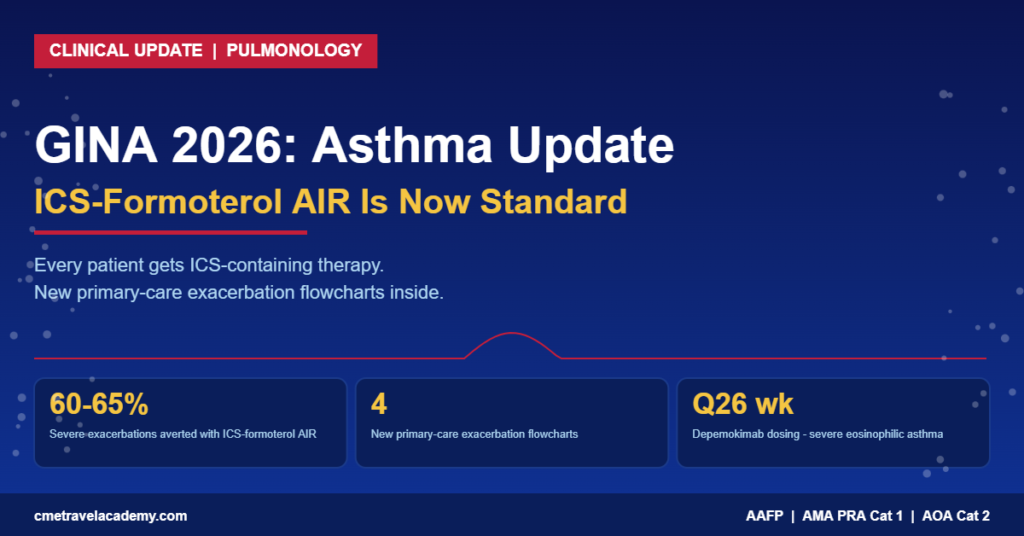
The Global Initiative for Asthma (GINA) released its 2026 Strategy Report on May 5, 2026, and primary care is squarely in its crosshairs. Asthma affects roughly 25 million Americans, and the majority of routine management still happens in family medicine, internal medicine, and advanced-practice offices rather than in pulmonology subspecialty suites. The 2026 update reflects that reality: four new primary-care–specific exacerbation flowcharts, refined guidance on inhaled corticosteroid (ICS)–containing reliever therapy, expanded biologic options, and a renewed push to minimize oral corticosteroid (OCS) exposure. For clinicians who manage chronic disease across the lifespan, this is the most consequential asthma update in several years — and one worth folding into your practice this week.
Clinical Context: Why GINA 2026 Matters
For decades, short-acting beta-agonists (SABAs) anchored asthma reliever therapy. We now know that pattern drives mortality. SABA-only reliever use is associated with severe exacerbations, OCS courses, and excess deaths — particularly in patients who feel “well-controlled” between flares. GINA’s pivot away from SABA monotherapy began in 2019, and the 2026 report consolidates that shift while addressing the modern realities of severe asthma: rising eosinophilic phenotypes, biologic access, and the unacceptable cumulative toxicity of repeated OCS courses. The report also acknowledges that primary care, not specialty, is where most acute and chronic asthma decisions are made — and the new flowcharts are designed accordingly.
Key 2026 Guideline Updates
Every patient gets ICS. GINA 2026 reiterates that all patients with asthma — even those with mild, intermittent symptoms — should receive ICS-containing therapy. SABA monotherapy is no longer supported at any step. This is the single most actionable takeaway for primary care: review your asthma roster and identify anyone still on a rescue-only regimen.
Track 1 (ICS-formoterol AIR) remains the preferred path. In adults and adolescents, the preferred reliever is low-dose ICS-formoterol used both as maintenance and as needed — the maintenance-and-reliever therapy (MART/SMART) strategy. Compared with SABA-only relief, as-needed ICS-formoterol reduces severe exacerbations by approximately 60–65%, reduces systemic corticosteroid exposure, and reduces urgent care utilization. For most adult patients, a single budesonide-formoterol inhaler used as both controller and reliever is the cleanest, evidence-based regimen.
Track 2 (ICS-SABA AIR) is now a Step 1 option. New in 2026: anti-inflammatory reliever therapy using a combination ICS-SABA inhaler is formally added at Step 1 for adults and adolescents. This matters for patients who cannot tolerate or access ICS-formoterol — it gives clinicians a second evidence-supported AIR option without falling back on SABA monotherapy.
Triple therapy expanded at Step 5. For adults and adolescents not well-controlled despite medium-dose ICS-LABA, GINA 2026 endorses an additional triple combination — budesonide-formoterol-glycopyrronium — alongside existing fluticasone-based triple options. This gives primary care more flexibility before referring for biologic evaluation.
New biologics, including ultra-long-acting options. Severe eosinophilic asthma has a new tool: depemokimab (Exdensur), a long-acting anti-IL-5 monoclonal approved by the FDA on December 16, 2025, and now incorporated into GINA 2026 for patients 12 and older. Dosing is every 26 weeks — twice yearly — based on the SWIFT-1 and SWIFT-2 trials, which showed roughly a 50% reduction in annualized exacerbation rates versus placebo. A biosimilar anti-IgE (omalizumab-igec) is also referenced, which may expand access in clinics where cost has been a barrier.
Four new primary-care exacerbation flowcharts. This is arguably the most practical change. GINA 2026 introduces four new flowcharts covering assessment, treatment, and follow-up of acute asthma exacerbations across adults, adolescents, and children 6–11 years presenting in primary care, plus updated guidance for acute care settings. They are designed to be printed and used at the point of care.
Red flags for fatal or near-fatal asthma. The 2026 report includes an explicit list of features that should prompt urgent escalation: prior intubation or mechanical ventilation for asthma, hospitalization or multiple ED visits within the past year, current or recently discontinued OCS, poor adherence or inhaler technique, food allergy with asthma, and SABA overuse (more than one canister monthly). Every primary care asthma visit should briefly screen for these.
Vaccinations and OCS minimization. Influenza, RSV, and COVID-19 vaccinations are explicitly recommended. The report frames every encounter as an opportunity to reduce OCS exposure — through optimized inhaler technique, addressing modifiable risk factors (smoking, allergen exposure, obesity, GERD), and stepping up to AIR therapy before reaching for prednisone bursts.
Practice Pearls
Three changes you can implement this week. First, run a registry pull or chart review to identify patients still on SABA-only regimens and transition them to ICS-formoterol AIR — the data on mortality reduction is now too strong to defer. Second, print the four new GINA primary-care exacerbation flowcharts and post them in your nursing pod and exam rooms; the visual algorithms are quicker than paging through guidelines mid-visit. Third, build a simple severe-asthma referral trigger into your EHR: two or more OCS courses in 12 months, any ED visit for asthma, or any of the red-flag features above should prompt a specialty referral for biologic evaluation — depemokimab’s twice-yearly dosing has materially changed the patient-adherence calculus.
A subtler pearl: inhaler technique is still the most common reason for “treatment failure.” Before escalating a patient, watch them use their device. The 2026 report includes updated device-selection guidance — when possible, prescribe one device class per patient and minimize switching, which improves both technique and adherence.
Conclusion
GINA 2026 is a primary-care–forward update. The ICS-everywhere message, the AIR-first reliever strategy, the new flowcharts, and the broadened severe-asthma toolkit collectively make this the most actionable asthma guideline release in recent memory. If you manage chronic disease in adults or children, these updates should be folded into your workflow now, not at your next CME cycle.
If you’d like a deeper dive — with evidence summaries, case discussions, and a one-page point-of-care reference for asthma management alongside heart failure, hypertension, CKD, diabetes, and the other top chronic diseases — join us at one of our 2026 conferences in Disney World (July 17–18) or New York City (October 12–13), or earn the same 12 AMA PRA Category 1 Credits™ from anywhere via our CME Livestream. All courses are AAFP Prescribed, AMA PRA Category 1, and AOA Category 2 accredited, physician-led, and 100% commercial-bias-free.
Earn your asthma CME — and the rest of your year’s chronic disease credits — at cmetravelacademy.com/conferences.
Want CME credit for staying current on asthma?
Our primary care CME conferences cover GINA 2026 asthma updates plus 10 other high-yield chronic disease topics — updated to the latest guidelines. Physician-led, zero commercial bias.
Earn Primary Care CME →