
For years, the conversation around GLP-1 receptor agonists in type 2 diabetes centered almost entirely on glucose lowering. Then came a series of landmark cardiovascular outcomes trials — LEADER, SUSTAIN-6, PIONEER 6 — and the paradigm began to shift. But until recently, one practical barrier remained: most GLP-1 receptor agonists required subcutaneous injection, limiting uptake among patients who are needle-averse or simply prefer oral therapy. The SOUL trial, published in the New England Journal of Medicine in March 2025, closes that gap decisively. And the 2026 ADA Standards of Care has taken notice.
For primary care physicians, nurse practitioners, and physician assistants managing the majority of type 2 diabetes in this country, these developments demand attention — not as background reading, but as a call to revisit and, in many cases, revise your treatment approach.
The Cardiovascular Burden of Type 2 Diabetes: Setting the Stage
Approximately 38 million Americans live with type 2 diabetes, and cardiovascular disease remains their leading cause of death. Patients with established atherosclerotic cardiovascular disease (ASCVD) or chronic kidney disease (CKD) represent an especially high-risk subset — prone to major adverse cardiovascular events (MACE) including nonfatal myocardial infarction, nonfatal stroke, and cardiovascular death. Historically, glycemic control and cardiovascular risk reduction were managed as parallel goals, layering statins, antihypertensives, and glucose-lowering agents in a somewhat siloed fashion.
The emergence of GLP-1 receptor agonists with proven cardiometabolic benefits fundamentally changed that approach. What SOUL has now demonstrated is that this protection extends to an oral formulation — removing one of the last practical barriers to broad prescribing in high-risk patients.
The SOUL Trial: What You Need to Know
SOUL was a double-blind, placebo-controlled, event-driven trial that enrolled 9,650 patients aged 50 or older with type 2 diabetes (HbA1c 6.5–10%), and established ASCVD, CKD, or both. Participants were randomized 1:1 to once-daily oral semaglutide titrated to a maximum of 14 mg, or matched placebo. The mean follow-up was approximately 47.5 months. Published in the New England Journal of Medicine on March 29, 2025 (N Engl J Med 2025;392:2001-2012).
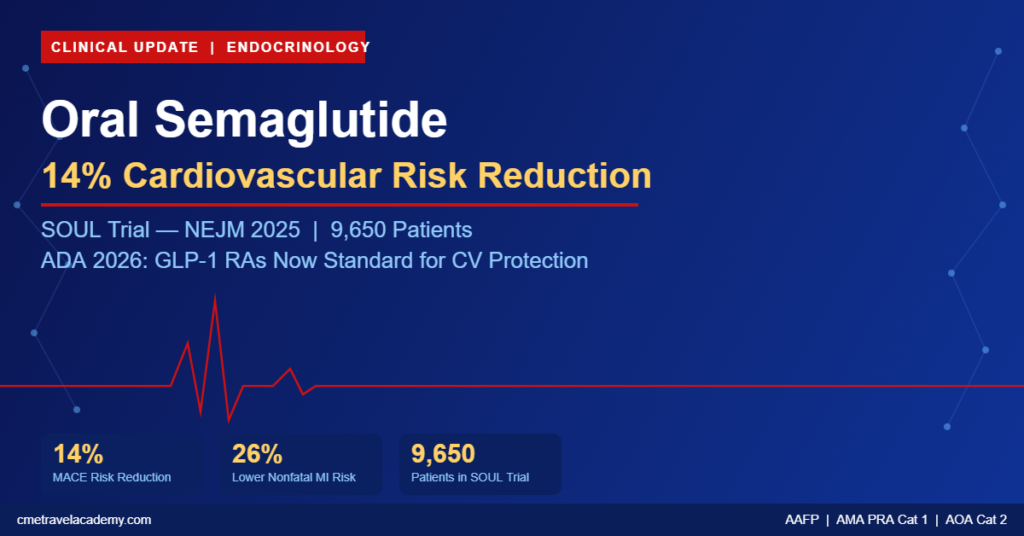
The primary endpoint — composite MACE — occurred in 12.0% of patients receiving oral semaglutide versus 13.8% in the placebo group. That translates to a hazard ratio of 0.86 (95% CI, 0.77–0.96; P=0.006): a statistically significant and clinically meaningful 14% relative risk reduction.
Examining the individual components tells an important story. Nonfatal MI showed the largest reduction at 26%. Nonfatal stroke was reduced by 12%. Cardiovascular death by 7%, though not reaching statistical significance independently. These findings align with the hypothesis that GLP-1 receptor agonists reduce atherosclerotic plaque progression and inflammation, rather than acting primarily through hemodynamic pathways.
From a safety standpoint, serious adverse events were slightly less frequent in the semaglutide group (47.9% vs. 50.3%). Gastrointestinal disorders were modestly more common (5.0% vs. 4.4%), consistent with the known GLP-1 RA tolerability profile. The key takeaway: SOUL confirms that the cardiovascular benefit of semaglutide is preserved in its oral formulation.
The 2026 ADA Standards of Care: Guideline Updates That Matter
The 2026 ADA Standards of Care codifies the evolving evidence into updated recommendations with direct implications for how you structure treatment plans.
The most clinically significant update: for adults with type 2 diabetes and established or high-risk ASCVD, a GLP-1 receptor agonist and/or SGLT2 inhibitor should be included in the treatment plan — irrespective of baseline HbA1c. This is a paradigm shift. These are foundational medications for a defined patient population, not add-on agents for inadequate glycemic control.
Recommendation 10.40c was updated to extend this guidance to patients with type 2 diabetes and CKD — specifically recommending a GLP-1 RA with demonstrated cardiovascular benefit to reduce CV event risk. This expansion reflects growing evidence for renal and cardiovascular benefit in CKD patients, historically undertreated with these agents.
On the heart failure front, the 2026 Standards now recommend a GLP-1 RA for patients with T2D and stage B (asymptomatic) heart failure with high CV risk. For patients with T2D, obesity, and symptomatic HFpEF, the dual GIP/GLP-1 RA tirzepatide carries a new recommendation — supported by data from the SUMMIT trial demonstrating reductions in HF events and symptom improvements.
Practice Pearls: Putting This Into Action
Translating these guideline updates into daily clinical practice requires navigating both clinical and logistical realities. A few focused recommendations:
- Identify your highest-risk patients first. Prioritize oral semaglutide for patients with established ASCVD, high ASCVD risk, or CKD who are not already on a GLP-1 RA or SGLT2 inhibitor — especially those who have declined injectable therapy.
- Counsel on administration. Oral semaglutide must be taken on an empty stomach with up to 4 oz (120 mL) of plain water, at least 30 minutes before the first food, beverage, or oral medication of the day. Non-adherence significantly reduces bioavailability.
- Manage GI side effects proactively. Start at 3 mg daily and titrate slowly (3 mg × 4 weeks → 7 mg × 4 weeks → 14 mg). Counsel patients that nausea is common, usually mild, and typically improves within 4–8 weeks.
- Address access and cost. Prior authorization is common. Utilize manufacturer savings programs and explore whether tirzepatide or injectable semaglutide offers better formulary coverage with comparable cardiovascular benefit.
- Coordinate care. Given the overlap of T2D, ASCVD, CKD, and HFpEF, a multidisciplinary approach with cardiology and nephrology improves outcomes. Clear documentation of your rationale for guideline-directed therapy also supports prior authorization appeals.
Conclusion
The SOUL trial and the 2026 ADA Standards of Care together represent a decisive step forward in protecting patients with type 2 diabetes from cardiovascular disease. Oral semaglutide is no longer just an option for glucose lowering — it is an evidence-based cardiovascular intervention in pill form. The guidelines have caught up to the evidence, and now it is time for clinical practice to do the same.
For primary care providers, this is not peripheral knowledge. Type 2 diabetes is one of the most common diagnoses in virtually every primary care panel. The patients who stand to benefit most — those with ASCVD and CKD layered on top of their diabetes — are patients you see every single week.
Staying current on evolving evidence and guidelines like these is at the core of what we do at CME Travel Academy. Our 2026 conferences at Walt Disney World (July 17–18, Orlando, FL) and New York City (October 12–13) feature physician-led, evidence-based sessions covering type 2 diabetes, hypertension, heart failure, CKD, asthma/COPD, and more — all earning 12 AMA PRA Category 1 Credits™ (AAFP Prescribed, AOA Category 2). Morning sessions only — afternoons free. Bring the whole family.