
Heart failure with preserved ejection fraction (HFpEF) now accounts for more than half of all heart failure diagnoses in the United States, and the proportion continues to rise alongside the obesity epidemic. For decades, clinicians managing this phenotype had few effective pharmacologic tools — spironolactone and SGLT-2 inhibitors offered modest benefit in selected patients, but a true disease-modifying strategy remained elusive. That landscape changed decisively with two landmark trials published in the New England Journal of Medicine: STEP-HFpEF (semaglutide) and SUMMIT (tirzepatide).
Both trials demonstrated that incretin-based therapies — already familiar to primary care clinicians from their use in type 2 diabetes and obesity — produce clinically meaningful improvements in symptoms, exercise capacity, and, in the case of tirzepatide, hard cardiovascular outcomes in patients with obesity-related HFpEF. For physicians, nurse practitioners, and physician assistants managing these patients in the outpatient setting, understanding the evidence and translating it into practice is now a clinical priority.
Clinical Context: The Obesity–HFpEF Connection
HFpEF is not a single disease but a heterogeneous syndrome driven by diverse upstream pathophysiology. Among the most prevalent and prognostically important phenotypes is obesity-related HFpEF, characterized by elevated left ventricular filling pressures, pericardial constraint from epicardial fat, systemic inflammation, and plasma volume expansion — all downstream consequences of adipose tissue excess.
Patients with this phenotype typically present with exertional dyspnea and fatigue that far exceeds what their ejection fraction would predict. Standard heart failure therapies — loop diuretics, beta-blockers, ACE inhibitors — manage congestion and control rate but do not address the underlying pathophysiology. SGLT-2 inhibitors (dapagliflozin, empagliflozin) improved heart failure–related hospitalizations in mixed HFpEF populations, but their benefit in the most obese subgroup was modest at best.
The rationale for GLP-1 receptor agonists in this setting is compelling: weight loss reduces epicardial fat and pericardial constraint, lowers systemic inflammation, decreases plasma volume, and improves left atrial remodeling. Animal and early human data suggested benefit. STEP-HFpEF and SUMMIT confirmed it at scale.
Key Trial Evidence: STEP-HFpEF and SUMMIT
The STEP-HFpEF Trial (Semaglutide)
Published in the New England Journal of Medicine in 2023, STEP-HFpEF enrolled 529 patients with HFpEF (LVEF ≥ 45%), a BMI ≥ 30 kg/m², and NYHA Class II–IV symptoms, all without concomitant type 2 diabetes. Participants received semaglutide 2.4 mg subcutaneously weekly or placebo for 52 weeks. The co-primary endpoints were the Kansas City Cardiomyopathy Questionnaire Clinical Summary Score (KCCQ-CSS) — a validated measure of symptom burden and physical limitation — and six-minute walk distance.
The results were striking. Semaglutide produced a mean improvement of 16.6 points in KCCQ-CSS versus 8.7 points with placebo (between-group difference: 7.8 points; p<0.001), a difference that exceeds the threshold for clinically meaningful benefit. Six-minute walk distance improved by a mean of 21.5 meters more in the semaglutide group. Body weight fell by 13.3% versus 2.6% with placebo. C-reactive protein and NT-proBNP — markers of inflammation and wall stress — both improved significantly. Importantly, benefit was consistent across all obesity classes and proportional to the degree of weight loss achieved.
The SUMMIT Trial (Tirzepatide)
SUMMIT, published in the New England Journal of Medicine in November 2024, enrolled 731 patients with HFpEF (LVEF ≥ 50%), BMI ≥ 30 kg/m², and evidence of elevated filling pressures or raised NT-proBNP. Unlike STEP-HFpEF, the SUMMIT primary endpoint included a hard cardiovascular outcome: a composite of death from cardiovascular causes or a worsening heart failure event.
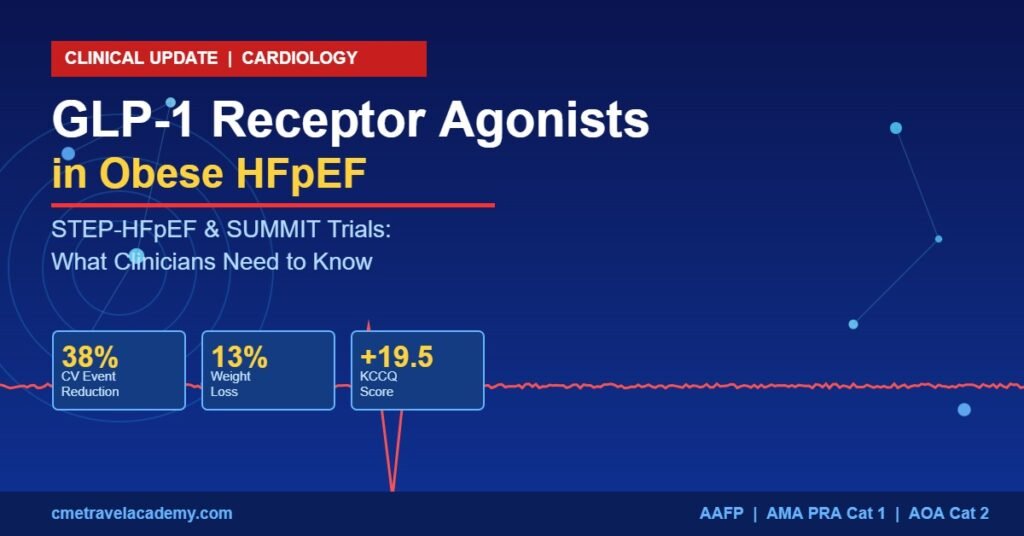
Tirzepatide — a dual GLP-1 and GIP receptor agonist — reduced this composite endpoint by a relative 38%. Events occurred in 9.9% of the tirzepatide group versus 15.3% with placebo (hazard ratio 0.62; 95% CI 0.41–0.95; p=0.026). Worsening heart failure events specifically fell from 14.2% with placebo to 8.0% with tirzepatide. On the functional side, KCCQ-CSS improved by 19.5 points in the tirzepatide group versus 12.7 with placebo — a highly significant and clinically meaningful difference. Body weight decreased by approximately 15% versus 2% with placebo, and systolic blood pressure, estimated blood volume, and C-reactive protein all fell significantly. A cardiac MRI substudy confirmed reductions in left ventricular mass and paracardiac adipose tissue.
Taken together, these two trials establish that GLP-1–based therapies address the core pathophysiology of obesity-related HFpEF — not merely symptoms — and that the dual agonist tirzepatide has now demonstrated a reduction in hard cardiovascular events in this population.
Practice Pearls for the Outpatient Clinician
Translating these data into daily practice requires thoughtful patient selection, awareness of practical considerations, and clear patient communication.
Patient Selection
- Target patients with confirmed HFpEF (LVEF ≥ 45–50%, elevated NT-proBNP or echo evidence of diastolic dysfunction) AND BMI ≥ 30 kg/m². Both trials excluded patients with type 2 diabetes, but real-world data and mechanistic reasoning strongly support use in patients with comorbid T2D — who are likely to benefit even more.
- Exclude patients with a personal or family history of medullary thyroid carcinoma or MEN2, active pancreatitis, or significant gastroparesis — standard contraindications for this drug class.
- The 2025 Canadian Cardiovascular Society/Canadian Heart Failure Society guidelines now recommend GLP-1 receptor agonist therapy for symptomatic patients with LVEF ≥ 45% and BMI ≥ 30 kg/m². U.S. guidance from the ACC/AHA is expected to formally incorporate these agents in the next heart failure guideline update.
Dosing and Titration
- Semaglutide (Wegovy/Ozempic): Start at 0.25 mg SC weekly, titrate every 4 weeks to target dose of 2.4 mg weekly (same regimen used in STEP-HFpEF). Slower titration reduces GI side effects.
- Tirzepatide (Zepbound/Mounjaro): Start at 2.5 mg SC weekly, increase by 2.5 mg every 4 weeks as tolerated to a maximum of 15 mg weekly (target dose in SUMMIT was 15 mg in most participants).
- GI tolerability (nausea, vomiting, diarrhea) is the primary barrier to titration. Counsel patients to eat smaller meals, avoid high-fat foods during initiation, and contact the office before stopping medication — most side effects are manageable and transient.
Monitoring
- Reassess KCCQ symptom burden and functional status at 3 and 6 months. A ≥5-point improvement in KCCQ-CSS signals meaningful response.
- Monitor NT-proBNP at 3–6 months — improvement correlates with reduced hospitalization risk.
- Watch for hypotension, especially in patients on diuretics; significant weight loss and volume reduction may allow loop diuretic dose reduction.
- Creatinine and eGFR trends may fluctuate during initiation but typically stabilize; a slight rise in creatinine alone is not an indication to stop therapy.
Insurance and Access
- Coverage for these agents in heart failure remains inconsistent across payers as of early 2026. Document the HFpEF diagnosis clearly (ICD-10 I50.30 or I50.32), BMI, and prior treatment failure. Some plans require prior authorization under cardiovascular or obesity indications; others still classify these as weight-loss drugs with restricted coverage.
- Manufacturer patient assistance programs (Novo Nordisk, Eli Lilly) are available for uninsured or underinsured patients. Copay assistance cards can significantly reduce out-of-pocket cost for commercially insured patients.
Conclusion
The STEP-HFpEF and SUMMIT trials represent a paradigm shift in the management of obesity-related heart failure with preserved ejection fraction. For the first time, primary care clinicians have access to therapies that address not just symptoms but the underlying pathophysiology of this syndrome — and, in the case of tirzepatide, reduce hard cardiovascular events. As GLP-1–based therapies continue to transform cardiometabolic medicine, staying current with evolving evidence and guidelines is more important than ever.
Whether you are managing HFpEF in a busy family medicine or internal medicine practice, or supporting patients as a nurse practitioner or physician assistant, the clinical landscape is changing rapidly — and your patients deserve care informed by the latest evidence.
Stay current. Earn your CME credits at one of our upcoming conferences.
CME Travel Academy offers AAFP Prescribed, AMA PRA Category 1, and AOA Category 2 accredited conferences combining high-yield chronic disease education with world-class destinations — including Walt Disney World (Orlando, FL, July 17–18, 2026).