Primary care clinicians face an increasingly complex landscape in chronic disease management. With evolving guidelines, new medications, and technology-driven care models, staying current is essential—not only to improve patient outcomes but also to meet continuing medical education (CME) requirements efficiently.
Here are five critical updates in chronic disease management that every primary care clinician should review in 2026, along with practical tips you can apply immediately in your practice—and opportunities to deepen your learning through CME Travel Academy.
1. Personalize Hypertension Management
Hypertension remains one of the most prevalent chronic conditions in primary care. Guidelines now emphasize individualized treatment plans based on patient risk, rather than a one-size-fits-all goal.
Key Takeaways:
- Consider combination therapy for patients with systolic BP >140 mmHg or those uncontrolled on a single agent.
- Integrate lifestyle interventions—dietary sodium reduction, exercise, and weight management.
- Track longitudinal trends in electronic health records to optimize therapy adjustments.
- Use one-page point-of-care (POC) guides to quickly reference treatment algorithms during patient visits.
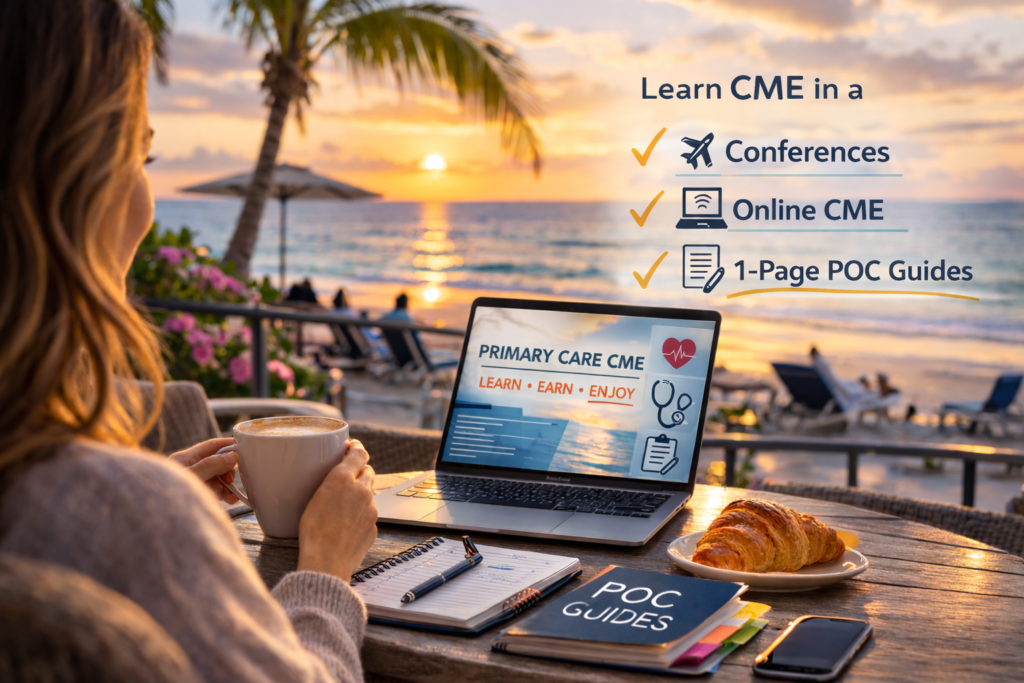
Learn more at our upcoming CME Travel Academy conferences or through our online CME courses, where expert-led sessions provide practical strategies and one-page POC references for hypertension and other chronic diseases.
2. Optimize Diabetes Care with Emerging Therapies and Technology
Diabetes management is evolving beyond blood sugar control. Technology and new medications are changing how clinicians approach care.
Practical Tips:
- Incorporate continuous glucose monitoring (CGM) into routine care to proactively adjust therapy.
- Understand the cardiovascular and renal benefits of SGLT2 inhibitors and GLP-1 receptor agonists.
- Encourage patient engagement with telehealth, remote monitoring, and mobile apps.
- Utilize one-page POC guides for quick reference to medication choices, dosing, and monitoring tips.
CME Travel Academy courses provide case-based learning and downloadable POC guides to help you implement these updates in your practice.
3. Revisit Heart Failure Guidelines for Better Outcomes
Heart failure continues to drive hospitalizations and morbidity in primary care populations. Guideline-directed medical therapy (GDMT) is now more critical than ever.
Clinical Considerations:
- Initiate eligible patients on ACE inhibitors/ARNIs, beta-blockers, MRAs, and SGLT2 inhibitors.
- Stratify patients by functional class and risk to tailor therapy intensity.
- Educate patients on self-monitoring for weight changes and fluid status.
- Keep one-page POC guides handy to ensure all GDMT components are considered for every patient.
Attend our in-person conferences or online CME sessions to practice these strategies with expert guidance and receive ready-to-use POC reference materials.
4. Proactive Asthma Management with ICS-Formoterol
Asthma care is moving toward preventive, maintenance-focused strategies rather than relying solely on rescue therapy. Primary care clinicians should stay current with GINA’s stepwise approach.
Key Updates:
- Use low-dose ICS-formoterol as both maintenance and reliever therapy, even in mild asthma.
- Reinforce proper inhaler technique and adherence at every visit.
- Screen for comorbidities like allergic rhinitis, obesity, and smoking, which can complicate control.
- Reference one-page POC guides to quickly select therapy steps, monitor control, and adjust treatment.
Our CME Travel Academy sessions include asthma-focused learning, case discussions, and practical POC guides to streamline care in busy practices.
5. Integrate CME and Spaced Reinforcement into Practice
Retaining and applying guideline updates is just as important as learning them. CME programs that combine spaced repetition, practical tools, and real-world cases help you make lasting changes in your practice.
Strategies for Primary Care Providers:
- Participate in CME Travel Academy conferences or online CME courses that provide structured follow-up over months.
- Use one-page POC guides for chronic disease management at the point of care.
- Engage in case-based learning to integrate new knowledge into clinical scenarios.
- Encourage your team—including NPs, PAs, and RNs—to participate in CME for consistent, clinic-wide improvements.
Why Staying Current Matters in 2026
Primary care clinicians who integrate these updates into daily practice improve outcomes, meet CME requirements efficiently, and reduce preventable complications. Whether managing hypertension, diabetes, heart failure, or asthma, having accessible, practical tools—like one-page POC guides—can make a difference in decision-making and patient care.
Take Action Today:
- Join our CME Travel Academy conferences to learn from experts, interact with peers, and take home one-page POC guides for quick reference.
- Enroll in online CME courses to get the same high-quality education and POC materials from anywhere.
- Apply these strategies in your practice to enhance care quality and patient outcomes in 2026 and beyond.