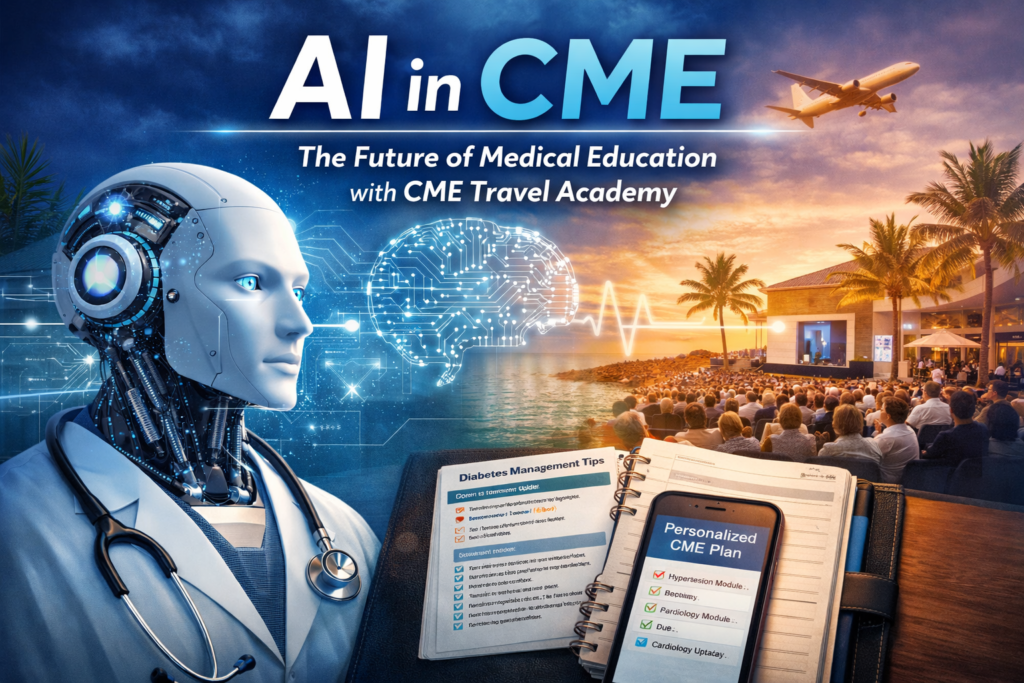
Continuing Medical Education (CME) is at an inflection point. For decades, CME has relied on conferences, lectures, and periodic updates to keep clinicians current. While this model has value, it increasingly clashes with the realities of modern medicine: exploding medical knowledge, rising administrative burden, clinician burnout, and the growing complexity of chronic disease management. At the same time, artificial intelligence (AI) is rapidly transforming how information is created, delivered, and applied. Together, these forces are reshaping what CME must become.
The future of CME will not be defined by AI replacing clinicians or educators. Instead, it will be defined by AI augmenting how clinicians learn, retain, and apply evidence-based medicine—making education more continuous, personalized, and clinically relevant.
The Problem with Traditional CME
Most clinicians recognize a frustrating truth: much of what we learn at conferences or online courses is forgotten within weeks. The traditional CME model is episodic—intensive bursts of information followed by long gaps with little reinforcement. This approach is poorly aligned with what cognitive science has taught us about learning and memory.
At the same time, clinicians face increasing pressure to deliver high-quality, guideline-directed care across multiple chronic diseases, often within 15-minute visits. Keeping up with evolving guidelines for conditions like diabetes, heart failure, asthma, chronic kidney disease, and coronary disease has become a cognitive burden.
The result is a gap between what clinicians know at the time of a CME event and what they can reliably apply months later at the point of care.
Enter AI: From Information Delivery to Learning Infrastructure
AI’s most immediate impact on CME is not flashy diagnostics or autonomous decision-making. It is far more practical: helping clinicians manage information overload and translate knowledge into action.
AI excels at pattern recognition, personalization, and repetition at scale—precisely the areas where traditional CME struggles. When thoughtfully applied, AI can help shift CME from a one-time educational event to an ongoing learning system.
Key ways AI is already influencing CME include:
1. Personalized Learning Pathways
AI can identify gaps in knowledge based on specialty, practice setting, prior learning behavior, or even clinical focus. Rather than every learner receiving the same content, CME can adapt—emphasizing what is most relevant to that individual clinician.
For example, a family physician managing a large panel of patients with heart failure may receive different reinforcement and case-based updates than a hospitalist or subspecialist, even within the same CME program.
2. Spaced Repetition and Long-Term Retention
Decades of research show that spaced repetition dramatically improves long-term retention. AI makes this feasible at scale by automating follow-up questions, brief clinical scenarios, and periodic refreshers long after a course or conference ends.
Instead of forgetting 70–80% of what was learned within weeks, clinicians can retain and reinforce key concepts over months—exactly when those concepts are needed in practice.
3. Case-Based, Real-World Learning
AI enables rapid generation and adaptation of clinical scenarios that mirror real-world complexity. CME content can move beyond slides and lectures toward interactive cases that evolve based on learner responses.
This aligns education with how clinicians actually think: evaluating uncertainty, weighing tradeoffs, and making decisions in imperfect conditions.
4. Point-of-Care Reinforcement
The future of CME is tightly linked to the point of care. AI-driven tools can help connect prior learning to real clinical decisions through concise summaries, one-page references, or just-in-time reminders—without overwhelming clinicians during patient encounters.
Importantly, this does not mean replacing clinical judgment. It means reducing cognitive friction so clinicians can focus on patient care rather than memory recall.
What AI Will Not Replace
Despite understandable concerns, AI will not replace the core human elements of medical education. It cannot substitute for clinical wisdom, ethical judgment, or the nuanced understanding that comes from experience.
Similarly, AI should not dictate care. Guidelines, evidence, and algorithms must remain tools—not authorities. The role of CME is to help clinicians understand why recommendations exist, when they apply, and when they do not.
In this sense, AI’s greatest value is not in providing answers, but in strengthening clinicians’ ability to ask better questions and make better decisions.
The Role of Educators and CME Organizations
As AI becomes more integrated into education, the role of CME organizations will evolve rather than disappear. High-quality CME will increasingly depend on:
- Clinical expertise and curation: Ensuring content is accurate, evidence-based, and aligned with current guidelines
- Educational design: Integrating learning science, spaced repetition, and case-based approaches
- Trust and independence: Maintaining transparency, minimizing bias, and prioritizing patient outcomes
AI can scale education, but it cannot replace thoughtful curriculum design or the responsibility to teach medicine well.
CME Travel Academy: A Practical Model for the Future of CME
At CME Travel Academy, this future-facing vision of CME is already being put into practice. The goal is not simply to deliver information, but to ensure that education meaningfully changes clinical behavior long after the conference ends.
CME Travel Academy integrates three core elements that reflect where CME must go:
1. Conferences as the Catalyst—not the Finish Line
High-quality, in-person conferences remain powerful. They create focus, inspiration, and protected time to engage deeply with evidence-based medicine—particularly when held in destinations that encourage reflection and connection.
However, CME Travel Academy treats conferences as the starting point of learning rather than the endpoint. Live events provide the foundational framework, shared language, and clinical context that subsequent learning builds upon.
2. Spaced Repetition Over 12 Months
Rather than relying on one-time exposure, CME Travel Academy applies principles from cognitive science through 12 months of spaced repetition following a course or conference. Clinicians receive periodic reinforcement via brief recall prompts, clinical scenarios, and targeted questions designed to strengthen long-term retention.
This approach directly addresses the well-documented problem of knowledge decay. Instead of forgetting most of what was learned within weeks, key concepts are revisited repeatedly—at increasing intervals—so they remain accessible when clinicians need them most.
AI plays an enabling role here: helping tailor follow-up content, vary question formats, and adapt reinforcement based on engagement patterns, all while keeping the cognitive load low.
3. Point-of-Care Focused Resources
Each CME Travel Academy program is paired with concise, one-page point-of-care references for chronic disease management. These are designed to bridge the gap between education and clinical application—supporting guideline-directed care without overwhelming clinicians during patient visits.
When combined with spaced repetition, these resources reinforce not just what to do, but why and when to do it.
AI as an Enabler—not the Educator
In the CME Travel Academy model, AI does not replace clinicians, faculty, or judgment. Instead, it functions as infrastructure—supporting personalization, timing, and reinforcement while preserving clinical nuance and independence.
The content remains clinician-led, evidence-based, and grounded in current guidelines. AI simply allows that content to be delivered more effectively, more consistently, and over a longer arc of learning.
The Future Is Continuous, Applied, and Human-Centered
The future of CME will belong to programs that respect how clinicians actually learn and practice. It will favor depth over volume, reinforcement over repetition of lectures, and application over passive consumption.
By combining destination-based conferences, long-term spaced repetition, and thoughtful use of AI, CME Travel Academy represents a scalable, clinician-centered model for lifelong learning—one that aligns education with real-world practice and ultimately improves care for patients with chronic disease.
That is not just the future of CME. It is the standard clinicians increasingly expect—and deserve.